Quick Facts
Quick Facts
Newton developed calculus independently of Leibniz, leading to a bitter feud.
He was a secretive man who published reluctantly. He feared criticism.
He spent years studying alchemy, the mystical pursuit of turning lead into gold.
He served as Master of the Royal Mint and pursued counterfeiters with zeal.
He never married. He may have died a virgin.
Visual answer
What Newton Actually Figured Out
The law of universal gravitation explained.
Before Newton
People knew things fell down. They knew planets moved. They did not connect the two.
Newton's Insight
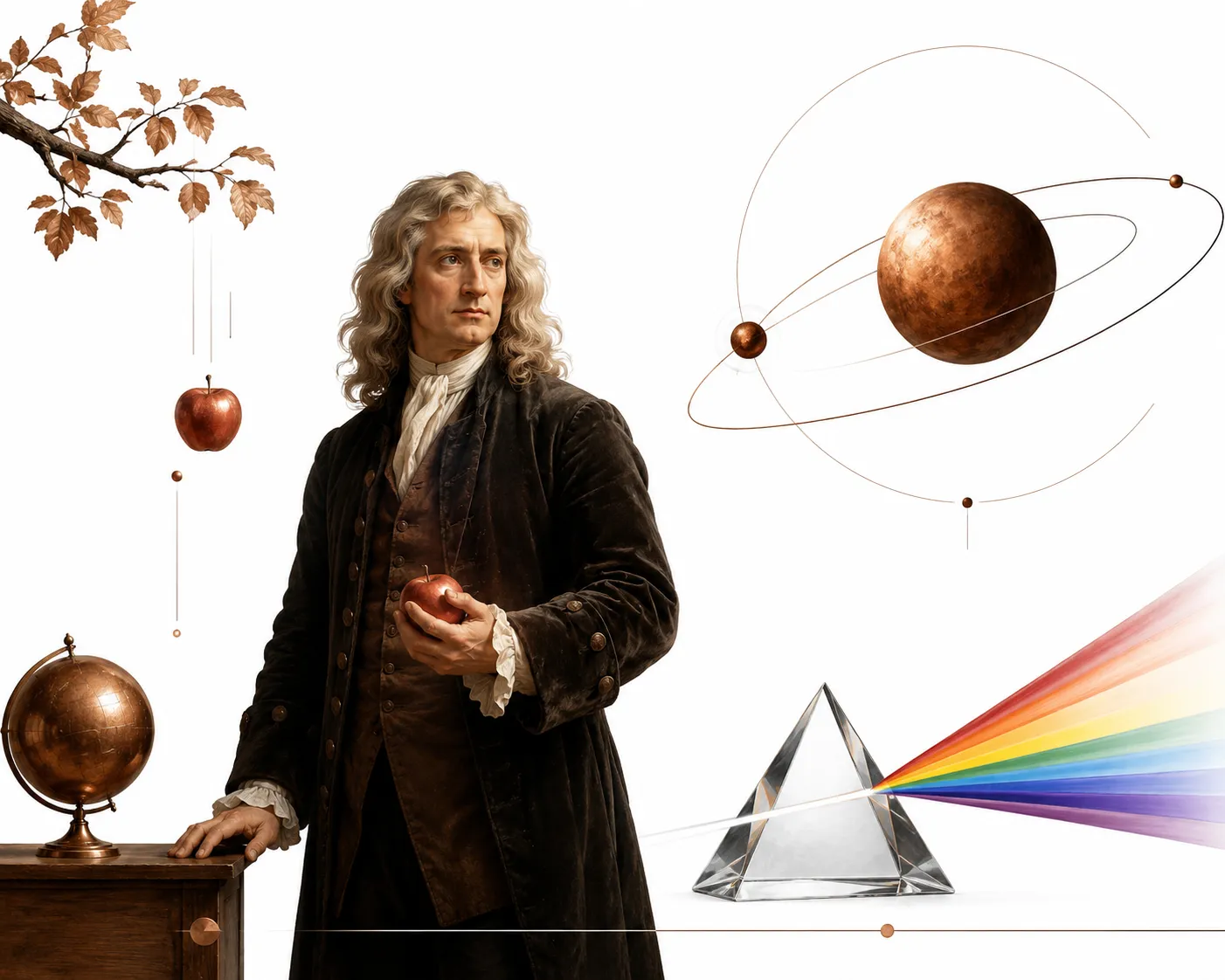
The same force that makes an apple fall holds the Moon in orbit. It is universal.
The Math
F = G (m1 m2) / r². The force between two objects depends on their mass and distance.
The Impact
Newton's law explained planetary orbits, tides, and comets. It was the first unified theory of physics.
Story in brief
Story in Brief
1665-1666
The plague forces Cambridge to close. Newton returns to his family farm. This is his 'annus mirabilis' (miracle year).
He develops calculus, optics, and the early ideas of gravity during this period.
1684
Edmond Halley (of Halley's Comet fame) visits Newton and asks him about planetary orbits.
1687
Newton publishes the Principia, containing the law of universal gravitation.
It is one of the most important scientific books ever written.
1727
Newton dies. He is buried in Westminster Abbey, the first scientist to receive that honor.
1728
The apple story is published after Newton's death. He had told it to friends late in life.
The story becomes a legend, simplifying Newton's genius into a single moment.
The Story
What Newton Actually Did
Isaac Newton was not the first person to wonder why the Moon stays in the sky. People had been wondering that for thousands of years. But Newton was the first person to answer the question mathematically. He showed that the Moon is falling. It just keeps missing Earth because it is also moving sideways.
This was a radical idea. It meant that the same force that pulls an apple down also pulls the Moon. And that same force holds the planets in orbit around the Sun. Gravity was not just a local thing. It was universal. The same laws applied everywhere, on Earth and in the heavens.
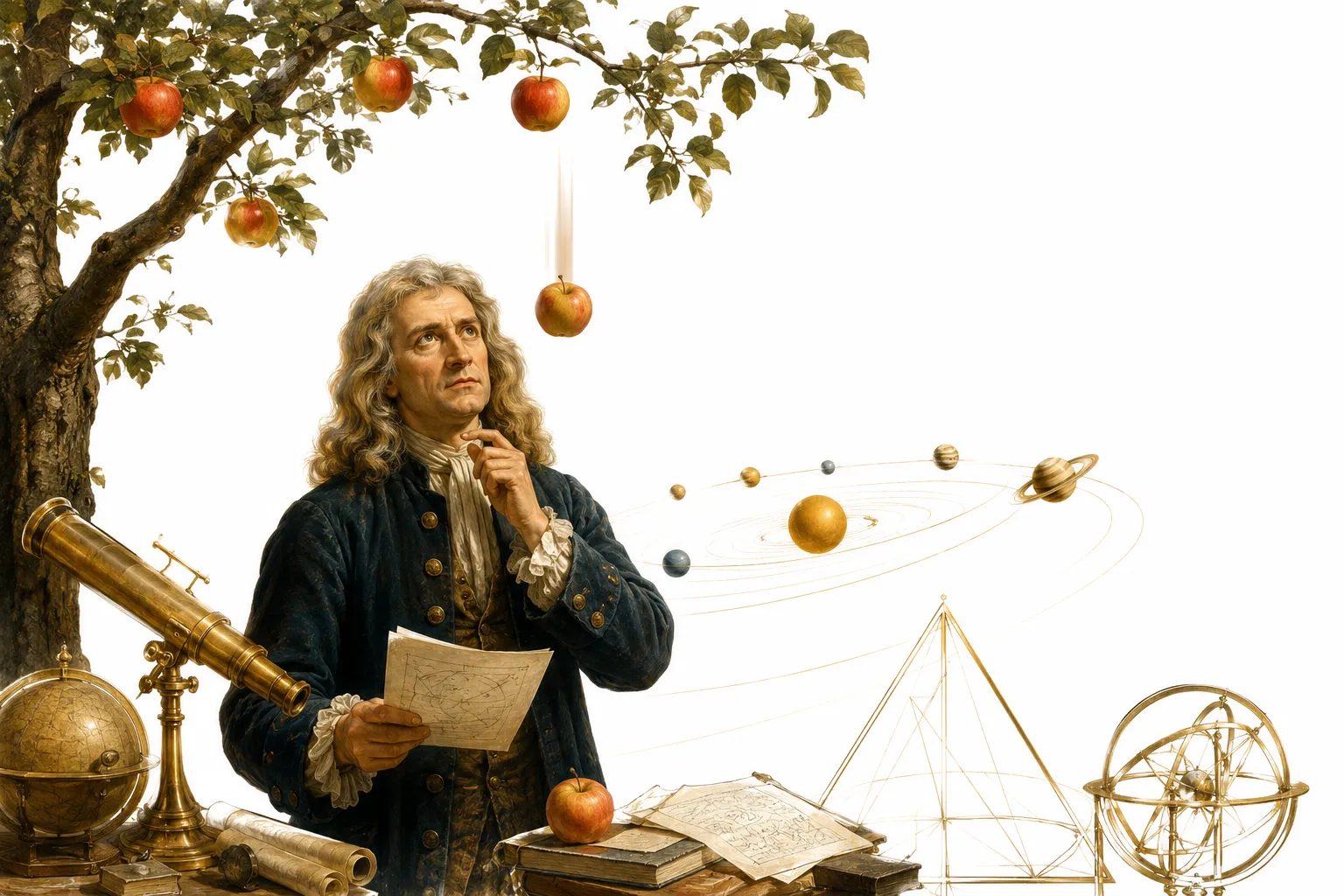
The apple story came later. Newton told it to friends when he was old. He said that watching an apple fall made him think about why the Moon does not fall. The story is charming. It is also misleading. Newton did not have a sudden flash of insight. He spent two decades refining his ideas. The apple was not the discovery. The Principia was.
Famous Quote
"If I have seen further it is by standing on the shoulders of giants."
, Isaac Newton
He wrote this in a letter to Robert Hooke, his rival. It was a backhanded compliment. Hooke was short. The 'giants' may have been a joke at Hooke's expense.
Evidence
What Really Happened
Newton did not discover gravity. He discovered the law that describes it.
StrongThe apple story was told by Newton himself late in life, possibly as a simplified illustration.
StrongNewton's real achievement was the Principia, which took him years to write.
StrongOthers, including Robert Hooke, had suggested that gravity might follow an inverse square law. Newton provided the proof.
ModerateKey Points
Key Points So Far
Newton did not discover gravity. He discovered the law that describes it.
The apple story is a simplified myth, possibly told by Newton himself.
Newton's real achievement was the Principia (1687), which unified physics.
His law of universal gravitation explained both falling apples and planetary orbits.
Analogy
Like Finding a Recipe, Not the Ingredient
The familiar part
Imagine someone says, 'I discovered bread.' That would be silly. Bread existed before you. What you discovered was how to bake it perfectly.
How it applies
Newton did not discover gravity. He discovered the recipe for gravity: the math that describes exactly how it works. That is much harder. And much more useful.
Where the analogy breaks
Recipes can be improved. Newton's law of gravity was the best we had for 200 years, until Einstein came along.
Curiosity Notes
Details Most People Miss
Why this still matters
Why This Still Matters
Newton's law of gravitation is still used today. NASA uses it to calculate spacecraft trajectories. Engineers use it to design buildings and bridges. It is not perfectly accurate (Einstein's general relativity is more precise), but it is close enough for most purposes. Newton gave us a tool that works. We have been using it for over 300 years. That is not bad for a man who may or may not have been hit by an apple.
Key Findings
- ✓Core findingNewton did not 'discover' gravity. He discovered the law that describes it.
- ✓Strong evidenceThe apple story is a simplified myth, possibly told by Newton himself.
- ⚠Main consequenceHis law of universal gravitation applies to both falling apples and planetary orbits.
- ✓Wider legacyHe published his work in the Principia (1687), one of the most important scientific books ever written.
- ★Bottom lineNewton's law is still used today for most practical calculations involving gravity.
Final insight
A Last Thought
Isaac Newton did not discover gravity. He discovered something much harder: the math that makes gravity predictable. The apple story is a fable. It turns a lifetime of work into a single moment of inspiration. The truth is more impressive. Newton spent years obsessing over calculus, optics, and alchemy. He was a strange, secretive, brilliant man. And he gave us the keys to the universe. The apple, if it existed at all, was just a small part of that story.
Quick answers
Common questions
Did an apple really fall on Newton's head? +
Probably not. Newton said he saw an apple fall. The 'hit on the head' detail was added later by others. The story is likely an oversimplification of a much more complex intellectual process.
Who else worked on gravity before Newton? +
Galileo studied falling objects. Robert Hooke suggested that gravity might follow an inverse square law. Newton provided the mathematical proof and unified the theory.