ECONOMIC CONCEPT

What Is the Cobra Effect? When Solutions Create Worse Problems

The British government offered a bounty for dead cobras in colonial India. People started breeding cobras to collect the reward. The Cobra Effect is the perfect example of a solution that made the problem worse.

Editorial illustration of a person breeding cobras for a bounty
Creator Horst Siebert (coined the term)Origin Colonial IndiaYear Late 19th century (incident), 2001 (term)Category Economics, Incentives

QUICK ANSWER

Here is the idea in plain English.

The Cobra Effect is a situation where an attempted solution to a problem actually makes the problem worse. It was named after an incident in colonial India where the British government offered a bounty for dead cobras. People started breeding cobras to collect the reward. When the bounty was canceled, the breeders released their cobras, increasing the population. The solution backfired. The Cobra Effect is a classic example of perverse incentives.

If you remember only a few things, remember these.

The basic move

The Cobra Effect is simple: when you try to solve a problem, the solution can make it worse. The British government wanted fewer cobras. They offered a bounty. People bred cobras. The cobra population increased.

Why it matters

This happens because people respond to incentives. If you reward a behavior, you get more of it. Even if the behavior is supposed to solve a problem. People will find the path of least resistance to the reward.

Use it deliberately

When designing a solution, ask: what will people do in response? How will they game the system?

CORE IDEA

The concept in its simplest useful form.

What Does the Cobra Effect Mean in Simple Terms?

The Cobra Effect is simple: when you try to solve a problem, the solution can make it worse. The British government wanted fewer cobras. They offered a bounty. People bred cobras. The cobra population increased.

This happens because people respond to incentives. If you reward a behavior, you get more of it. Even if the behavior is supposed to solve a problem. People will find the path of least resistance to the reward.

The Cobra Effect applies everywhere: business, government, and everyday life. Any time you create an incentive, you risk unintended consequences.
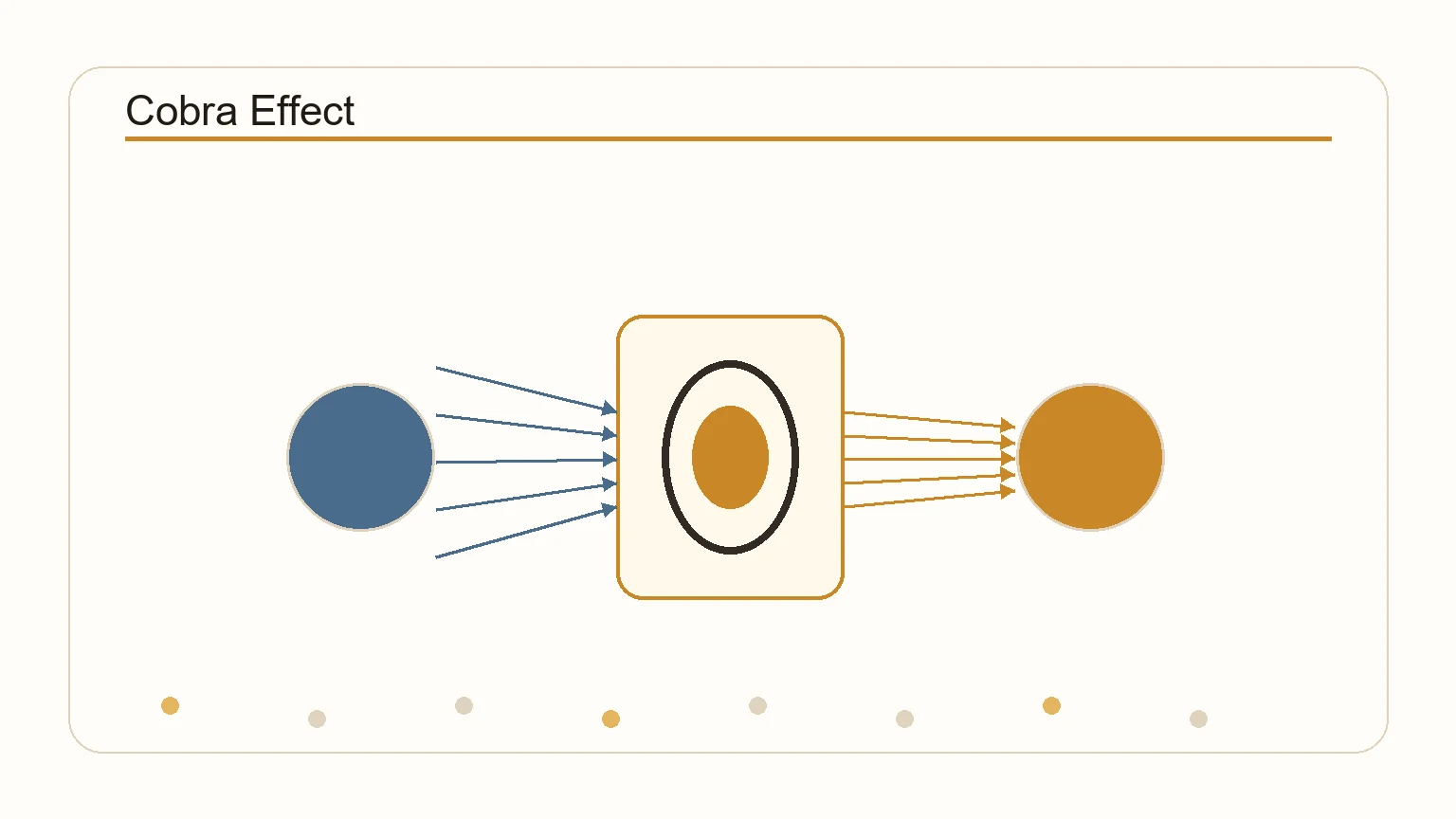

The small mechanism underneath the big idea.

01

The Story Behind the Cobra Effect

During British colonial rule in India, the government was concerned about the number of venomous cobras in Delhi. They offered a bounty for every dead cobra. The plan seemed logical: pay people to kill cobras, reduce the population.

It backfired. People realized they could make money by breeding cobras. They started breeding them, killing the adults, and collecting the bounty. The cobra population did not decrease. It increased.

When the government discovered the scheme, they canceled the bounty. The breeders released their now-worthless cobras. The cobra population skyrocketed. The solution had made the problem worse.

02

Why the Cobra Effect Became Famous

The Cobra Effect became famous because it is a perfect example of unintended consequences. The story is simple and memorable. It illustrates a universal truth: incentives matter.

The concept was popularized by economist Horst Siebert in 2001. It has since become a staple of economics and public policy discussions. It is a warning against simplistic solutions.

Today, the Cobra Effect is one of the most cited examples of perverse incentives. It is taught in economics classes, business schools, and public policy programs.

Diagram showing the perverse incentive cycle of the Cobra Effect
A diagram showing the perverse incentive cycle: problem, solution, unintended consequence, worse problem.

Where this idea shows up outside the textbook.

History

The cobra bounty in colonial India is the classic example. The solution made the problem worse. The cobra population increased.

Business

A company rewards employees for the number of customer calls handled. Employees rush through calls. Customer satisfaction drops. The solution backfired.

Everyday Life

You reward your child for cleaning their room. They start hiding messes. The room looks clean. It is not. The solution backfired.

Internet Culture

A platform rewards creators for video length. Creators make longer videos, not better videos. The quality drops. The solution backfired.

CONCEPT MAP

Every idea has neighbors. This is where the current concept sits in the TinyThat knowledge graph.

Current concept

Cobra Effect

A solution creates incentives that make the problem worse.

What people often get wrong about this idea.

The Cobra Effect is only about government policy.

No. It applies everywhere: business, education, healthcare, and everyday life. Any incentive creates the risk.

The Cobra Effect means incentives are bad.

No. Incentives are powerful. They can be used well or poorly. The Cobra Effect is a warning about poor design.

You can avoid the Cobra Effect by being careful.

You can reduce the risk, but you cannot eliminate it. Unintended consequences are always possible. The best defense is awareness.

Useful ideas become dangerous when they are stretched too far.

Criticisms and Limitations of the Cobra Effect

The Cobra Effect is a powerful warning, but it has limitations. Not every incentive backfires. Some solutions work as intended.

The concept can be misused. People use it to argue against any intervention. Not all interventions are bad. The Cobra Effect is a warning, not a prohibition.

The original story may be apocryphal. Historians debate the details. The lesson remains valid, even if the story is not perfectly accurate.

Three simple ways to apply the idea without turning it into a slogan.

1

When designing a solution, ask: what will people do in response? How will they game the system?

When designing a solution, ask: what will people do in response? How will they game the system?

2

Look for perverse incentives

Look for perverse incentives. Reward the outcome you want. Do not reward the behavior you think will lead to it.

3

Test your solutions before implementing them

Test your solutions before implementing them. Pilot programs can reveal unintended consequences.

EXPLORE NEXT

The best next ideas to read after this one.

Quick answers to common questions.

What is the Cobra Effect in simple terms?

A solution makes the problem worse. The British government offered a bounty for cobras. People bred cobras. The problem got worse.

What is an example of the Cobra Effect?

The cobra bounty in colonial India is the classic example. The solution made the problem worse.

How do you avoid the Cobra Effect?

Design incentives carefully. Ask: what will people do in response? Look for perverse incentives. Test your solutions.

Why is the Cobra Effect a problem?

It leads to wasted resources, unintended consequences, and worse problems. The solution makes the problem worse.