Surgeons can probe brain tissue in awake patients with no discomfort to guide tumor removal safely.
Body & Brain
Can the human brain feel pain?
Can the Brain Feel Pain?
Surgeons have cut into living, conscious human brains while the patient chatted, answered questions, and even played guitar. The brain felt absolutely nothing.
On this page
The short answer
No. The brain has no nociceptors, the specialized nerve endings that detect pain, and therefore cannot sense pain directly.
Pain requires nociceptors to detect a threat and send signals to the brain for processing. The brain is extraordinarily rich in the circuitry that interprets pain signals arriving from elsewhere in the body, but its own tissue contains none of the sensors needed to generate those signals in the first place.
At a glance
No nociceptors means no direct pain signal.
Headaches are caused by the brain hurting.
Neurosurgeons routinely perform awake craniotomies, slicing and probing brain tissue while patients carry on conversations, simply because there is no discomfort to manage.
Imagine the world's most sophisticated alarm system with no alarm installed inside its own control room.
Behind the science
The story behind it
Awake Brain Surgery for Tumor Removal
Surgeons at major neurological centers routinely perform awake craniotomies, keeping patients conscious and conversational throughout. Wilder Penfield mapped the human brain's functions in the 1930s and 1950s by electrically stimulating tissue in awake patients and asking what they experienced.
Penfield's patients reported vivid memories, sensations in distant limbs, and involuntary movements, but never any pain from the probing itself.
The absence of pain in brain tissue was not a theoretical observation but a practical, repeatable fact that built the map of human brain function.
Cortical stimulation studies by Penfield and Boldrey
Stimulating specific points on the exposed cortex reliably triggered specific experiences: memories, the feeling of a hand moving, flashes of childhood.
Patients described these experiences calmly, in real time, while surgeons took notes. The brain reported everything except its own involvement in the process.
Diagram
Can the Brain Feel Pain: the idea in one diagram
Pain is not produced by damage alone. It requires sensors, signal pathways, and brain interpretation.
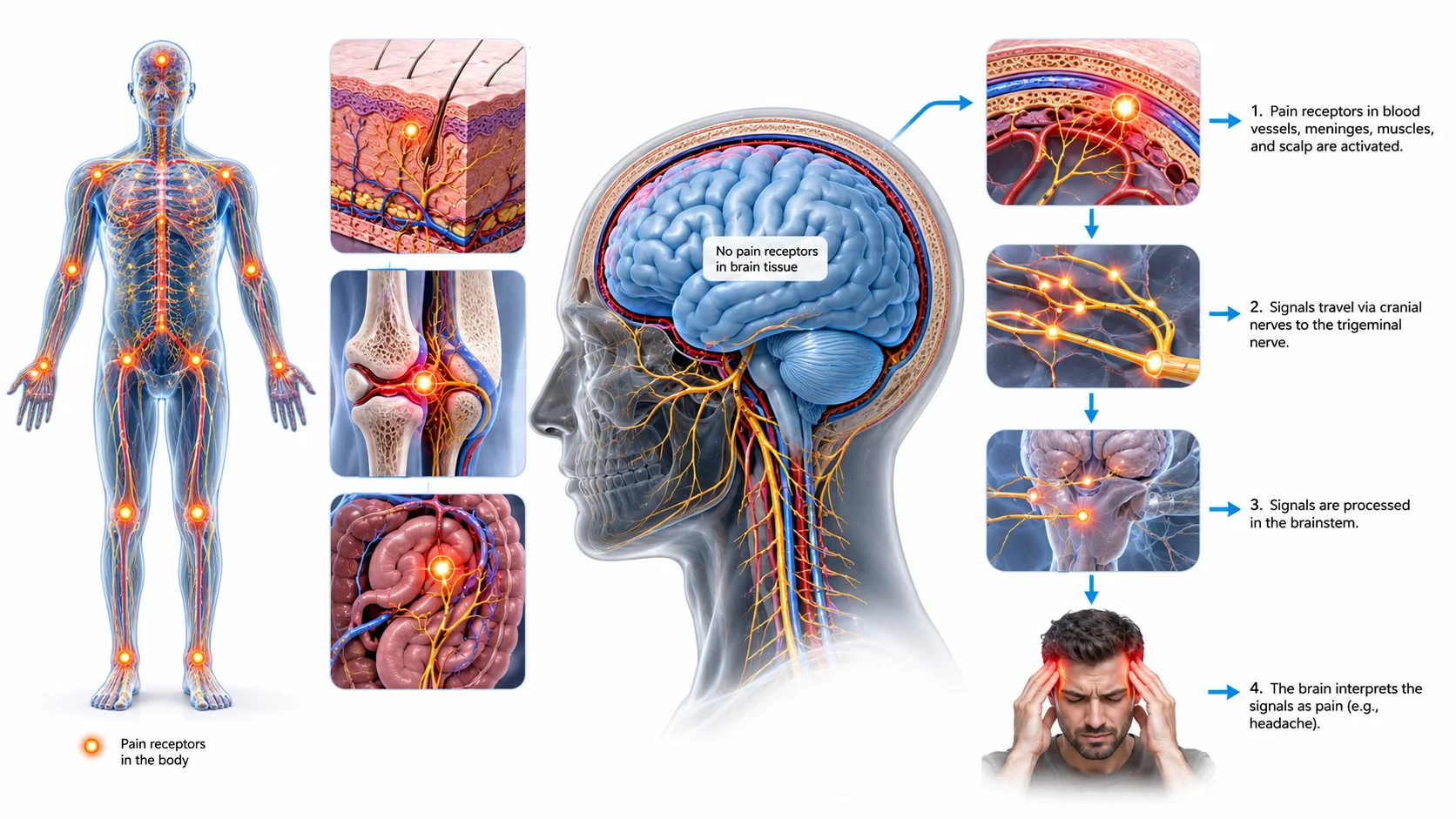
- 1Pain needs nociceptors
No nociceptors means no direct pain signal.
- 2The brain interprets the signal
The brain processes pain without sensing its own tissue.
- 3The surrounding structures hurt
Headaches come from structures around the brain.
How it works
The mechanism
Pain is not produced by damage alone. It requires sensors, signal pathways, and brain interpretation.
- Step 01
Pain needs nociceptors
Nociceptors detect damaging pressure, heat, chemicals, or injury and start the pain signal.
They are the smoke detectors of tissue damage.
No nociceptors means no direct pain signal.
- Step 02
The brain interprets the signal
Pain signals arrive from the body and are interpreted by brain networks that create the conscious experience of pain.
The brain is the control room reading alarms from elsewhere.
The brain processes pain without sensing its own tissue.
- Step 03
The surrounding structures hurt
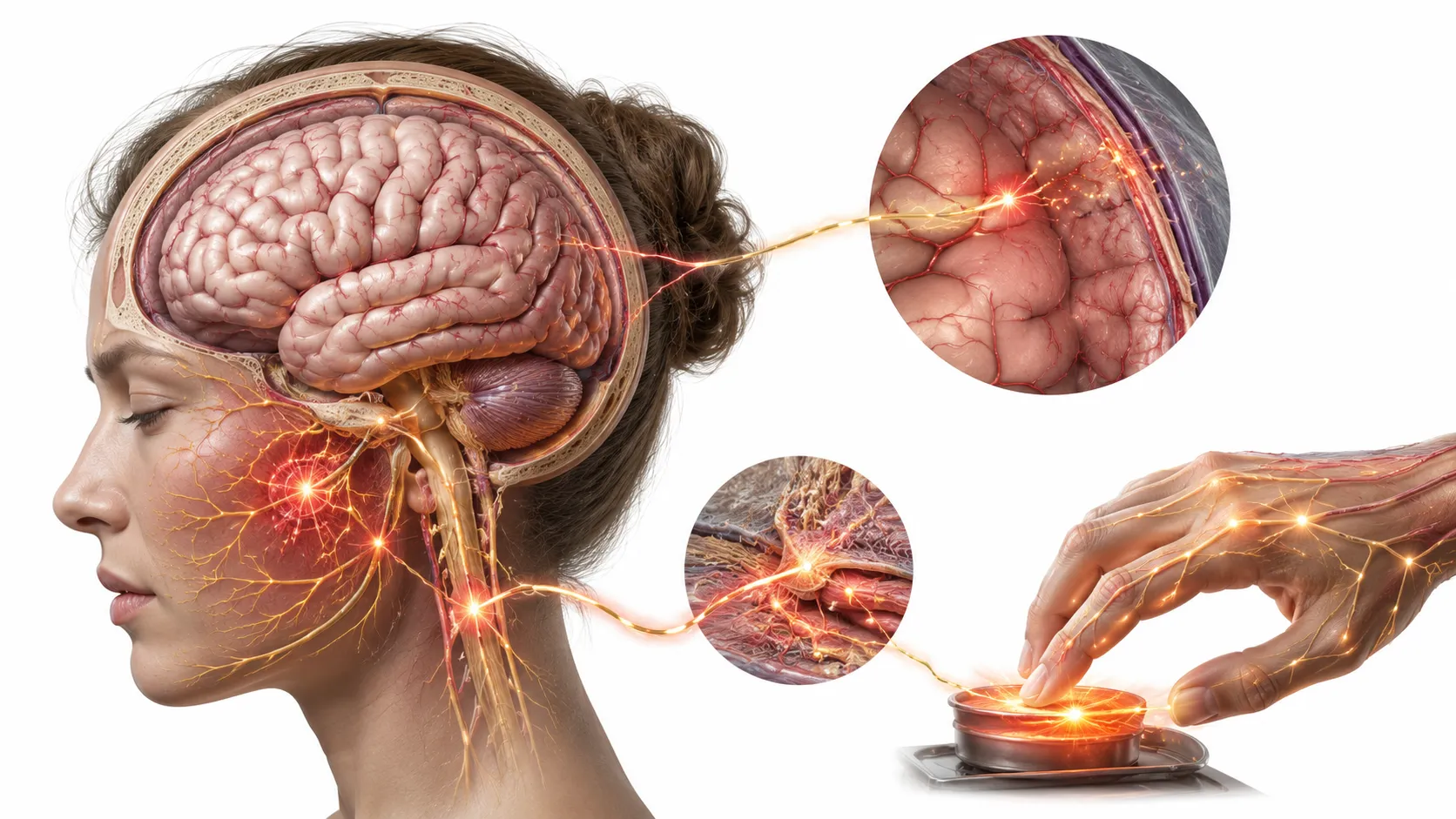
The meninges, scalp, skull, and blood vessels contain pain receptors and can create headache pain.
The walls around the control room have alarms, even if the room itself does not.
Headaches come from structures around the brain.
Clarify
Myth and reality
Myth
Headaches are caused by the brain hurting.
Reality
Headaches arise from pain receptors in the meninges, scalp muscles, blood vessels, and neck, never from brain neurons themselves.
Evidence
Brain stimulation during awake surgery produces no pain, while stretching the meninges or compressing blood vessels produces intense headache.
Myth
Migraines are a form of brain pain.
Reality
Migraines involve the trigeminovascular system, a network of pain-sensitive blood vessels and nerves surrounding the brain rather than within it.
Evidence
Migraine treatments target these vascular and nerve pathways, not brain tissue directly.
Surprises
Facts worth sitting with
Surgeons can probe brain tissue in awake patients with no discomfort to guide tumor removal safely.
Surprising facts
What seems backwards
Worth comparing
In everyday life
Easy to get wrong
Pressure points
Where the simple answer gets interesting
If the brain feels no pain, why do brain tumors cause headaches?
Tumors cause pain by pressing on surrounding structures like the meninges, blood vessels, and the skull itself, all of which do contain pain receptors. The tumor tissue pushing outward is the problem, not the brain tissue itself.
It reveals that headache pain is almost always structural pressure, never the brain tissue crying out.
Could a surgeon accidentally damage your brain during awake surgery without you knowing?
Precisely. That is why awake craniotomies involve continuous conversation and cognitive tasks. Surgeons monitor patient responses in real time because the brain will not alert its owner to damage through pain.
Your words and behavior become the only pain signal available during brain surgery.
Why did evolution leave the brain without pain receptors?
One compelling hypothesis is that the brain sits inside a rigid protective skull, so external threats that reach brain tissue are already catastrophic and beyond repair. Pain would serve little survival purpose at that stage. The skull and pain-sensitive meninges form the protective early warning system instead.
It reframes the skull as the brain's real pain system.
Looking closer
The deeper pattern
The brain's invulnerability to pain is not an oversight but a byproduct of its protected position inside the skull.
One way to think about it
Nature built the protective layers, the skull, the meninges, and the cerebrospinal fluid, to be the pain-sensitive early warning system so the brain itself never needed to be.
Sometimes the most important systems delegate their alarm functions entirely to their outer defenses.
Limits
Where the explanation bends
A patient with a large brain tumor reports no neurological symptoms for months.
Because brain tissue generates no pain signal, tumors growing slowly in so-called silent regions of the brain can reach considerable size before causing pressure-related symptoms.
The absence of pain receptors turns the brain into one of the few places in the body where serious damage can progress silently.
In daily life
What this helps you notice
Understanding that headaches are vascular and meningeal events, not neuronal ones, explains why caffeine, hydration, and blood vessel-targeting drugs treat them effectively.
Caffeine constricts blood vessels. Since many headaches involve dilated cranial blood vessels pressing on pain-sensitive meninges, caffeine relieves the pressure and reduces pain.
Remember
Key takeaways
- 1
The brain contains no nociceptors and cannot feel pain.
- 2
Headaches originate in the meninges, blood vessels, and scalp, not in brain tissue.
- 3
Awake brain surgery is possible precisely because brain tissue is pain-free.
- 4
Evolution placed the pain warning system in the skull and meninges, not the brain itself.
The organ that taught humanity what pain is has never once felt it.
Every headache you have ever had was your meninges and blood vessels protesting. Your brain, processing every signal and managing every response, remained the calmest structure in the room.
Read around the idea
More questions with the same curious pull
Nearby doors from the TinyThat archive, chosen by topic, intent, and reader curiosity.
Body & Brain
Does Your Brain Eat Itself?
Yes, in a controlled process called autophagy.
Body & Brain
Why Does Brain Fog Happen?
Brain fog is not imaginary. Learn what actually causes that thick, cloudy feeling in your head and what science says...
Body & Brain
Why Do Fish Sleep?
Fish do sleep, but not the way you'd expect. Learn how fish rest without eyelids, what sleep looks like underwater, a...