Autophagy is so important for brain health that the 2016 Nobel Prize in Physiology or Medicine was awarded entirely for its discovery.
Body & Brain
Does the human brain actually consume its own tissue?
Does Your Brain Eat Itself?
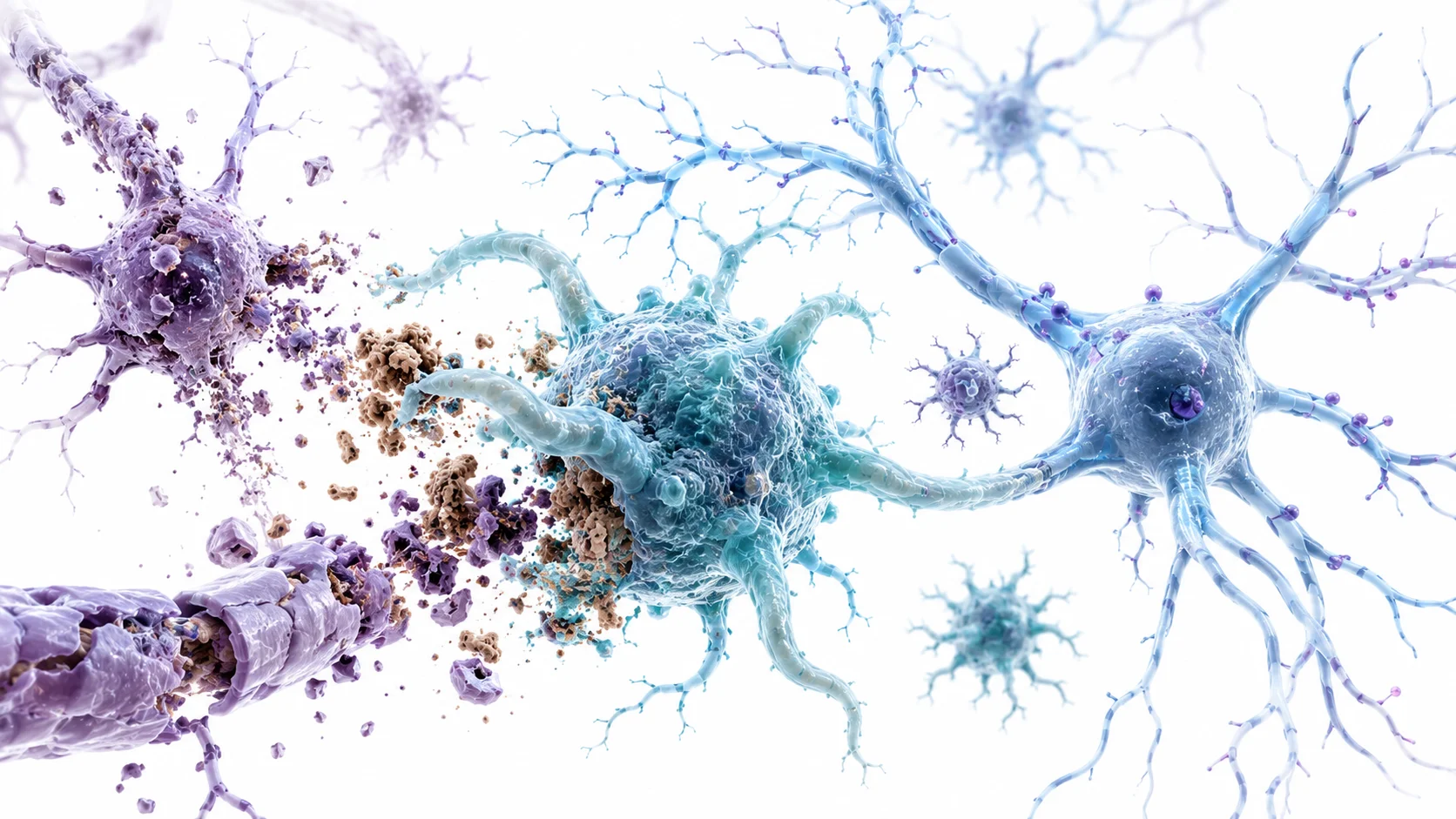
Right now, your brain is quietly dismantling parts of itself, digesting old cellular machinery, and recycling the material for fuel. This is not a malfunction. It is one of the most important things a healthy brain does.
On this page
The short answer
Yes, in two distinct ways. Through autophagy, brain cells recycle their own damaged components, and through synaptic pruning, the brain eliminates neural connections it no longer needs.
Autophagy is a cellular recycling mechanism where brain cells break down and digest damaged proteins and organelles, repurposing the material for energy and new construction. Synaptic pruning is a larger-scale process where the brain actively eliminates synaptic connections deemed redundant, particularly during childhood development and adolescence. Both processes are essential for healthy function and both can go dangerously wrong.
At a glance
Controlled self-consumption protects neurons.
The brain eating itself is always a sign of damage or disease.
Sleep deprivation accelerates this self-consumption past healthy levels, causing the brain to eat components it was never meant to lose.
Picture a city that routinely demolishes its own abandoned buildings and reuses the bricks. Useful and orderly until the demolition crews start tearing down buildings that are still occupied.
Behind the science
The story behind it
Yoshinori Ohsumi and the Nobel Prize for Autophagy
Japanese cell biologist Yoshinori Ohsumi studied how yeast cells devour their own components under starvation conditions. In the 1990s he identified the genes controlling autophagy and described the molecular machinery involved.
His work revealed that autophagy is universal across organisms including humans, fundamental to cellular health, and implicated in aging, cancer, and neurodegeneration.
One of biology's most important survival mechanisms was hiding in yeast cells for decades before anyone looked carefully.
Michele Bellesi's sleep deprivation and microglial activation study, 2017
Sleep-deprived mice showed significantly higher activity in microglial cells, the brain's resident immune cells responsible for synaptic pruning.
The sleep-deprived brains were pruning synapses at a much higher rate than rested brains, including connections that should have been preserved.
Diagram
Does Your Brain Eat Itself: the idea in one diagram
Brain self-consumption is controlled maintenance: cells recycle damaged parts, immune cells prune excess connections, and sleep clears waste.
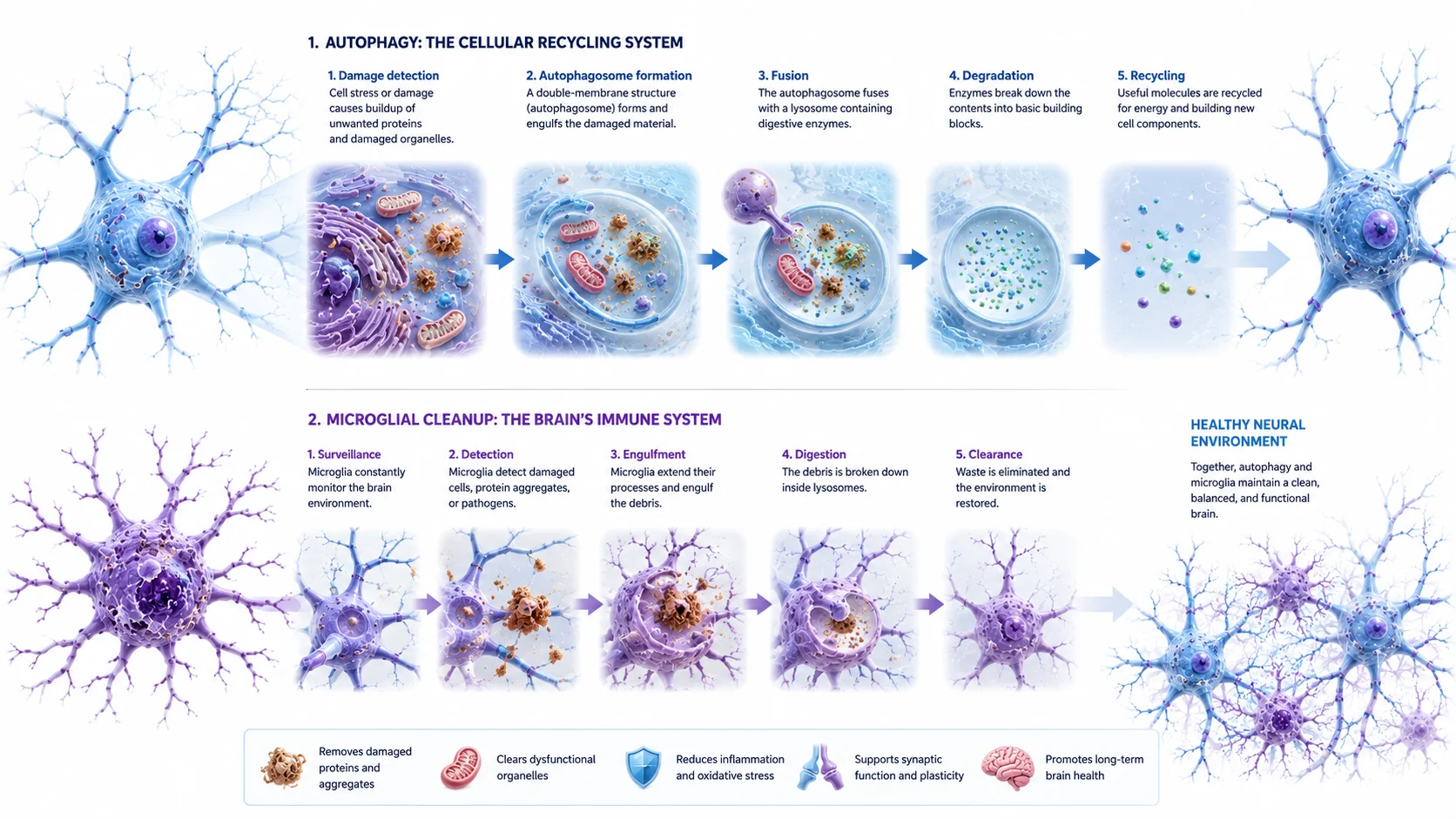
- 1Autophagy recycles damaged parts
Controlled self-consumption protects neurons.
- 2Synaptic pruning edits connections
Elimination can improve performance.
- 3Sleep runs cleanup
Poor sleep disrupts the maintenance cycle.
How it works
The mechanism
Brain self-consumption is controlled maintenance: cells recycle damaged parts, immune cells prune excess connections, and sleep clears waste.
- Step 01
Autophagy recycles damaged parts
Cells wrap damaged proteins and organelles in membranes, digest them, and reuse the raw materials.
A recycling plant stripping old machinery for parts.
Controlled self-consumption protects neurons.
- Step 02
Synaptic pruning edits connections
The brain removes unused or redundant synapses so stronger pathways work more efficiently.
An editor cutting weak sentences so the argument becomes clearer.
Elimination can improve performance.
- Step 03
Sleep runs cleanup
During deep sleep, waste clearance increases and the brain removes metabolic debris.
A city washing its streets at night.
Poor sleep disrupts the maintenance cycle.
Clarify
Myth and reality
Myth
The brain eating itself is always a sign of damage or disease.
Reality
Controlled autophagy is a healthy and essential daily process. It is when autophagy becomes dysregulated that problems arise.
Evidence
Knockout of autophagy genes in mice produces rapid neurodegeneration even without external injury, proving that normal autophagy is actively protective.
Myth
You can simply make up lost sleep on weekends.
Reality
Some research suggests that the synaptic damage caused by chronic sleep deprivation is not fully reversible with recovery sleep.
Evidence
Biomarkers of neuronal damage can remain elevated after recovery periods in chronically sleep-deprived subjects.
Surprises
Facts worth sitting with
Autophagy is so important for brain health that the 2016 Nobel Prize in Physiology or Medicine was awarded entirely for its discovery.
Surprising facts
What seems backwards
Worth comparing
In everyday life
Easy to get wrong
Pressure points
Where the simple answer gets interesting
What happens when the brain stops eating itself properly?
Dysfunctional autophagy allows toxic proteins to accumulate. Researchers have linked impaired autophagy to Alzheimer's disease, Parkinson's disease, and other neurodegenerative conditions where misfolded proteins build up and damage neurons.
Some of the most feared neurological diseases may be partly failures of cellular housekeeping.
Does fasting make the brain eat itself more?
Yes. Caloric restriction and intermittent fasting strongly upregulate autophagy throughout the body and brain. This is one reason fasting has attracted serious scientific attention as a potential intervention in neurodegenerative disease, though the clinical evidence in humans remains early-stage.
Deliberately starving the body slightly may help the brain clean house more efficiently.
Can the brain ever prune the wrong connections?
Yes, and this may have significant consequences. Overactive synaptic pruning during adolescence has been proposed as a factor in the onset of schizophrenia, which typically emerges during the same developmental window when pruning is most aggressive.
A process essential to healthy development may, in excess, contribute to one of psychiatry's most complex disorders.
Looking closer
The deeper pattern
The brain's self-consumption processes reflect a deeper biological principle: maintaining quality requires constant elimination of the substandard.
One way to think about it
Organisms that can efficiently dismantle and recycle their own faulty components outlast those that merely accumulate damage. The brain's ruthless self-editing is a form of ongoing self-mastery.
Decline often begins not with external attack but with the failure of internal maintenance systems.
Limits
Where the explanation bends
An adolescent brain during peak synaptic pruning, typically between ages 12 and 25.
The brain eliminates synaptic connections at the highest rate of any period in adult life. This creates adult specialization but also a window of vulnerability to disorders like schizophrenia.
The turbulence of adolescence may have a cellular cause: a brain literally dismantling and rebuilding significant portions of its architecture.
In daily life
What this helps you notice
Sleep quality directly governs how effectively the brain clears its daily accumulation of toxic proteins.
People who regularly sleep fewer than six hours per night show higher accumulation of amyloid beta protein than those who sleep seven to nine hours.
Intermittent fasting and exercise both upregulate autophagy, providing a possible mechanism for cognitive benefits.
Exercise-induced autophagy has been linked to BDNF, which supports neuronal survival and new connections.
Remember
Key takeaways
- 1
The brain recycles its own damaged components through autophagy, a Nobel Prize-winning discovery.
- 2
Synaptic pruning eliminates unused connections to improve efficiency, especially during adolescence.
- 3
Sleep is when the brain's waste clearance system runs at full capacity.
- 4
Chronic sleep deprivation can trigger abnormal self-consumption that damages connections permanently.
- 5
Impaired autophagy is linked to Alzheimer's, Parkinson's, and other neurodegenerative diseases.
The brain's health depends not on what it builds but on what it is willing to destroy.
Every night when you sleep, your brain tears down a little of itself, hauls away the debris, and quietly rebuilds. It has always been less a monument than a construction site. The danger is not the demolition. It is when the crews stop showing up.
Read around the idea
More questions with the same curious pull
Nearby doors from the TinyThat archive, chosen by topic, intent, and reader curiosity.
Body & Brain
Why Does Brain Fog Happen?
Brain fog arises from disruptions in neural signaling, inflammation, and impaired cellular maintenance.
Body & Brain
Can the Brain Feel Pain?
No, brain tissue has no pain receptors.
Body & Brain
Why Do Fish Sleep?
Fish do sleep, but not the way you'd expect. Learn how fish rest without eyelids, what sleep looks like underwater, a...