Quick Facts
Quick Facts
Tutankhamun became pharaoh at age 9. He died around age 19.
His tomb was small for a pharaoh. He died suddenly, so a smaller tomb was used.
The tomb had been robbed twice in ancient times, but the robbers took only portable items. The main burial chamber was untouched.
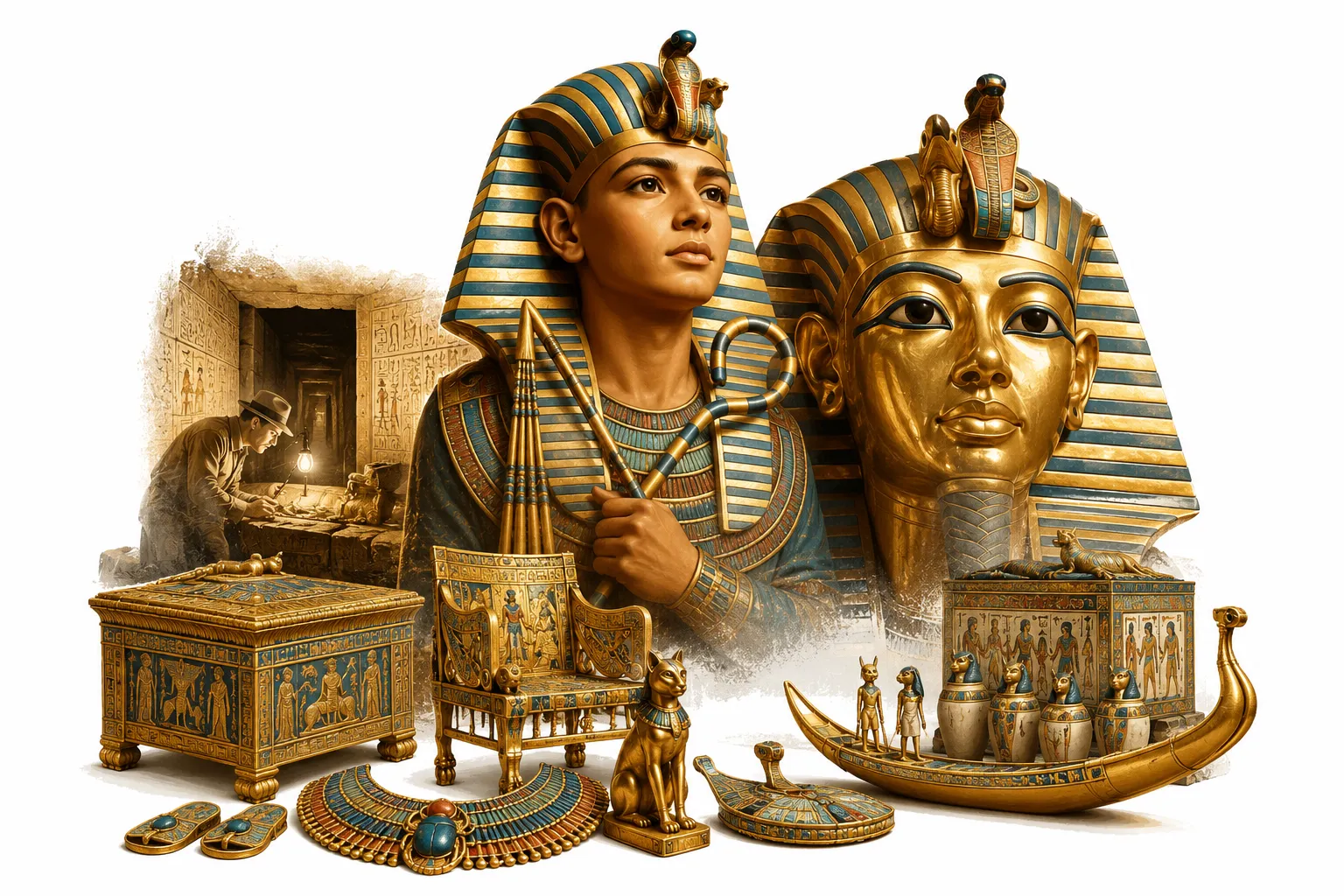
The golden death mask weighs 22 pounds (10 kilograms).
The discovery sparked 'Egyptomania' worldwide. Fashion, music, and art were influenced by Egyptian styles.
Visual answer
The Contents of the Tomb
What Carter found inside King Tut's burial chamber.
The Antechamber
Contained chariots, furniture, and everyday objects. Disorganized, as if the robbers had been interrupted.
The Annex
Storage room filled with jars, oils, and food offerings for the afterlife.
The Burial Chamber
The golden shrine containing Tut's sarcophagus. The famous death mask was on his mummy.
The Treasury
Contained canopic jars (holding Tut's organs) and a statue of Anubis, the jackal god of mummification.
Story in brief
Story in Brief
c. 1323 BC
Tutankhamun dies at age 19. He is buried in a small tomb in the Valley of the Kings.
Ancient Times
The tomb is robbed twice, but the robbers are caught or interrupted. The main chamber is untouched.
c. 1000 BC
Workers digging a later tomb dump debris over the entrance to Tut's tomb. It is hidden.
The debris protected the tomb for 3,000 years.
1907
Howard Carter begins excavating in the Valley of the Kings.
November 4, 1922
Workers discover a step cut into the rock.
It was the first step of the staircase leading to Tut's tomb.
November 26, 1922
Carter peers through a hole in the sealed doorway. 'Can you see anything?' asks his patron, Lord Carnarvon. Carter replies: 'Yes, wonderful things.'
The most famous archaeological discovery in history.
1923-1932
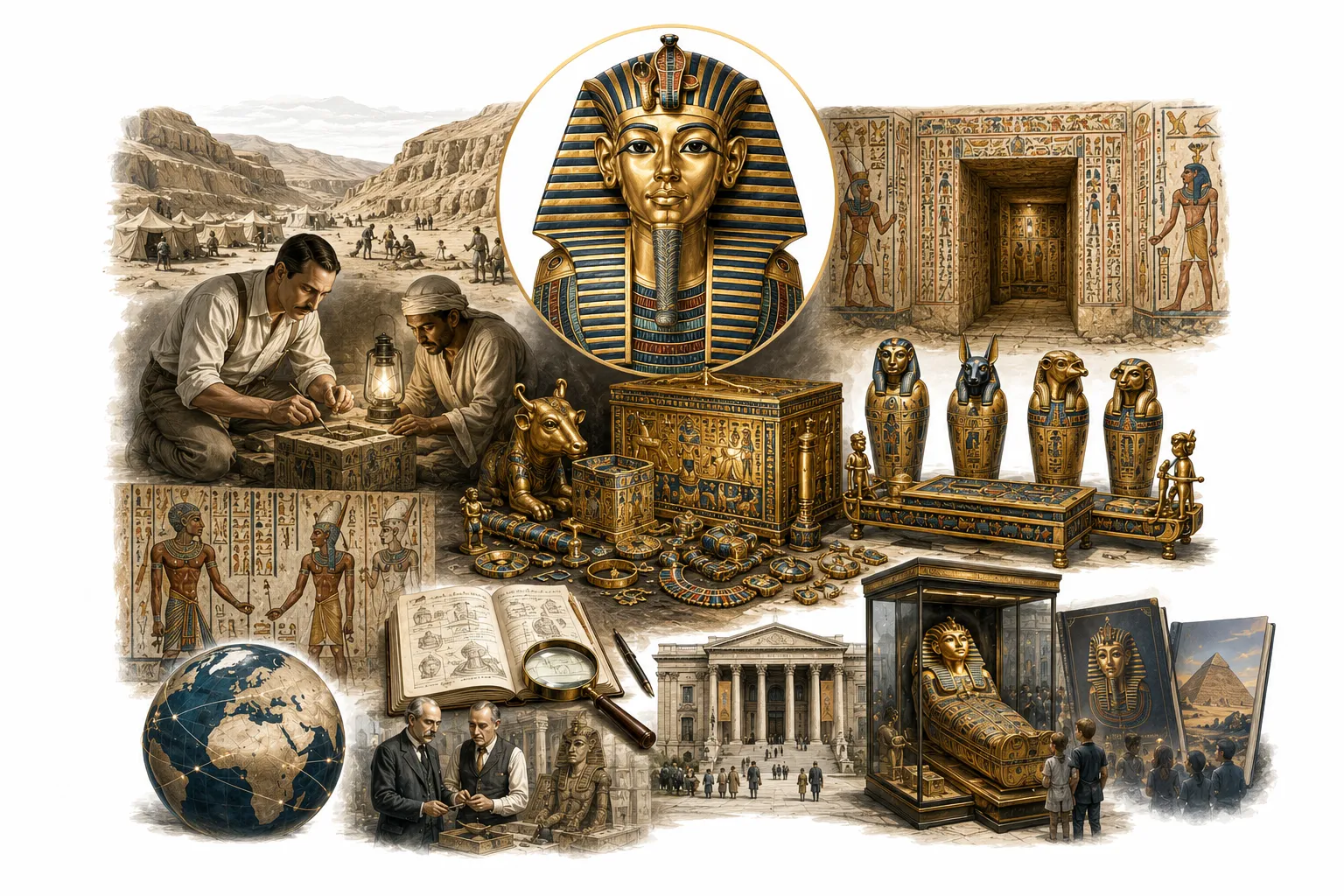
Carter and his team catalog and remove over 5,000 objects from the tomb.
The Story
The Day the 20th Century Met Ancient Egypt
Howard Carter had been searching for King Tut's tomb for years. His patron, Lord Carnarvon, was about to cut off his funding. Carter begged for one more season. He got it.
On November 4, 1922, a water boy digging in the sand uncovered a step. It was the top of a staircase. Carter dug deeper. At the bottom of the staircase was a sealed doorway. The seals were intact. The tomb had not been opened in 3,000 years.
On November 26, Carter made a small hole in the door. He inserted a candle and peered inside. Lord Carnarvon asked, 'Can you see anything?' Carter replied, 'Yes, wonderful things.' He had found the burial chamber of a pharaoh. Gold glinted in the candlelight. The room was packed with treasures. The world would never be the same.
Famous Quote
"Can you see anything? Yes, wonderful things."
, Howard Carter and Lord Carnarvon, November 26, 1922
This exchange became famous. It captured the moment of discovery perfectly: the patron's anxious question, the archaeologist's stunned reply.
Evidence
Why the Tomb Matters
It is the only nearly intact pharaoh's tomb ever discovered.
StrongThe artifacts reveal how pharaohs were buried, what they were buried with, and what they believed about the afterlife.
StrongThe discovery sparked a global fascination with ancient Egypt that continues today.
StrongThe golden death mask is one of the most famous artworks in history.
StrongKey Points
Key Points So Far
King Tut's tomb was discovered intact in 1922 by Howard Carter.
It contained over 5,000 artifacts, including the golden death mask.
King Tut was a minor pharaoh. The tomb is important because it was intact.
The discovery sparked 'Egyptomania' worldwide.
The tomb took nearly a decade to fully excavate and catalog.
Analogy
Like a 3,000 Year Old Time Capsule
The familiar part
Imagine finding a sealed box from your great-great-great-grandparents. Inside are their clothes, their furniture, their jewelry, and a letter explaining their lives.
How it applies
King Tut's tomb was that box, but 3,000 years old. It contained everything a pharaoh needed for the afterlife: food, furniture, weapons, jewelry, and even board games. It was a snapshot of ancient Egypt.
Where the analogy breaks
Time capsules are usually small. Tut's tomb was the size of a small apartment. It was not a capsule. It was a museum.
Curiosity Notes
Details Most People Miss
Why this still matters
Why This Still Matters
King Tut's tomb is still important because it is a window into a lost world. The ancient Egyptians believed in the afterlife. They filled tombs with everything the dead might need: food, furniture, weapons, and magic spells. Tut's tomb showed us what that belief looked like in practice. It was not just a burial. It was an entire worldview, preserved in gold and stone.
Key Findings
- ✓Core findingKing Tut's tomb was discovered intact in 1922 by Howard Carter.
- ✓Strong evidenceIt is the only nearly intact pharaoh's tomb ever found.
- ⚠Main consequenceThe tomb contained over 5,000 artifacts, including the golden death mask.
- ✓Wider legacyKing Tut was a minor pharaoh. The tomb is important because it was intact.
- ★Bottom lineThe discovery sparked a global fascination with ancient Egypt.
Final insight
A Last Thought
King Tut's tomb is important because it should not exist. Every other pharaoh's tomb was looted. The gold was stolen. The mummies were destroyed. Tut's tomb survived because of an accident: workers digging a later tomb dumped debris over the entrance. It was hidden. For 3,000 years, it waited. When Carter opened it, he found a world that had been sealed since the Bronze Age. Tut himself was a footnote. His tomb was a miracle.
Quick answers
Common questions
Is the curse of the pharaohs real? +
No. The 'curse' was invented by journalists. Most of the people who entered the tomb lived long lives. Howard Carter died at age 64, 17 years after the discovery.
Where is King Tut's mummy now? +
King Tut's mummy is still in his tomb in the Valley of the Kings. It is displayed in a climate-controlled case. Visitors can see his face, preserved for 3,000 years.