Quick Facts
Quick Facts
Tutankhamun reversed his father's religious reforms, restoring the traditional Egyptian gods.
His tomb was small for a pharaoh. He died suddenly, so a smaller tomb was used.
The tomb had been robbed twice in ancient times, but the main burial chamber was untouched.
The golden death mask weighs 22 pounds (10 kilograms).
The discovery sparked 'Egyptomania' worldwide. Fashion, music, and art were influenced by Egyptian styles.
Visual answer
Why King Tut Is Famous
The accident of history that made a minor pharaoh a legend.
He Was a Minor Pharaoh
If he had been important, his tomb would have been larger and more obvious. It would have been looted.
His Tomb Was Hidden
Debris from a later tomb covered the entrance. It was hidden for 3,000 years.
The Discovery (1922)
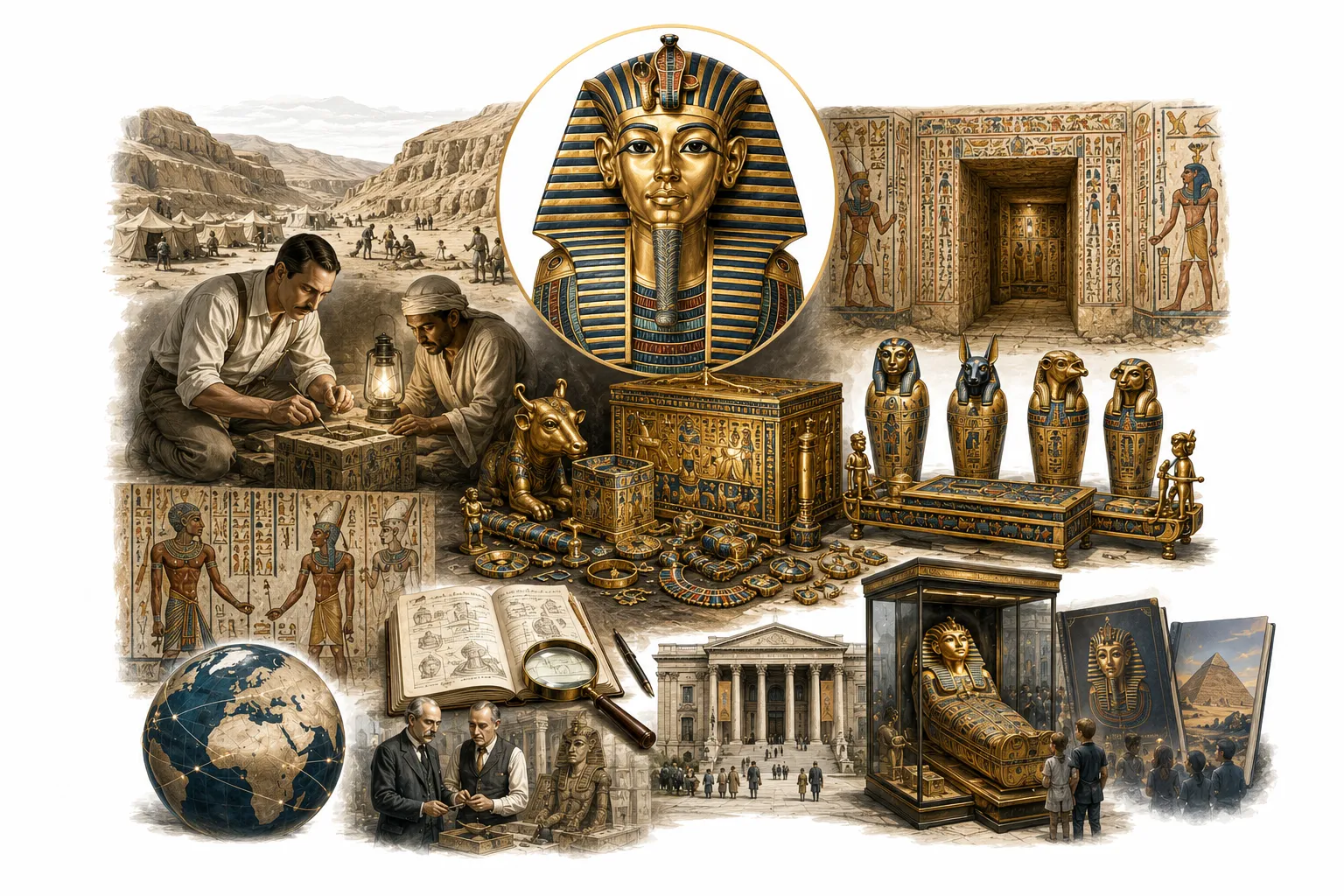
Howard Carter found the tomb intact. It was the only intact pharaoh's tomb ever discovered.
The Treasures
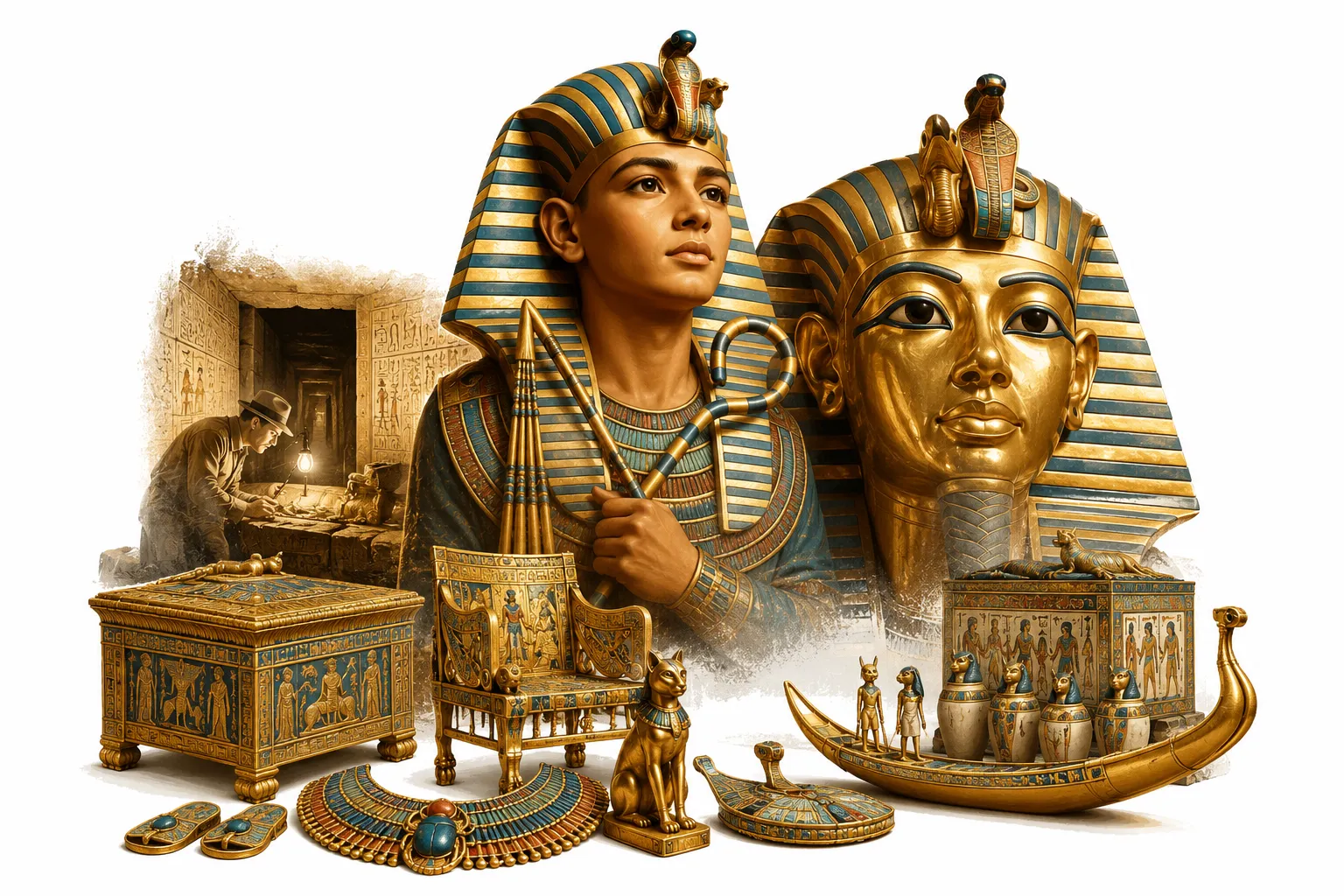
Over 5,000 objects, including the golden death mask. The world was amazed.
The Curse
Lord Carnarvon, the expedition's patron, died shortly after. Newspapers invented the 'curse of the pharaohs.' The story spread.
Story in brief
Story in Brief
c. 1332 BC
Tutankhamun becomes pharaoh at age 9.
c. 1323 BC
He dies at age 19. He is buried in a small tomb in the Valley of the Kings.
Ancient Times
The tomb is robbed twice, but the robbers are caught or interrupted. The main chamber is untouched.
c. 1000 BC
Workers digging a later tomb dump debris over the entrance to Tut's tomb. It is hidden.
The debris protected the tomb for 3,000 years.
1922
Howard Carter discovers the tomb. He and his patron, Lord Carnarvon, open it.
The discovery is the greatest archaeological find in history.
1923
Lord Carnarvon dies. Newspapers claim a 'curse.' The story goes viral (in 1920s terms).
The curse makes the story even more famous.
Today
King Tut is the most famous pharaoh. His mask is one of the most recognizable objects in the world.
The Story
How a Minor Pharaoh Became a Global Icon
Tutankhamun was not a great pharaoh. He ascended the throne at age 9. He died at age 19. In between, he reversed his father's religious reforms, restoring the traditional Egyptian gods. That is about all he did. He did not win great battles. He did not build great monuments. He was a footnote.
But his tomb survived. Every other pharaoh's tomb had been looted in ancient times. Tut's tomb was hidden by accident. Workers digging a later tomb dumped debris over the entrance. For 3,000 years, no one knew it was there.
When Howard Carter opened the tomb in 1922, he found a time capsule. The golden death mask, the jewelry, the chariots, the furniture, all preserved. The world had never seen anything like it. Tut became the most famous pharaoh in history. Not because of what he did. But because of what he left behind.
Famous Quote
"Can you see anything? Yes, wonderful things."
, Howard Carter and Lord Carnarvon, 1922
This exchange became famous. It captured the moment of discovery perfectly.
Evidence
Why Tut Is Famous
His tomb was discovered intact, the only intact pharaoh's tomb ever found.
StrongThe golden death mask is one of the most iconic objects in history.
StrongThe 'curse of the pharaohs' generated enormous media attention.
StrongTut himself was a minor pharaoh. His fame is accidental.
StrongKey Points
Key Points So Far
King Tut was a minor pharaoh who reigned for about a decade and died at 19.
His tomb was discovered intact in 1922 by Howard Carter.
The tomb contained over 5,000 artifacts, including the golden death mask.
The 'curse of the pharaohs' made the story even more famous.
Tut is famous because his tomb survived, not because of his accomplishments.
Analogy
Like a Footnote Becoming the Main Text
The familiar part
Imagine a history book. Most of the text is about important people. There is a footnote about a minor figure. Someone accidentally highlights the footnote.
How it applies
Tut was a footnote. His tomb was the highlight. The footnote became the main text. He was not important. But his tomb was.
Where the analogy breaks
Footnotes do not contain golden death masks. Tut's tomb did.
Curiosity Notes
Details Most People Miss
Why this still matters
Why This Still Matters
King Tut is still famous because his tomb is a window into a lost world. The ancient Egyptians believed in the afterlife. They filled tombs with everything the dead might need. Tut's tomb showed us what that belief looked like in practice. It was not just a burial. It was an entire worldview, preserved in gold and stone. That is why we remember him. Not because he was great. But because his tomb was preserved.
Key Findings
- ✓Core findingKing Tut was a minor pharaoh who reigned for about a decade and died at 19.
- ✓Strong evidenceHis tomb was discovered intact in 1922 by Howard Carter.
- ⚠Main consequenceThe tomb contained over 5,000 artifacts, including the golden death mask.
- ✓Wider legacyThe 'curse of the pharaohs' made the story even more famous.
- ★Bottom lineTut is famous because his tomb survived, not because of his accomplishments.
Final insight
A Last Thought
King Tut is famous because he was forgotten. His tomb was hidden. The other pharaohs, the great ones, were remembered. Their tombs were looted. Tut's insignificance saved him. He was not important enough to be remembered. And that is exactly why he is remembered now. There is a lesson in that irony. Sometimes the people who seem least important leave the biggest mark. Not because of what they did. But because of what they left behind.
Quick answers
Common questions
Is the curse of the pharaohs real? +
No. The 'curse' was invented by journalists. Most of the people who entered the tomb lived long lives. Howard Carter died at age 64, 17 years after the discovery.
Where is King Tut's mummy now? +
King Tut's mummy is still in his tomb in the Valley of the Kings. It is displayed in a climate-controlled case. Visitors can see his face, preserved for 3,000 years.