Quick Facts
Quick Facts
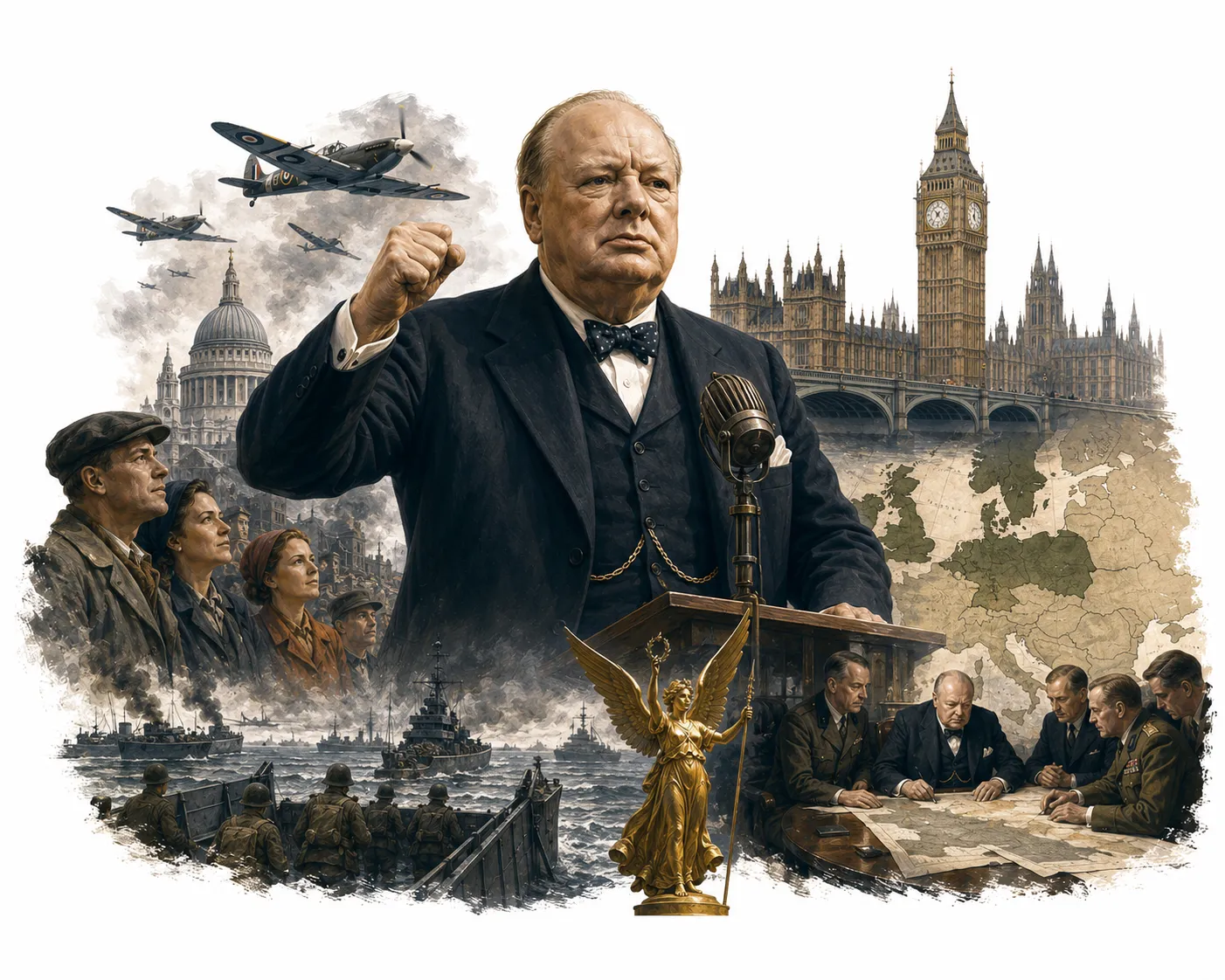
Churchill was a soldier, journalist, historian, painter, and politician.
He was a heavy drinker and smoker. He claimed to have drunk 42,000 bottles of champagne in his life.
He gave his 'We shall fight on the beaches' speech in June 1940, after the evacuation of Dunkirk.
He was voted the greatest Briton of all time in a 2002 BBC poll.
He had a lisp and struggled with pronouncing the letter S.
Visual answer
Churchill's Finest Hour
The key moments of his wartime leadership.
May 10, 1940
Churchill becomes prime minister as Germany invades France, Belgium, and the Netherlands.
May 26-June 4, 1940
Dunkirk evacuation. 338,000 soldiers are rescued from the beaches.
June 4, 1940
Churchill gives 'We shall fight on the beaches' speech.
July-October 1940
Battle of Britain. The RAF defeats the German air force. Britain is saved.
June 1944
D-Day. Allied forces land in Normandy.
May 8, 1945
Victory in Europe Day. Churchill waves to cheering crowds.
Story in brief
Story in Brief
1915
Churchill masterminds the disastrous Gallipoli campaign in WWI. He is forced to resign.
He spent years in the political wilderness, written off as a failure.
1930s
Churchill warns about Hitler's rise. He is ignored.
May 10, 1940
Churchill becomes prime minister. The same day, Germany invades France.
June 4, 1940
Dunkirk evacuation ends. Churchill gives his famous speech.
He turned a military defeat into a rallying cry.
June 18, 1940
He gives the 'Finest Hour' speech. 'This was their finest hour.'
August 20, 1940
He gives the 'Never was so much owed by so many to so few' speech about the RAF pilots.
He celebrated the heroes of the Battle of Britain.
1945
Germany surrenders. Churchill is voted out of office two months later.
The Story
When Britain Stood Alone
On May 10, 1940, Winston Churchill became prime minister. That same day, Germany invaded France, Belgium, and the Netherlands. Within weeks, France had fallen. The British army was trapped at Dunkirk, facing annihilation.
By some miracle, the army was evacuated. But Britain was alone. The entire might of Nazi Germany was turned against a single island. Invasion seemed imminent. Many in the British government wanted to negotiate with Hitler. They thought Britain could not win.
Churchill refused. In a series of speeches broadcast to the nation, he gave the British people a choice: fight or surrender. He made fighting seem not just necessary, but noble. 'We shall fight on the beaches, we shall fight on the landing grounds, we shall fight in the fields and in the streets, we shall fight in the hills,' he said. 'We shall never surrender.' Britain did not surrender. Hitler eventually turned his attention to Russia. Britain survived. Churchill's words had made the difference.
Famous Quote
"We shall fight on the beaches. We shall fight on the landing grounds. We shall fight in the fields and in the streets. We shall fight in the hills. We shall never surrender."
, Winston Churchill, June 4, 1940
He gave this speech after the evacuation of Dunkirk, which was a military defeat. He turned defeat into determination.
Evidence
Why Churchill Is Remembered
He led Britain through its darkest hour and to victory in WWII.
StrongHis speeches inspired a nation to resist Nazi Germany.
StrongHe won the Nobel Prize in Literature for his historical writings.
StrongHe is considered one of the greatest Britons of all time.
StrongKey Points
Key Points So Far
Churchill became prime minister in May 1940 as Hitler conquered Western Europe.
France fell. Britain stood alone against Nazi Germany.
His speeches gave the British people the courage to resist.
He famously said, 'We shall never surrender.'
Britain survived. Hitler invaded Russia instead. The tide of war turned.
Analogy
Like a Ship Captain Refusing to Abandon Ship
The familiar part
Imagine a ship that has been hit by a torpedo. It is sinking. The crew wants to abandon ship. The captain says no. He tells the crew to patch the holes and keep fighting.
How it applies
Churchill was that captain. Britain was the ship. It was taking on water. Most of Europe had already sunk. Churchill told the crew to keep fighting. They did. The ship did not sink.
Where the analogy breaks
Ship captains do not usually give speeches that win Nobel Prizes. Churchill did.
Curiosity Notes
Details Most People Miss
Why this still matters
Why This Still Matters
Churchill is still famous because 1940 was a hinge moment in history. If Britain had surrendered, Hitler would have controlled all of Western Europe. The United States might never have entered the war. The Soviet Union might have fallen. The world would look very different. Churchill's refusal to surrender was not inevitable. Many of his own advisors wanted to negotiate. He held the line. For that, he is remembered. The rest, the racism, the imperialism, the disastrous military campaigns, those are also part of his story. But 1940 is what matters.
Key Findings
- ✓Core findingChurchill became prime minister in May 1940 as Hitler conquered Europe.
- ✓Strong evidenceHe refused to surrender when Britain stood alone against Nazi Germany.
- ⚠Main consequenceHis speeches, including 'We shall fight on the beaches,' inspired the nation.
- ✓Wider legacyHe was voted out of office immediately after the war ended.
- ★Bottom lineHe won the Nobel Prize in Literature in 1953.
Final insight
A Last Thought
Winston Churchill was not a good man by modern standards. He was a racist, an imperialist, and a warmonger. But in 1940, he was exactly the man Britain needed. He was stubborn, defiant, and utterly unwilling to compromise with evil. His flaws did not disappear. But his courage did not either. History is complicated. Churchill is complicated. He is both hero and villain, depending on where you stand. That is not a contradiction. That is just history.
Quick answers
Common questions
Did Churchill really say 'We shall fight them on the beaches'? +
Yes. The full speech is one of the most famous in history. You can listen to a recording of it online. He delivered it to the House of Commons, not directly to the public, but it was broadcast on the radio.
Was Churchill a heavy drinker? +
Yes. He famously said, 'I have taken more out of alcohol than alcohol has taken out of me.' He drank champagne, whiskey, and brandy throughout the day. He was almost certainly an alcoholic, but he was also a highly functional one.