Quick Facts
Quick Facts
The theorem only applies to right triangles (triangles with a 90 degree angle).
The side opposite the right angle is called the hypotenuse (c).
The theorem does not work on curved surfaces, like spheres.
There are over 350 known proofs, including one by James Garfield, the 20th US president.
The visual proof involves arranging four identical right triangles into a square.
Visual answer
The Visual Proof
Why a² + b² = c², explained with pictures.
Step 1
Draw a right triangle with legs a and b and hypotenuse c.
Step 2
Create a large square by arranging four identical triangles around a smaller square.
Step 3
The area of the large square is (a + b)².
Step 4
The area also equals c² (the center square) plus 4 times (ab/2) (the triangles).
Step 5
Set the expressions equal: (a + b)² = c² + 2ab. Simplify to a² + b² = c².
Story in brief
Story in Brief
Ancient Times
Babylonian tablets record Pythagorean triples. The relationship is known but not proven.
c. 500 BCE
Pythagoras or his followers develop the first proof.
The theorem becomes a proven mathematical fact.
c. 300 BCE
Euclid includes a proof in his Elements, Book I, Proposition 47.
The proof becomes part of the mathematical canon.
1876
James Garfield, later US president, discovers a new proof.
The theorem continues to inspire new proofs, even from politicians.
The Story
The Visual Proof Anyone Can Understand
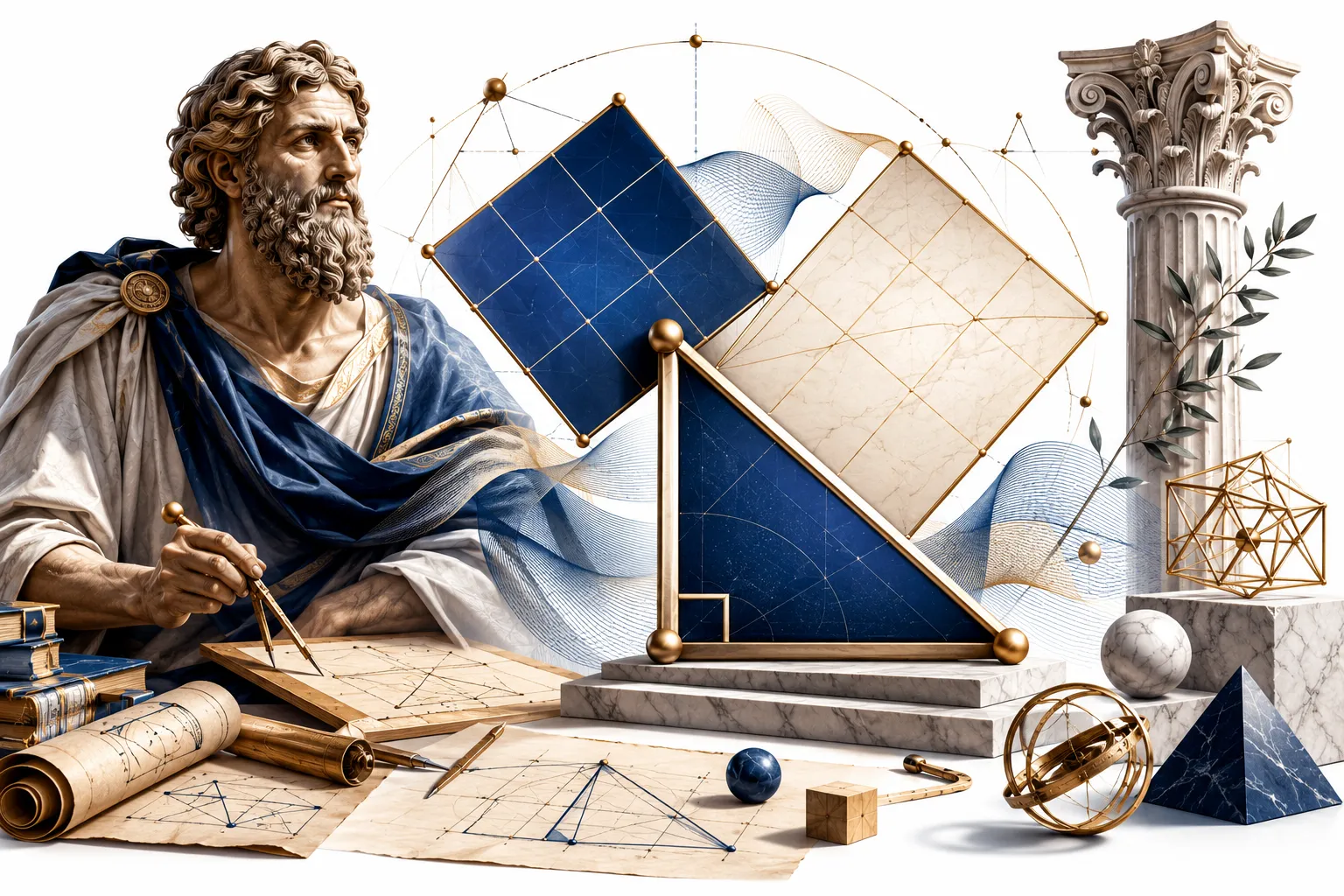
The Pythagorean theorem can be proven in many ways. The simplest is visual. Draw a right triangle. Draw a square on each side. The theorem says that the area of the big square (on the hypotenuse) is exactly equal to the sum of the areas of the two smaller squares.
Why is that true? Imagine arranging four identical right triangles into a square. They fit together perfectly, leaving a smaller square in the middle. The area of the large square can be expressed in two ways: as (a + b)², and as c² plus the area of the four triangles. Do the algebra. Cancel the triangles. You get a² + b² = c².
That is not magic. It is algebra. It is geometry. It is inevitable. Given a right triangle, the relationship must hold. That is why the theorem works.
From Euclid
"In right angled triangles, the square on the side opposite the right angle equals the sum of the squares on the sides containing the right angle."
, Euclid, Elements, Book I, Proposition 47
This is the earliest written proof of the theorem. It appears in the most famous mathematics textbook ever written.
Evidence
Why the Theorem Works
It is a consequence of Euclidean geometry (flat space).
StrongThe proof involves area relationships that are independent of the triangle's size.
StrongThe theorem fails on curved surfaces (like a sphere).
StrongIt can be proven using similar triangles, algebra, or visual rearrangement.
StrongKey Points
Key Points So Far
The theorem applies only to right triangles in flat (Euclidean) space.
It can be proven visually by arranging triangles into a square.
The proof involves equating two expressions for the same area.
The theorem works because of the fundamental properties of area and length.
Analogy
Like a Perfect Balance
The familiar part
Imagine a seesaw. A child of weight a sits on one side. A child of weight b sits on the other. The seesaw balances when the distances are right.
How it applies
The Pythagorean theorem is a balance. The square on the hypotenuse balances the squares on the legs. The numbers are the weights. The geometry is the balance.
Where the analogy breaks
Seesaws have levers. The Pythagorean theorem has squares. But the idea of balance is similar.
Curiosity Notes
Details Most People Miss
Why this still matters
Why This Still Matters
The Pythagorean theorem is still taught because it is useful. Surveyors use it to measure land. Engineers use it to design buildings. Astronomers use it to measure distances to stars. It is everywhere. But the theorem is also beautiful. It is a simple statement about the geometry of the universe. It works. It always works. That is why we still teach it. That is why we still love it.
Key Findings
- ✓Core findingThe theorem applies only to right triangles in flat (Euclidean) space.
- ✓Strong evidenceIt can be proven visually by arranging triangles into a square.
- ⚠Main consequenceThe proof involves equating two expressions for the same area.
- ✓Wider legacyThe theorem does not work on curved surfaces, like a sphere.
- ★Bottom lineThere are over 350 known proofs, including one by President James Garfield.
Final insight
A Last Thought
Why does the Pythagorean theorem work? Because the universe is flat. That is not a joke. The theorem is a geometric fact about the space we live in. It works because the angles of a triangle add up to 180 degrees. It works because parallel lines never meet. It works because the space around us is Euclidean. That is not true in all possible universes. It is true in ours. That is why the theorem works. And that is why we still use it.
Quick answers
Common questions
Does the Pythagorean theorem work on a sphere? +
No. On a sphere, the geometry is curved. The angles of a triangle add up to more than 180 degrees. The Pythagorean theorem does not apply.
Who discovered the Pythagorean theorem? +
It was known in ancient Babylon 1,000 years before Pythagoras. Pythagoras or his followers may have been the first to prove it. The name stuck.