Visual answer
The Capillary Engine of a Candle
How solid wax becomes a burning gas.
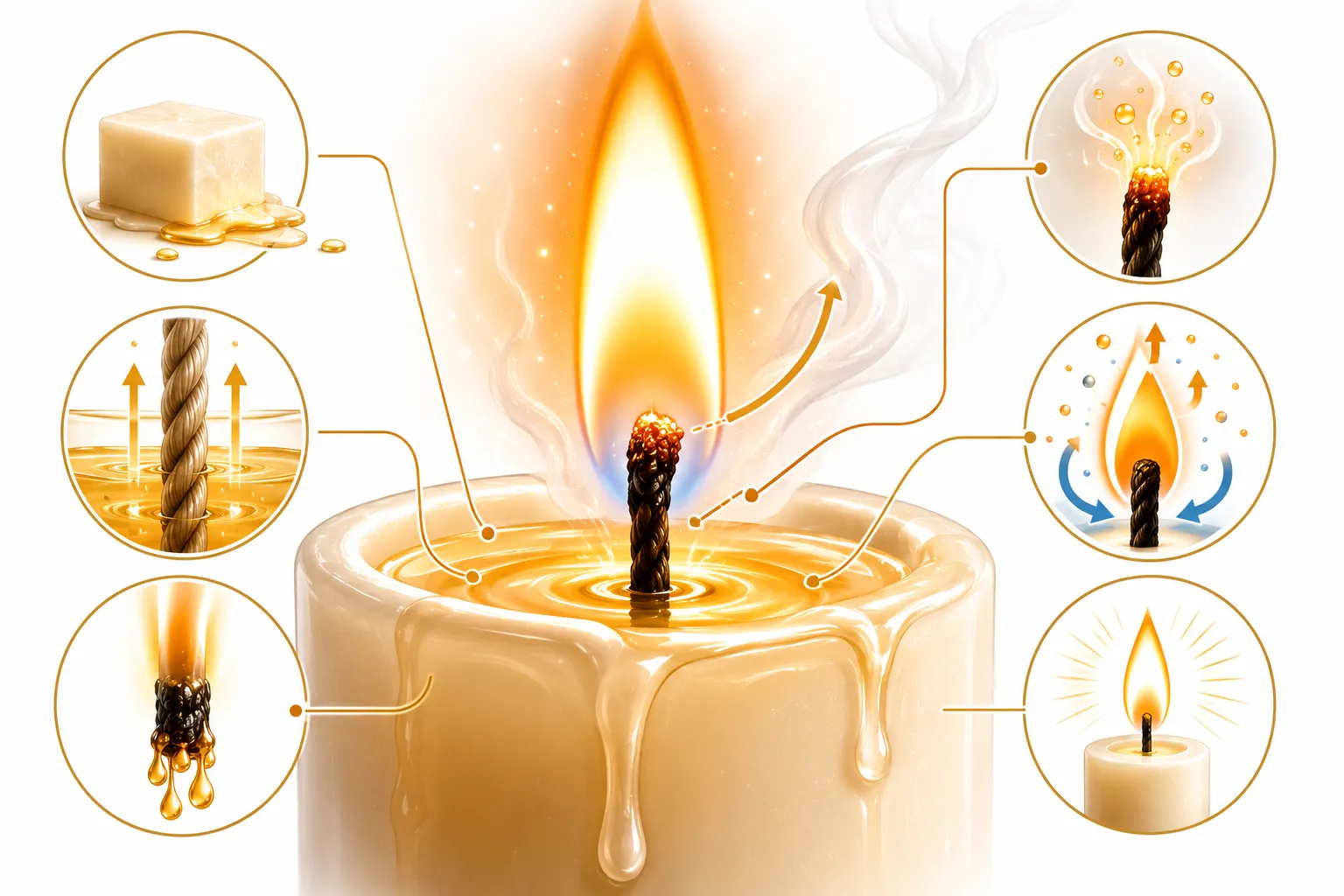
Heat Melts Wax
The flame's heat radiates downward, melting the solid wax into a liquid pool.
Capillary Action
The braided cotton wick acts like a microscopic straw, drawing the liquid wax upward against gravity.
Vaporization
As the liquid wax nears the flame, the intense heat vaporizes it into a gas.
Combustion
The wax vapor mixes with oxygen in the air and combusts, creating the visible flame, heat, and light.
Where We Stand
A Masterpiece of Pre-Industrial Engineering
Current state
The modern braided cotton wick is the result of thousands of years of trial and error. It perfectly balances the rate at which it draws fuel with the rate at which the flame consumes it, creating a self-regulating system that is remarkably stable.
What supports this
The Romans used papyrus wicks. The Middle Ages saw animal hair and rushes. But the 19th century brought the braided cotton wick, which had a revolutionary property: it curled over as it burned, ensuring the tip was always in the hottest part of the flame (the outer blue edge) where it could be completely consumed, preventing the wick from getting too long and smothering the candle.
What could change this
We've largely moved past candles for primary illumination, so the wick's evolution has slowed. Changes now are mostly chemical (adding metals like zinc or tin to the braid to ensure the tip curves just right or to reduce soot) rather than structural.
The Core Idea
Think of It Like an Oil Lamp Without the Pot
The familiar part
In an old oil lamp, you have a reservoir of liquid oil and a cloth wick dipping into it. The wick sucks up the oil, and the flame vaporizes it at the tip. It's a liquid fuel delivery system.
How it applies
A candle is exactly the same thing, except the 'reservoir' is the solid block of wax itself. As the flame melts the wax near the wick, a tiny puddle forms. The wick immediately begins drawing this liquid up via capillary action, the same force that lets paper towels absorb spills. The wick is just the bridge between the solid fuel reservoir and the vaporizing heat of the flame.
Where the analogy breaks
Unlike an oil lamp where the fuel is already liquid, a candle has to *become* liquid first. If the wick is too thick, it draws fuel faster than the flame can melt it, and the candle goes out. If it's too thin, it starves the flame. The balance is extraordinarily delicate.
The Physics
The Invisible Fire: Why Wax Must Vaporize
Here is something that feels profoundly counterintuitive: the wax itself is not on fire. If you blow out a candle, you can see the smoke rising. If you quickly touch a match to that smoke trail, the flame will zip down the smoke and relight the wick. That smoke is unburned wax vapor.
Combustion requires a chemical reaction between a fuel and oxygen in the gaseous state. Solid wax and liquid wax cannot react with oxygen fast enough to sustain a flame. The wick's essential job is to deliver liquid wax to the 'combustion zone', the intense heat right above the wick, where it is instantly vaporized into a gas. It is this invisible cloud of hydrocarbon gas that you are actually seeing burn.
And the wick itself? Ideally, it shouldn't burn much at all. The vaporizing wax cools the wick's tip. In a perfectly balanced candle, the wick only turns to ash at the very apex, while the rest acts purely as a passive liquid transport highway.
The Evidence
The Mechanics of the Melt
Capillary action draws liquid wax up the wick against gravity.
StrongThe flame's heat vaporizes the liquid wax; the vapor is what combusts.
StrongBraided wicks curl to ensure the tip is consumed in the hottest part of the flame.
StrongIf a wick is too long, it burns too hot, creates soot, and smolders the flame.
ModerateThe Big Myth
The Most Common Misconception
What people think
"The wick is the fuel, and the wax just holds it up."
It's easy to assume the wick is like the wood in a campfire, and the wax is just there to keep it burning longer.
What actually happens
The wick is the pump; the wax is the fuel
If you light a bare wick with no wax, it burns out in seconds, leaving a tiny, pathetic flare. The wick contributes almost no energy to the flame. It is a passive mechanical component. The wax is the vast majority of the fuel mass, transformed from a solid block into a combustible gas by the wick's capillary delivery and the flame's heat.
What If It's True?
What If You Lit a Pool of Melted Wax?
Imagine this
Imagine melting a candle down into a metal cup so you just have a pool of liquid wax, and holding a match to the surface.
What would happen
It would be incredibly difficult to light. Liquid wax has a relatively high 'flash point' (the temperature at which it gives off enough vapor to ignite). A brief match flame might scorch the surface but wouldn't sustain a fire. You need the concentrated, continuous heat of a wick to continuously vaporize the fuel fast enough to keep the reaction going.
Why this matters
The wick creates a micro-climate of extreme heat. It narrows the massive block of potential energy down into a tiny, intensely focused point of vaporization. It's a lesson in how constraints, making the fire small and localized, can paradoxically make it more sustainable.
Final insight
The Elegance of the Draw
A candle is a self-contained, self-regulating machine. It uses no moving parts, requires no external power, and relies entirely on the invisible forces of capillary action and thermodynamics to turn a solid block of fat into hours of light. The wick is the silent engineer of this process, a tiny, fibrous bridge between the solid world and the world of fire.
Quick answers
Common questions
Are candle wicks always made of cotton? +
Almost exclusively today, yes, for safety and environmental reasons. Historically, wicks were made of rushes, reeds, papyrus, and even animal hair. In the 19th and early 20th centuries, lead cores were sometimes used to keep wicks rigid, but this has been banned in most countries due to lead poisoning concerns.
Why do some wicks have a metal core? +
In container candles or pillars, a plain cotton wick might flop over into the melting wax. A core of zinc or tin keeps the wick rigid and standing straight up, ensuring it draws fuel evenly from the center of the candle pool.
What causes 'mushrooming' at the top of a wick? +
Mushrooming happens when the wick is drawing up more liquid fuel than the flame can efficiently vaporize and burn. The unburned carbon from the wax builds up on the tip. It usually means the wick is too large for the candle's diameter, or there's a draft causing incomplete combustion.
Why do you have to trim wicks? +
To maintain that perfect balance. A wick that's too long draws too much fuel, creating a large, unsteady flame that produces soot and burns the wax too fast. Trimming it to about 1/4 inch resets the fuel delivery rate to match the heat output.