Quick Facts
Quick Facts
The Berlin Wall went up overnight on August 13, 1961, catching Berliners by surprise.
It was actually two walls with a 'death strip' in between.
Over 5,000 people successfully escaped across or under the wall.
The fall was broadcast live on television across East Germany.
November 9 is also the anniversary of Kristallnacht, the Nazi pogrom against Jews in 1938.
Visual answer
How a Bureaucrat's Mistake Brought Down the Wall
The chain of events on November 9, 1989, that changed the world.
Pressures Build
Mass protests and emigration weaken East Germany.
New Travel Rules
East German leaders draft relaxed travel rules to calm protests.
Schabowski's Press Conference
He announces the new rules but says they take effect 'immediately'.
People Rush to Checkpoints
Millions of East Germans head to the wall.
Guards Open the Gates
Overwhelmed guards let people cross rather than start a massacre.
Story in brief
Story in Brief
August 13, 1961
The Berlin Wall is built overnight.
1985
Mikhail Gorbachev comes to power in the Soviet Union.
His reforms, Glasnost and Perestroika, weakened Soviet control over Eastern Europe.
Summer 1989
Thousands of East Germans flee through Hungary.
October 1989
Massive protests erupt across East Germany.
November 9, 1989, 6:53 PM
Günter Schabowski announces immediate travel freedom.
November 9, 1989, 11:30 PM
The first checkpoint opens. People pour through.
Within hours, the wall was covered in people dancing on top of it.
The Story
One Wrong Answer Changed Everything
On the evening of November 9, 1989, Günter Schabowski was tired and unprepared. He had been handed a press release about new travel rules for East Germans. The rules were supposed to take effect the next day, after a careful, controlled process.
But Schabowski had not read the release carefully. When a journalist asked when the new rules would take effect, he shuffled his papers, looked confused, and said: 'As far as I know, immediately.'
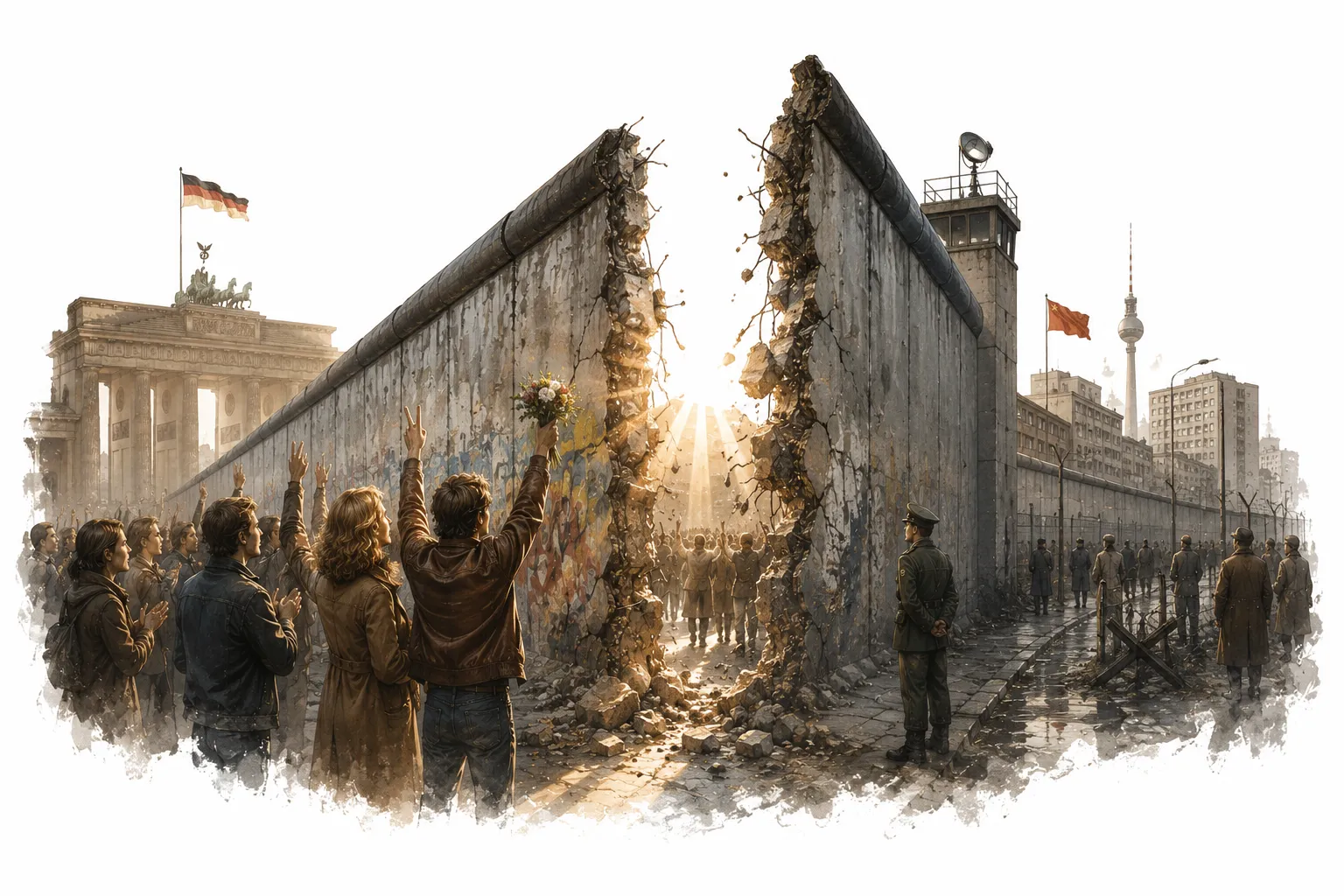
Within an hour, West German television had broadcast his words to every household in East Germany. Thousands of East Berliners grabbed their passports and headed to the wall. The guards, confused and overwhelmed, had no orders to shoot. They opened the gates. By midnight, strangers were crying and hugging each other on both sides of a wall that had divided a city for 28 years.
Famous Quote
"As far as I know, immediately."
, Günter Schabowski, November 9, 1989
The six words that brought down the Berlin Wall. Schabowski later admitted he had been confused and had not read the document properly.
Evidence
What Led to the Fall
Soviet reforms under Gorbachev weakened communist control.
StrongMass protests in East Germany demanded change.
StrongThousands were fleeing through Hungary and Czechoslovakia.
StrongThe East German economy was collapsing.
StrongKey Points
Key Points So Far
The fall was triggered by a bureaucratic mistake at a press conference.
The deeper cause was years of economic failure and political pressure.
Gorbachev's refusal to send Soviet troops to crush protests was crucial.
The guards opened the gates because they had no orders to shoot.
Analogy
Like a Dam with Too Many Cracks
The familiar part
Imagine a dam that has been leaking for months. Engineers keep patching the cracks, but the pressure keeps building.
How it applies
The Berlin Wall was that dam. Schabowski's mistake was not the cause of the collapse. It was the moment the pressure finally became too much. The wall had been weakening for years. He just happened to be holding the sledgehammer when it gave way.
Where the analogy breaks
Unlike a dam, the collapse of the wall was a joyful event. People danced in the water.
Curiosity Notes
Details Most People Miss
Why this still matters
Why This Still Matters
The fall of the Berlin Wall is a reminder that change can come suddenly and unexpectedly. For 28 years, the wall seemed permanent. Then, in a single night, it was gone. The lesson is both hopeful and unsettling: the systems we think are unshakeable can crumble in an instant, often for reasons no one could have predicted.
Key Findings
- ✓Core findingThe fall was triggered by an accidental announcement at a press conference.
- ✓Strong evidenceThe deeper cause was economic collapse and political pressure.
- ⚠Main consequenceGorbachev's refusal to send Soviet troops was decisive.
- ✓Wider legacyThe wall fell on November 9, 1989, one of history's happiest accidents.
- ★Bottom lineGerman reunification followed in October 1990.
Final insight
A Last Thought
The Berlin Wall fell because a tired bureaucrat gave the wrong answer to a journalist's question. History does not always follow grand plans. Sometimes it follows confusion, exhaustion, and a piece of paper read too quickly. The lesson is not that accidents make history. The lesson is that people, even tired bureaucrats, matter more than walls.
Quick answers
Common questions
How many people died trying to cross the Berlin Wall? +
At least 140 people were killed attempting to cross from East to West Berlin. The last person killed was in 1989, just months before the wall fell.
What happened to Günter Schabowski? +
After reunification, Schabowski faced a trial for his role in the East German regime. He was convicted but served no jail time due to poor health. He died in 2015, still remembered as the man who accidentally brought down the wall.