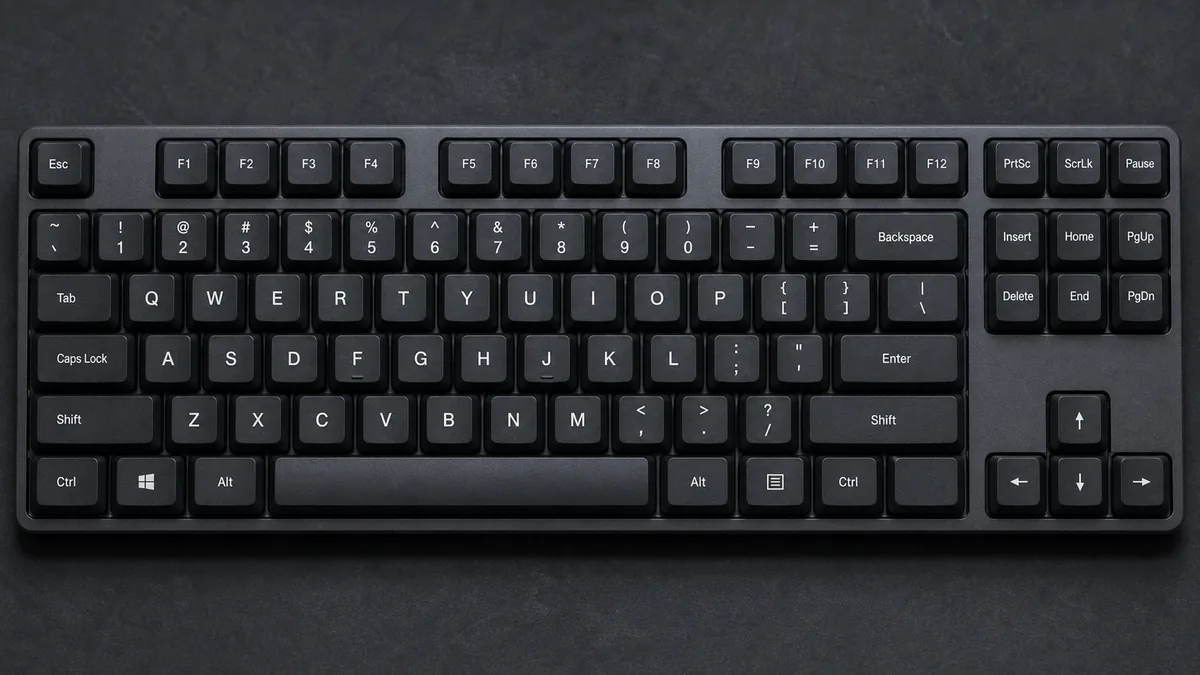
Visual answer
How QWERTY Replaced Straight Alphabetical Keys
The layout came from mechanical typewriter constraints, then stayed because people learned it.
Notice the pattern
The visible detail hints at a practical reason behind the everyday design or behavior.
Identify the mechanism
The core cause is shown with simple arrows so the relationship is easy to follow.
See the effect
The diagram connects the cause to what you actually notice in real life.
Remember the takeaway
The final step reduces the idea to the simple answer behind the article.
The typewriter jam
The typewriter jam problem
Early mechanical typewriters had metal arms that swung up to strike a ribbon and print a letter. If you typed two nearby keys quickly, the arms could collide and get stuck. The QWERTY layout was designed to place commonly paired letters far apart on the keyboard to reduce how often this happened.
Who invented QWERTY?
Who invented QWERTY?
Christopher Latham Sholes, the inventor of the first commercial typewriter, developed the QWERTY layout around 1873. His typewriter was manufactured and sold by Remington, which helped spread the layout widely across offices and businesses.
Did QWERTY actually
Did QWERTY actually prevent jams?
The evidence is mixed. QWERTY does separate some common letter pairs, but it was probably not a perfectly scientific arrangement. It likely evolved through trial and error rather than a detailed study of English letter frequency.
Why did we
Why did we not switch when computers arrived?
By the time computers replaced typewriters, QWERTY was already deeply embedded. Millions of people had learned to type on it. Businesses relied on it. Teaching everyone a new layout would have been enormously disruptive, so the layout simply carried over.
Are there better
Are there better layouts?
Yes. The Dvorak layout was designed in the 1930s to be more efficient, putting the most common letters on the home row. Some studies suggest it reduces finger movement. However, most people never switch because relearning takes significant time and the practical benefits are modest for casual typists.
Misconception
Common Misconception
What people think
QWERTY was designed to make typing faster.
QWERTY was designed to make typing faster.
What actually happens
Reality
QWERTY was designed to reduce mechanical jamming in typewriters, not to maximise typing speed. Some argue it actually slows down modern typing compared to purpose-built layouts.
Quick answers
Common questions
Is QWERTY used everywhere in the world? +
No. Many countries use adapted layouts. French keyboards use AZERTY, German keyboards use QWERTZ, and other languages have entirely different arrangements to suit their alphabets.
Could we switch to a better keyboard layout today? +
Technically yes, but practically it is very difficult. Billions of people type on QWERTY, and retraining everyone would take years. Software can remap keys, but the physical habit is deeply ingrained.
Is there any keyboard in alphabetical order? +
Some very basic children's learning keyboards use alphabetical order. However, this layout is slower for actual typing because common letters end up far apart.