Visual answer
How Gravity Pulls Earth Into a Sphere
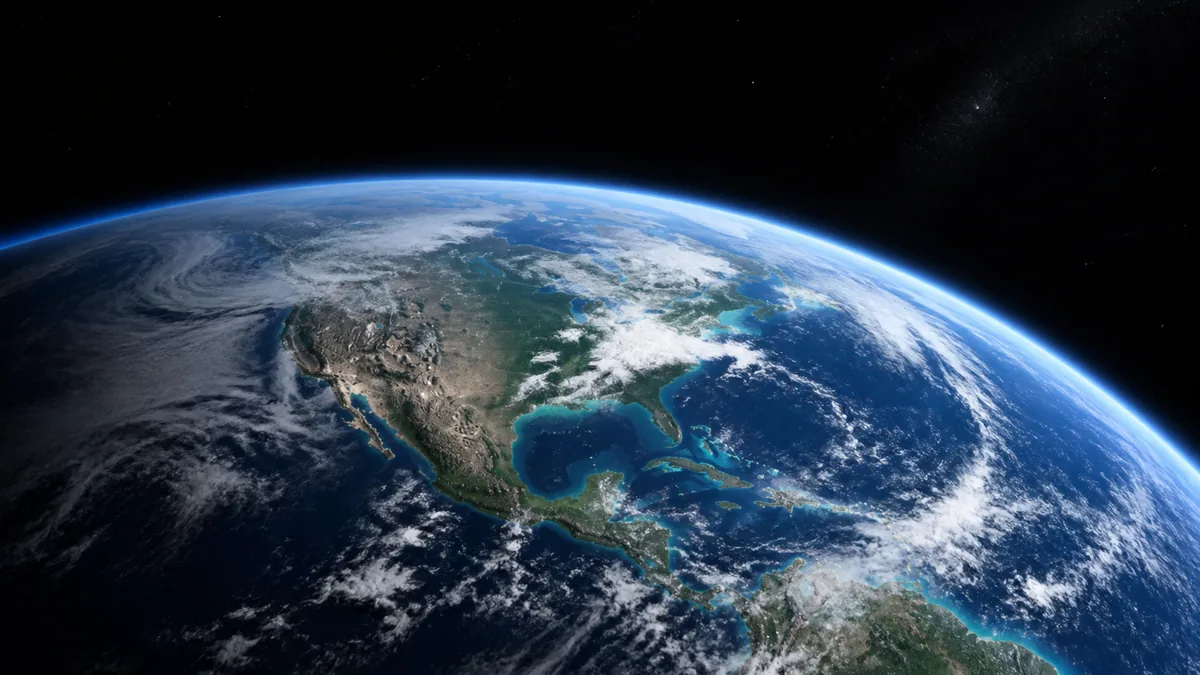
Gravity pulls matter toward the center from every direction, smoothing a planet into a round shape.
Notice the pattern
The visible detail hints at a practical reason behind the everyday design or behavior.
Identify the mechanism
The core cause is shown with simple arrows so the relationship is easy to follow.
See the effect
The diagram connects the cause to what you actually notice in real life.
Remember the takeaway
The final step reduces the idea to the simple answer behind the article.
How gravity shapes
How gravity shapes a planet
Gravity pulls matter toward a central point. When a planet is forming, its material is molten or loosely packed, so gravity can move it around freely. Any bumps or irregularities get pulled inward over time. The result is a shape where the surface is roughly the same distance from the center in all directions, which is a sphere.
Why small rocks
Why small rocks stay lumpy
Smaller objects like asteroids and comets are often oddly shaped. This is because they do not have enough mass to generate strong gravity. Without that gravitational pull, there is nothing forcing the material into a spherical form, so they keep whatever irregular shape they happen to have.
Earth is not
Earth is not a perfect sphere
Earth bulges slightly at the equator and is flattened at the poles. This is because Earth is spinning. The rotation creates a small outward force that pushes the equator outward, making Earth about 43 kilometres wider at the equator than it is tall from pole to pole.
How long did
How long did this take?
Earth formed about 4.5 billion years ago. In its early stages, it was largely molten rock after being bombarded by other space debris. As the planet cooled and settled, gravity continued to shape it into the near-sphere we live on today.
Misconception
Common Misconception
What people think
Earth is a perfect sphere.
Earth is a perfect sphere.
What actually happens
Reality
Earth is slightly flattened at the poles and wider at the equator due to its rotation. Scientists call this shape an oblate spheroid.
Quick answers
Common questions
Are all planets round? +
All the major planets in our solar system are round, or nearly round, because they are large enough for gravity to shape them. Some moons and most asteroids are irregular.
Could a planet be shaped like a cube? +
Not naturally. Any object massive enough to become a planet would have strong enough gravity to round out its edges and corners. A cube-shaped planet would collapse into a sphere over time.
Why does Saturn bulge more than Earth? +
Saturn spins much faster than Earth, completing a rotation in about ten and a half hours. Its rapid spin creates a stronger outward force at the equator, making its bulge much more pronounced.