Visual answer
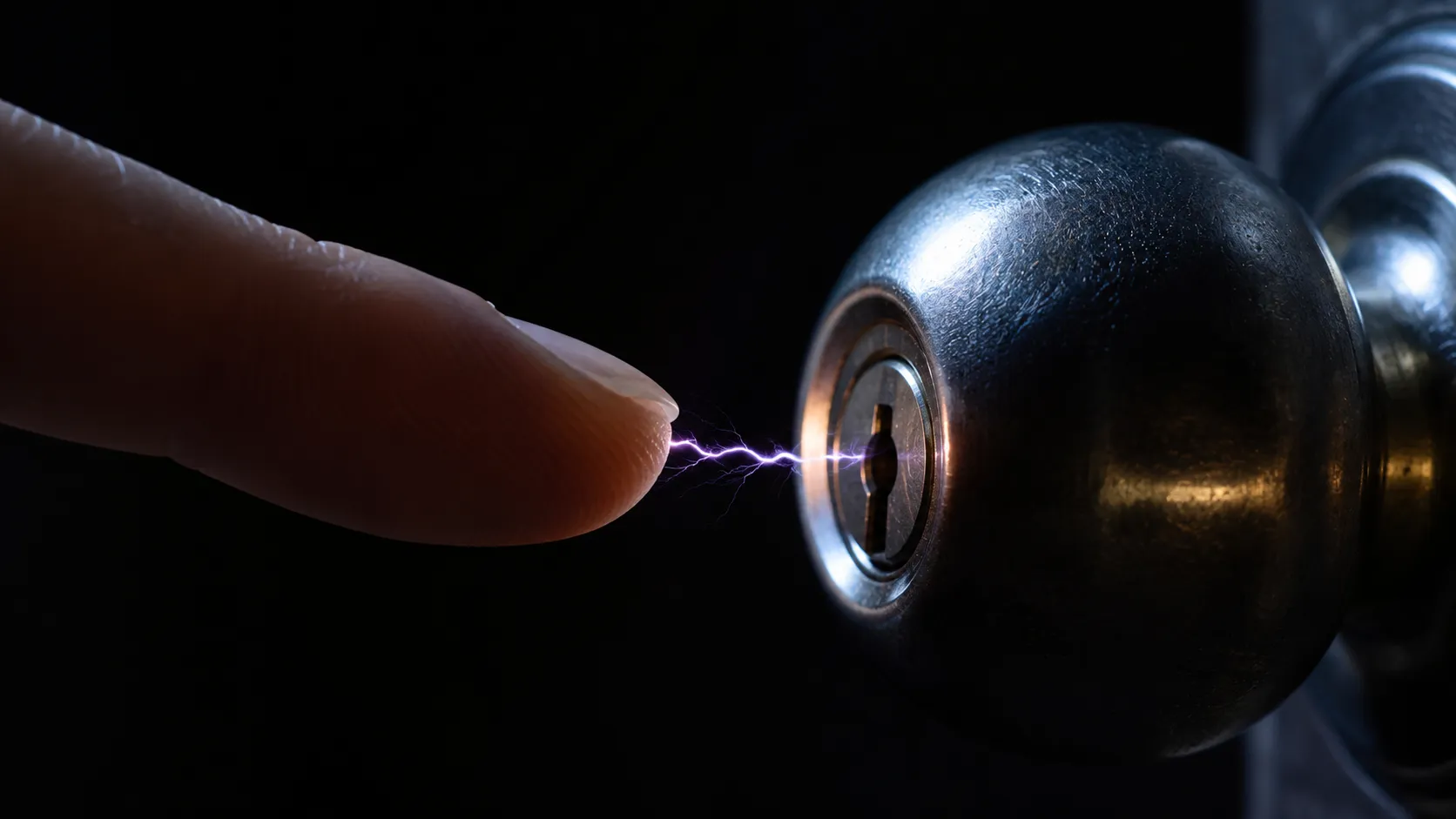
How the doorknob shock happens
The whole process happens in three steps that take only seconds.
Walking on carpet
Friction transfers electrons between your shoes and the carpet, leaving your body with a net charge.
Charge buildup
Extra electrons (or a deficit of them) accumulate on your body's surface.
Approaching metal
Before contact, the electric field from your charge ionizes the air. A spark jumps to equalize.
Discharge
Charge flows through the spark, equalizing in a tiny fraction of a second.
How it builds up
Friction moves electrons between surfaces
Every material holds onto its electrons with different strength. When two different materials rub together, electrons transfer from the material with a weaker grip to the one with a stronger grip.
This is called the triboelectric effect. Wool, human skin, and nylon tend to give up electrons easily. Rubber, polyester, and plastic tend to gain them.
After shuffling across carpet, your body may carry tens of thousands of volts of static charge. The current involved is tiny, which is why it does not hurt you badly.
Is static electricity lightning?
Is a static shock just tiny lightning?
What people think
Static shocks and lightning are completely different things.
Lightning is a weather event and static shocks are just a minor annoyance. They seem unrelated.
What actually happens
They are the same phenomenon at very different scales.
Both involve charge buildup and sudden discharge through ionized air. Lightning is static electricity at a massive scale, with far more charge, longer channels, and vastly more current.
When it happens more
When static electricity is more common
Dry air
Humid air allows charge to leak away gradually. Dry air keeps it trapped. Winter and desert climates have more static.
Synthetic clothing
Polyester and nylon are highly prone to triboelectric charging.
Carpeted floors
Carpets are efficient at transferring electrons with every step.
Rubber-soled shoes
Insulate the charge so it stays on your body rather than dissipating through the floor.
How to reduce it
How to reduce static shocks
Using a humidifier in winter keeps moisture in the air and allows charge to dissipate gradually.
Wearing natural fiber clothing like cotton instead of synthetics reduces charge buildup.
Touching a non-sensitive metal object (a wall bracket, a filing cabinet) before touching sensitive electronics discharges your body safely.
Quick answers
Common questions
What causes static electricity? +
Friction between two different materials causes electrons to transfer from one to the other, leaving one material with extra electrons and the other with a deficit.
Why do I get shocked more in winter? +
Cold air is drier. Dry air is a poor conductor, so charge builds up on your body instead of gradually leaking away.
Can static electricity damage electronics? +
Yes. Even a small static discharge can destroy sensitive components. This is why electronics are often shipped in antistatic bags and technicians use grounding straps.
Is static electricity the same as lightning? +
Physically yes. Both are electrical discharges caused by charge separation and buildup. Lightning operates at a vastly larger scale.
Why does hair stand up with static? +
When hair becomes charged, each strand carries the same polarity of charge. Like charges repel, so the strands push away from each other and stand up.