Quick Facts
Quick Facts
The human body carries roughly as many bacterial cells as human cells, by most modern estimates.
A single gram of healthy soil can contain billions of individual bacteria.
Most bacteria are harmless, and many—especially in the gut—are essential for health.
Bacterial colonies can double in number in as little as 20 minutes under the right conditions.
Visual answer
Where bacteria actually live
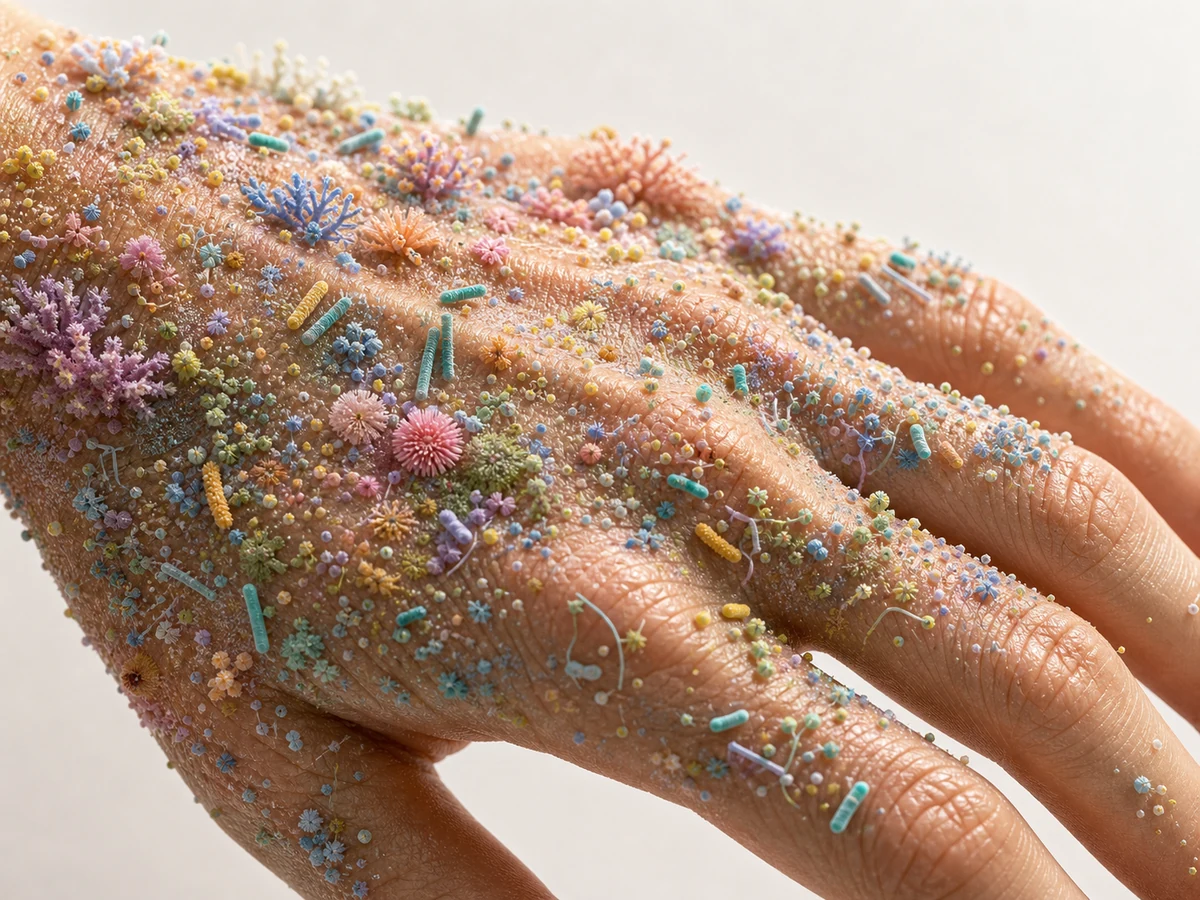
Bacteria aren't confined to 'dirty' places—they blanket nearly every surface, including your own body.
Your skin
Home to trillions of bacteria across countless distinct microbial neighborhoods.
Your gut
Houses the densest bacterial population in your body, vital for digestion.
Everyday surfaces
Doorknobs, phones, and countertops all carry thriving, if invisible, colonies.
The Scene
Your Kitchen Would Look Like a Coral Reef
If bacteria suddenly became visible, your kitchen sponge—a modest object you likely don't think about twice—would look less like a cleaning tool and more like a living reef, dense with shifting colonies in more colors and textures than you'd expect.
Your own skin would take on a faint, mottled texture, subtly different from one patch to the next, since different regions of the body host entirely different bacterial communities—the crook of your elbow looks nothing like your scalp, microbially speaking.
Doorknobs, phone screens, and keyboards, all currently pristine to the eye, would reveal themselves as busy, well-established neighborhoods, quietly rebuilding themselves within hours of every cleaning.
Not All Bad
Mostly Harmless, Genuinely Helpful
The instinct here is to recoil, but the vast majority of visible bacteria would turn out to be entirely harmless, and a great many would be actively working in your favor—breaking down food in your gut, competing with harmful microbes for space on your skin, and generally keeping the peace.
Seeing them wouldn't reveal a hidden threat so much as a hidden ecosystem, one that's been quietly running in the background of your life the entire time.
Analogy
A City You Never Knew You Were Hosting
The familiar part
A city looks calm and quiet from a plane window, even though millions of individual lives are unfolding down below, invisible at that scale.
How it applies
Your body is much the same, except the city is bacterial, the population is in the trillions, and the plane window is simply the limit of human eyesight.
Where the analogy breaks
Unlike a real city, this one rebuilds itself completely within hours of any disruption.
Curiosity Notes
Details Most People Miss
Why this still matters
Why This Still Matters
Thinking through a visibly bacterial world is a useful nudge toward remembering that cleanliness isn't the same as sterility, and that a healthy human body is, and has always been, a shared project with trillions of microscopic tenants.
Key Findings
- ✓Core findingBacteria cover nearly every surface, including your own skin, in vast numbers.
- ✓Strong evidenceThe human body hosts roughly as many bacterial cells as human cells.
- ⚠Main consequenceMost visible bacteria would be harmless, and many are genuinely beneficial.
- ✓Wider legacyBacterial colonies can regrow remarkably fast, often within hours of cleaning.
Final insight
A Last Thought
If bacteria suddenly became visible, the world wouldn't turn frightening so much as humbling—a quiet reminder that you've never once been alone in your own skin, and never really needed to be.
Quick answers
Common questions
Are most bacteria actually dangerous? +
No—the overwhelming majority of bacteria are harmless or beneficial. Only a small fraction of known bacterial species cause disease in humans.
Can you ever actually see bacteria without a microscope? +
Individual bacteria are far too small to see with the naked eye, but large colonies—like mold or certain slimy buildups—can become visible once they grow dense enough.