1
01. Rubber at rest: chains randomly tangled
Maximum entropy configuration - high disorder.
Everyday Science
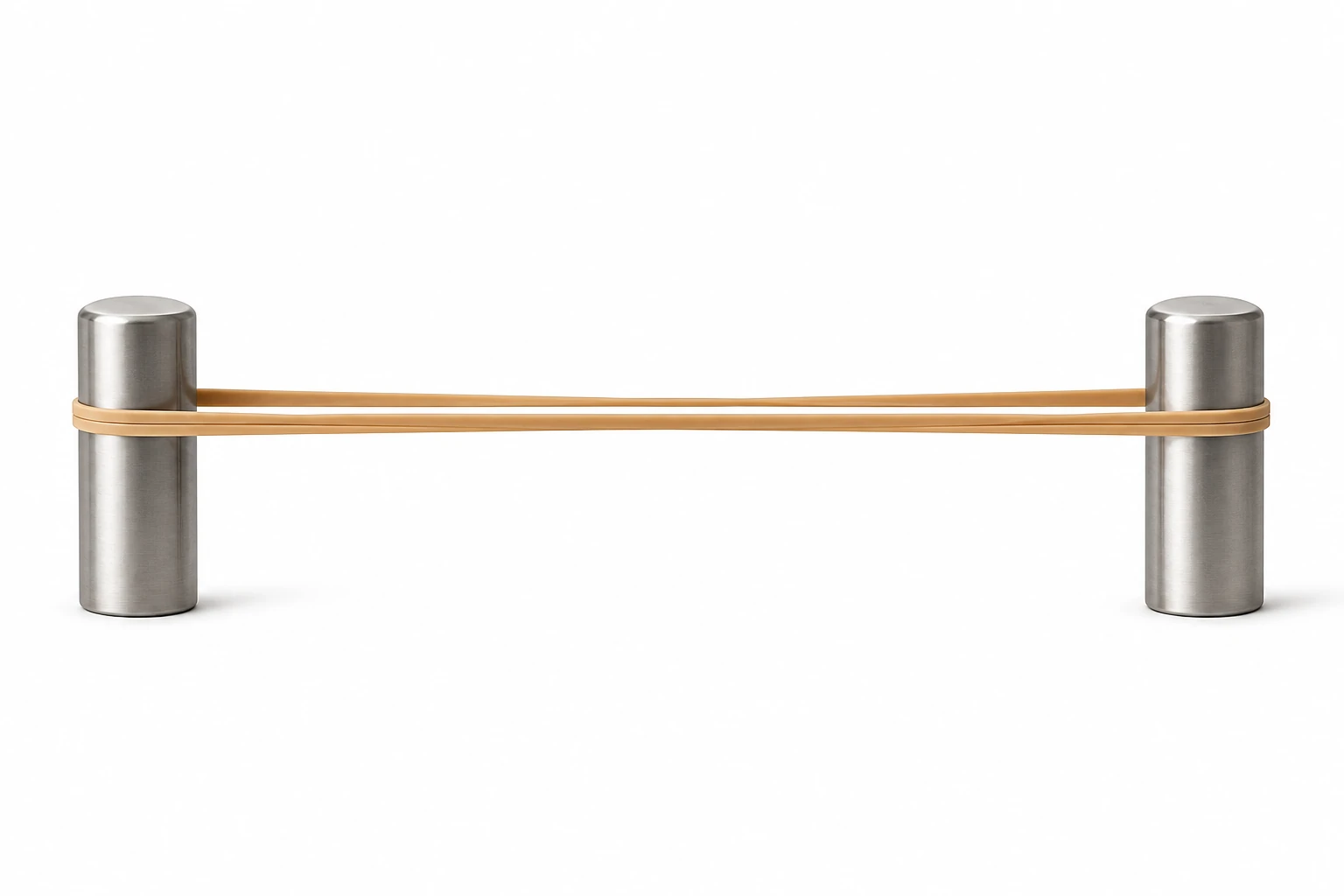
A material that seems to break every rule about how solid things should behave. Pull a rubber band to three times its resting length and release it - it snaps back to exactly where it started, apparently undamaged. Most solid materials that deform significantly do not return to their original shape. Rubber does this reliably, repeatedly, and for reasons that have nothing to do with the material being unusually springy in any familiar sense. The answer involves tangled polymer chains, entropy, and the counterintuitive thermodynamics of elastic materials.
Quick answer
Rubber bands stretch because natural rubber is composed of very long polymer chains that are normally tangled and coiled. Stretching uncoils and aligns these chains, while the thermodynamic drive to return to maximum entropy, maximum tangling, creates the restoring force that snaps the rubber back. A stretched rubber band is thermodynamically unusual: it actually gets warmer when stretched and colder when suddenly released - the opposite of what most materials do - because the restoring force is entropic rather than energetic.
The mystery
The answer involves tangled polymer chains, entropy, and the counterintuitive thermodynamics of elastic materials.
The short answer
Rubber bands stretch because natural rubber is composed of very long polymer chains that are normally tangled and coiled. Stretching uncoils and aligns these chains, while the thermodynamic drive to return to maximum entropy, maximum tangling, creates the restoring force that snaps the rubber back.
The twist
A stretched rubber band is thermodynamically unusual: it actually gets warmer when stretched and colder when suddenly released - the opposite of what most materials do - because the restoring force is entropic rather than energetic.
Common mistake
Rubber is often described as springy, implying its elastic behavior is similar to metal springs.
Everyday Science
Oxidation attacks the polymer chains, breaking them and eliminating the long-chain structure that enables stretching.
The man who made rubber useful
An American inventor who discovered the vulcanization process in 1839, enabling rubber to maintain elastic properties across a wide temperature range.
Where entropic elasticity matters
Tendons, skin, and artery walls all use biological elastomers that rely on entropic elasticity similar to rubber.
Where entropic elasticity matters
Rubber O-rings and gaskets exploit the same polymer chain thermodynamics to maintain seals under compression.
Is rubber springy like a metal spring?
Metal spring elasticity is energetic, driven by atomic displacement forces; rubber elasticity is entropic, driven by thermodynamics. They produce similar macroscopic behavior through completely different mechanisms.
Continue learning
Everyday Science
Another familiar question explained by simple physics.
Everyday Science
Another familiar question explained by simple physics.
Everyday Science
Another familiar question explained by simple physics.