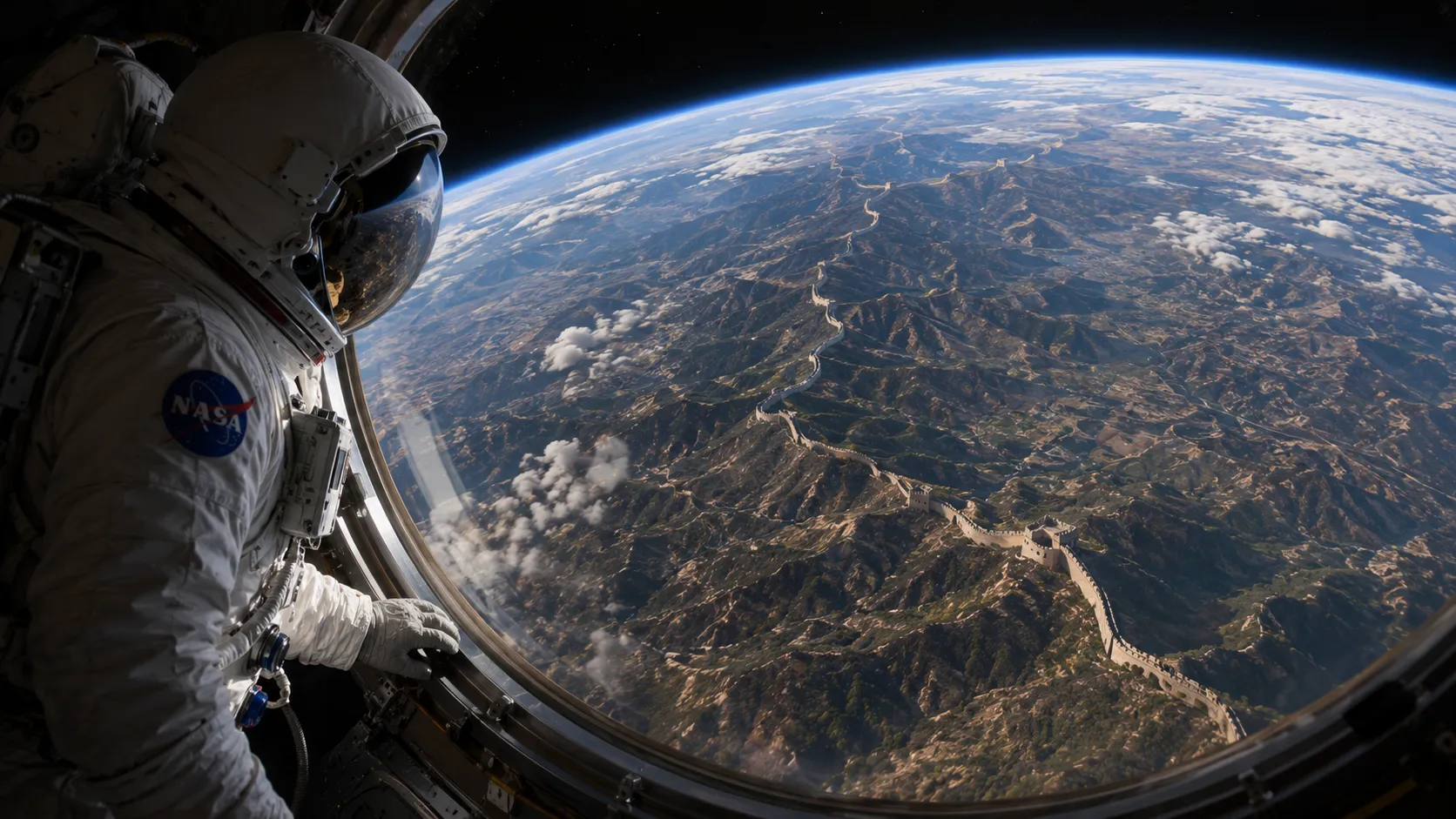
Visual answer
Why the wall fails the visibility test
Visibility from orbit depends on width, not length.
Low Earth orbit altitude
The International Space Station orbits at roughly 400 km above Earth.
Wall width at that distance
At 400 km, the 5-8 meter wide wall subtends an angle far below normal human visual acuity.
What you can see
Roads, runways, cities, and reservoirs are visible because they are wide enough.
The wall from orbit
The length is enormous but width is what determines visibility. Length alone is not enough.
Why not visible
Width matters for visibility, not length
The human eye cannot resolve an object from orbital altitude unless it is wide enough to exceed the eye's angular resolution limit.
At 400 km, the minimum resolvable width is roughly 10 km in good conditions. The Great Wall is about 5 to 8 meters wide.
The wall is extraordinarily long but extremely narrow. From space, it would be like trying to see a hair from 10 meters away.
Myth origin
Where did this myth come from?
What people think
The Great Wall is so massive it is visible from space.
The wall's sheer length across thousands of kilometers gave rise to the idea that it must be identifiable from far above.
What actually happens
The myth predates space travel and was never scientifically tested until astronauts went up.
The claim appears in print as early as 1932, long before any human went to space. No one checked whether the wall's width actually met the threshold for human vision at those distances.
What is visible from space
What you can actually see from low Earth orbit
Major cities at night
Visible. The glow of city lights creates a large, bright signal.
Large reservoirs and lakes
Visible. Water reflects light distinctively and covers large areas.
Airport runways
Some large ones are visible due to their width and contrasting color.
Great Wall of China
Not visible with the naked eye. Too narrow despite its length.
With cameras
Cameras and telephoto lenses change the story
With a long telephoto lens and ideal conditions, astronauts have occasionally captured what appears to be sections of the wall in photographs.
But this is optical assistance, not naked-eye visibility, which is what the original claim always referred to.
The same way your phone camera can photograph something your naked eye cannot resolve, camera lenses extend beyond human visual limits.
Quick answers
Common questions
Can you see the Great Wall of China from space? +
No. It is too narrow to resolve with the naked eye from low Earth orbit. Multiple astronauts have confirmed this directly.
Why do people say you can see the Great Wall from space? +
The myth has been repeated in books and popular media since at least the 1930s. It sounds plausible because the wall is so long, but length alone does not determine visibility. Width does.
What is the narrowest thing visible from space? +
With the naked eye, you need an object to be several kilometers wide to reliably see it from 400 km altitude. Major roads, runways, and some buildings are only visible with camera assistance.
Has any astronaut ever seen the Great Wall from space? +
Not with the naked eye. Some have photographed what may be sections of it using telephoto lenses under optimal conditions, but this is not naked-eye visibility.
What is the largest man-made structure visible from space? +
City light networks, large reservoirs, and deforestation patterns are all clearly visible. No single linear structure like a wall or road is reliably seen with the naked eye.