Quick Facts
Quick Facts
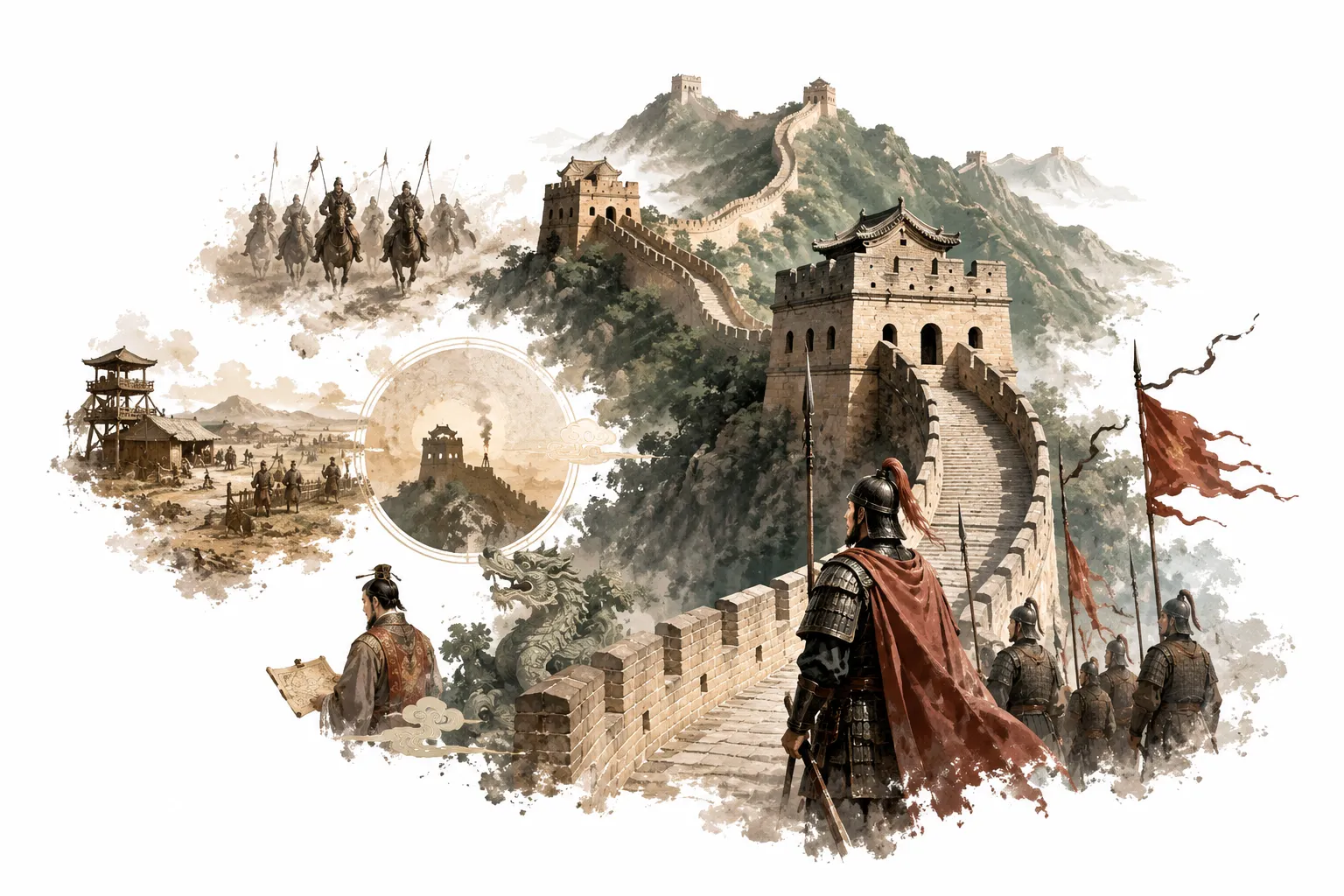
The Great Wall is not one continuous wall. It is a series of walls, trenches, and natural barriers.
Over 1 million workers died building the wall during the Qin Dynasty alone.
Sticky rice mortar was used to bind bricks during the Ming Dynasty.
The wall failed to stop the Mongols, who simply bribed the guards.
The 'visible from space' myth was popularized by a 1932 travel guide.
Visual answer
How the Great Wall Evolved Over 2000 Years
Different dynasties built different walls for different reasons.
7th-3rd Century BC
Warring States build separate walls to defend against each other and northern nomads.
221 BC: Qin Dynasty
Emperor Qin Shi Huang connects existing walls into a single system.
Han Dynasty
The wall is extended westward to protect the Silk Road.
Ming Dynasty
The famous brick wall is built after the Mongols are driven out.
Today
Sections are restored for tourism. Other sections are crumbling or have disappeared.
Story in brief
Story in Brief
7th century BC
Chinese states begin building defensive walls.
221 BC
Qin Shi Huang unifies China and connects the walls.
The first 'Great Wall' is created, built largely of rammed earth.
206 BC - 220 AD
Han Dynasty extends the wall to protect the Silk Road.
1368
Ming Dynasty comes to power after driving out the Mongols.
1368-1644
Ming emperors build the stone and brick wall we know today.
This is the wall tourists visit. It is not the original.
1644
The Ming wall fails to stop the Manchu invasion.
The wall's military value was always questionable. The Manchus simply walked around it.
The Story
The Most Expensive Failed Project in History
The Great Wall of China is one of the most impressive structures ever built by human hands. It is also one of the most expensive failures. Invaders breached it repeatedly. The Mongols simply bribed the guards and walked through. The Manchus marched around the end of the wall and conquered China anyway.
So why build it? The answer is complicated. The wall was never just a military barrier. It was a statement. It said: this is China. Beyond this line is not China. Everything inside is ours. Everything outside is theirs.
The wall also controlled trade. Goods entering China had to pass through checkpoints where they could be taxed. People entering had to show papers. The wall was less a fence and more a customs booth stretched across 13,000 miles.
Famous Quote
"I have unified the world. I will build a wall to protect it forever."
, Emperor Qin Shi Huang (attributed)
Qin's dynasty lasted only 15 years after his death. His wall did not protect it.
Evidence
Why the Wall Was Built
Defense against northern nomads like the Xiongnu and Mongols.
StrongControl of trade and taxation along the Silk Road.
StrongRegulation of immigration and emigration.
ModerateSymbolic projection of imperial power.
StrongKey Points
Key Points So Far
The Great Wall was built over 2000 years by multiple dynasties.
Its military effectiveness was limited. Invaders found ways around or through it.
It served economic and symbolic purposes as much as defensive ones.
The famous brick wall is from the Ming Dynasty (1368-1644).
Analogy
Think of It Like a Giant Border Fence
The familiar part
Imagine the border fence between Mexico and the United States, but stretching for 13,000 miles and built with medieval technology.
How it applies
Like modern border fences, the Great Wall was never meant to be completely impenetrable. It was meant to slow down invaders, channel them into defensible checkpoints, and make casual raiding too much trouble.
Where the analogy breaks
Modern border fences have helicopters and sensors. The Great Wall had men with torches and a lot of time on their hands.
Curiosity Notes
Details Most People Miss
Why this still matters
Why This Still Matters
The Great Wall is still visited by millions of tourists every year. It remains a symbol of China's ancient power and modern identity. But it is also a reminder that walls, no matter how impressive, are never perfect. Invaders will always find a way around, over, or through. What matters is what the wall means, not just what it does.
Key Findings
- ✓Core findingThe Great Wall was built primarily for defense against northern nomads.
- ✓Strong evidenceIt also controlled trade, immigration, and projected imperial power.
- ⚠Main consequenceThe wall we see today is from the Ming Dynasty (1368-1644).
- ✓Wider legacyIts military effectiveness was limited. Invaders breached it repeatedly.
- ★Bottom lineThe 'visible from space' myth is false.
Final insight
A Last Thought
The Great Wall is a monument to human ambition. Thousands of miles of stone and brick, built over two millennia, costing millions of lives. And for all that effort, it did not really work. Invaders still came. Dynasties still fell. The wall stands today not because it protected anyone, but because it is too big to tear down. There is a lesson in that, though it is not an entirely comfortable one.
Quick answers
Common questions
How long did it take to build the Great Wall? +
The wall was built in sections over more than 2000 years. The Ming Dynasty section took about 200 years to complete.
How many people died building the Great Wall? +
Estimates vary widely. Some sources claim over 1 million workers died during the Qin Dynasty alone. Many of their bodies were buried inside the wall itself.