Quick Facts
Quick Facts
Turing's work at Bletchley Park was kept secret for decades. The public did not know about his wartime contributions until the 1970s.
He is estimated to have shortened World War II by two to four years.
He invented the 'Turing machine,' a theoretical device that is the foundation of modern computing.
He was a long-distance runner. He almost qualified for the British Olympics.
He was posthumously pardoned by Queen Elizabeth II in 2013.
Visual answer
The Contributions of Alan Turing
How one man changed the world.
1936: The Turing Machine
A theoretical device that can perform any calculation. The foundation of modern computer science.
1939-1945: Enigma
Turing cracks the German naval Enigma code, allowing Allied ships to avoid U-boats. Millions of lives saved.
1950: The Turing Test
A test to determine if a machine can think. Still used in AI research today.
1952-1954: Tragedy
Arrested for homosexuality. Chemically castrated. Dies by suicide at 41.
Story in brief
Story in Brief
1936
Turing publishes 'On Computable Numbers,' introducing the concept of the Turing machine.
He invents the theoretical foundation of every computer.
1939
Turing joins Bletchley Park, the British codebreaking center.
1940-1942
Turing develops the Bombe, a machine that cracks Enigma codes.
Allied ships can now avoid German U-boats. The tide of the war turns.
1945
After the war, Turing designs the Automatic Computing Engine (ACE), one of the first stored-program computers.
1950
Turing publishes 'Computing Machinery and Intelligence,' introducing the Turing test for AI.
1952
Turing is arrested for 'gross indecency' (homosexuality). He is chemically castrated.
His security clearance is revoked. He cannot continue his work.
1954
Turing dies by suicide. He is 41 years old.
The Story
How One Man Saved the World and Was Killed by It
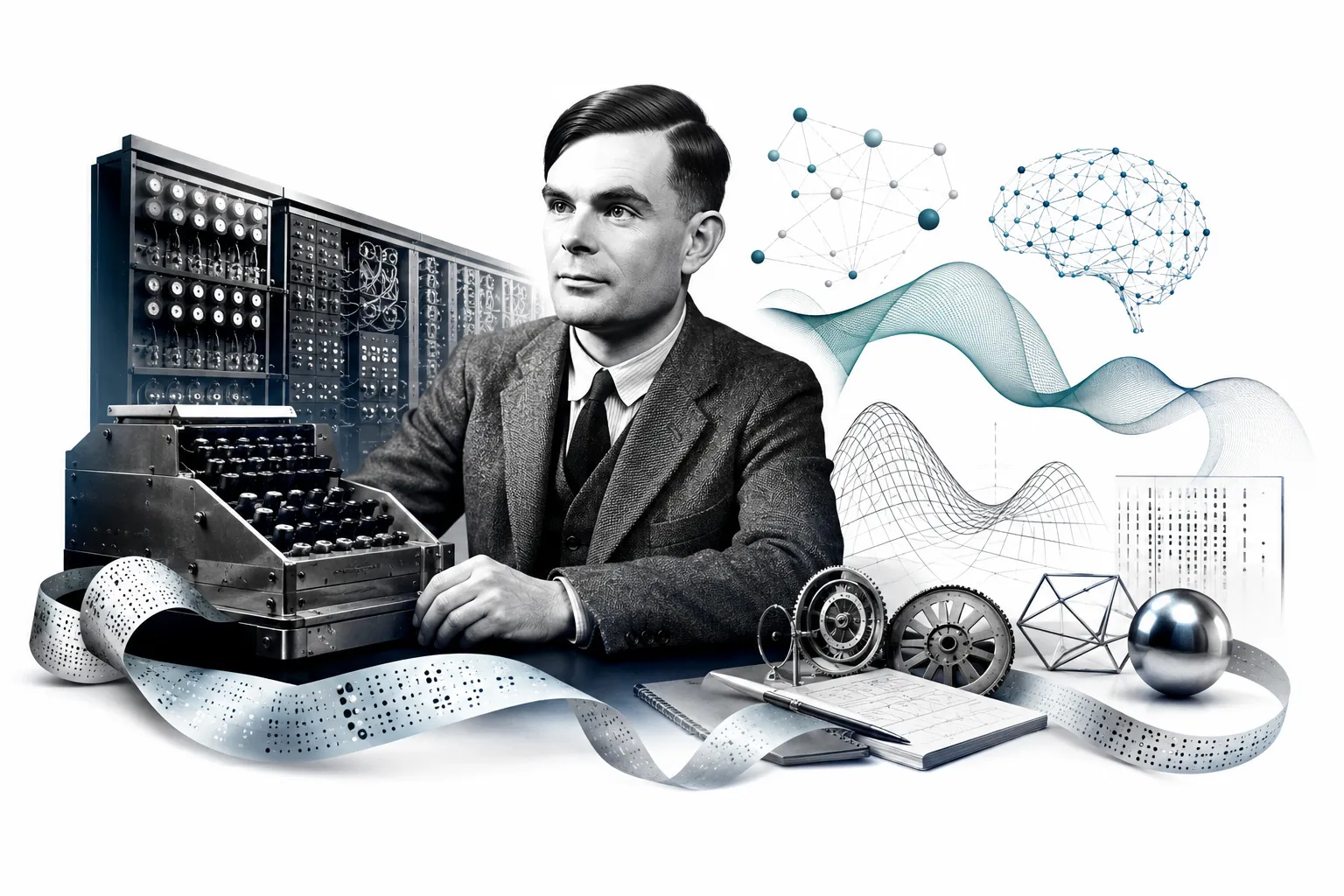
Alan Turing was a mathematician. In 1936, he invented the concept of the Turing machine, a theoretical device that could perform any calculation. Every computer you have ever used is a physical version of Turing's machine. He invented the computer before the computer existed.
During World War II, Turing was recruited by British intelligence to crack the German Enigma code. Enigma was thought to be unbreakable. Turing built a machine, the Bombe, that could decode Enigma messages in hours. The intelligence gained from Enigma, called Ultra, was decisive. Allied ships could avoid U-boats. Troop movements were anticipated. Historians estimate that Turing's work shortened the war by two to four years and saved millions of lives.
After the war, Turing continued his research. He proposed the Turing test to measure artificial intelligence. Then, in 1952, he was arrested for being gay. He was given a choice: prison or chemical castration. He chose castration. The treatment left him impotent and depressed. He died by suicide in 1954. He was 41 years old. The man who saved the world was destroyed by it.
Famous Quote
"We can only see a short distance ahead, but we can see plenty there that needs to be done."
, Alan Turing
He wrote this in a paper about computing. He could not see the future. But he built it anyway.
Evidence
Why Turing Matters
He invented the theoretical foundation of modern computing.
StrongHe cracked the Enigma code, shortening WWII by years and saving millions of lives.
StrongHe created the Turing test, a foundational concept in AI research.
StrongHe was persecuted for being gay and died by suicide.
StrongKey Points
Key Points So Far
Turing invented the concept of the computer (the Turing machine) in 1936.
He cracked the Enigma code during WWII, saving millions of lives.
He created the Turing test for artificial intelligence.
He was arrested for being gay, chemically castrated, and died by suicide at 41.
He was posthumously pardoned in 2013.
Analogy
Like an Architect Who Built a City and Was Exiled
The familiar part
Imagine an architect who designs a beautiful city. The city thrives. Then the city's leaders exile the architect for being different.
How it applies
Turing designed the digital city. Every computer, every smartphone, every AI is built on his ideas. And his country punished him for being gay.
Where the analogy breaks
Exiled architects can return. Turing never could. He was dead.
Curiosity Notes
Details Most People Miss
Why this still matters
Why This Still Matters
Alan Turing's story is still important because it is a warning. Genius can come from anywhere. It can be destroyed by prejudice. Turing saved millions of lives and invented the future. And his country punished him for being gay. That is not ancient history. That happened in the 1950s. It could happen again. We remember Turing not just for his brilliance, but for his tragedy. The two are inseparable.
Key Findings
- ✓Core findingTuring invented the theoretical foundation of modern computing.
- ✓Strong evidenceHe cracked the Enigma code, shortening WWII and saving millions of lives.
- ⚠Main consequenceHe created the Turing test, a foundational concept in AI.
- ✓Wider legacyHe was arrested for being gay, chemically castrated, and died by suicide at 41.
- ★Bottom lineHe was posthumously pardoned in 2013.
Final insight
A Last Thought
Alan Turing was important because he saw the future. He imagined computers before they existed. He imagined AI before anyone thought machines could think. And he won a war by building machines that could outthink humans. Then his country destroyed him. He was not killed by the enemy. He was killed by the people he saved. That is the tragedy. That is the warning. Genius is fragile. Prejudice is strong. Turing lost. We are still fighting his fight.
Quick answers
Common questions
What was the Turing machine? +
A theoretical device that can perform any calculation. It is the foundation of computer science. Every computer is a physical version of Turing's theoretical machine.
How many lives did Turing save? +
Historians estimate that his work shortened World War II by two to four years, saving millions of lives. The exact number is impossible to calculate. But it is large.