Quick Facts
Quick Facts
King was arrested over 30 times for civil disobedience.
He started college at age 15. He was a gifted student.
His 'I Have a Dream' speech was partly improvised. The most famous part was not in his written notes.
He was the youngest person to win the Nobel Peace Prize at the time (age 35).
A month before he died, he preached a sermon saying he might not live to see the promised land.
Visual answer
The Key Moments of the Civil Rights Movement
The major events that King led or inspired.
1955
Montgomery Bus Boycott. Rosa Parks is arrested. King leads a 381-day boycott. Segregated buses are ruled unconstitutional.
1963
Birmingham Campaign. King is jailed. He writes 'Letter from Birmingham Jail.' The campaign leads to desegregation.
August 28, 1963
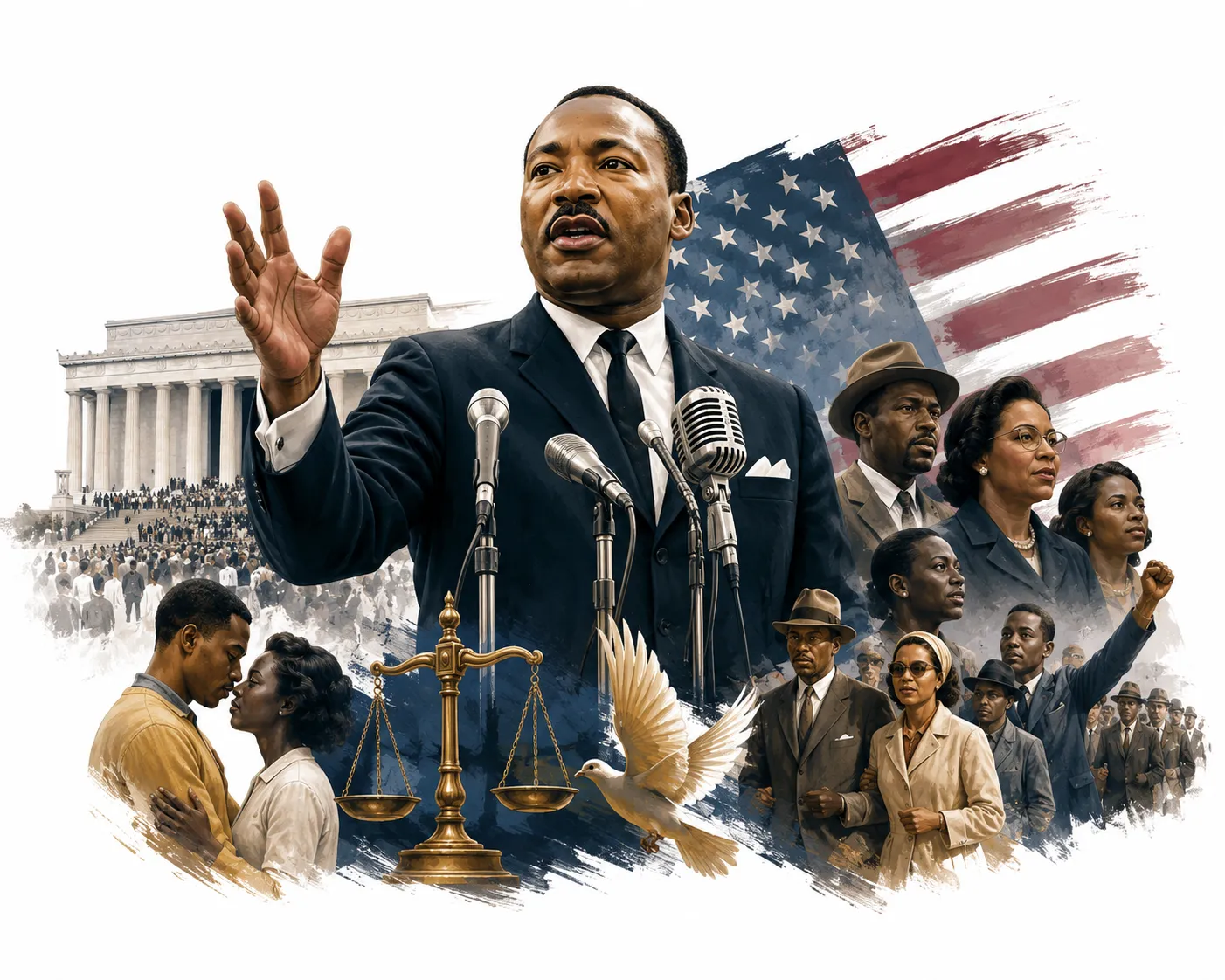
March on Washington. 250,000 people gather. King delivers 'I Have a Dream.'
1964
Civil Rights Act is signed. Segregation in public places is banned.
1965
Selma to Montgomery marches. Voting Rights Act is signed. Barriers to Black voting are removed.
Story in brief
Story in Brief
1955
The Montgomery Bus Boycott begins after Rosa Parks is arrested.
King, a 26-year-old pastor, becomes the leader of the movement.
1957
The Southern Christian Leadership Conference is founded. King is its first president.
1963
The Birmingham Campaign. King is jailed. He writes 'Letter from Birmingham Jail.'
August 28, 1963
The March on Washington. King delivers 'I Have a Dream.'
The speech defines the movement for history.
1964
King wins the Nobel Peace Prize. The Civil Rights Act is signed.
1965
The Voting Rights Act is signed after the Selma marches.
April 4, 1968
King is assassinated in Memphis, Tennessee.
He was 39 years old. Riots erupt in over 100 American cities.
The Story
How a Preacher Changed a Nation
In 1955, a Black woman named Rosa Parks refused to give up her bus seat to a white man. She was arrested. The Black community of Montgomery, Alabama, decided to boycott the buses. They needed a leader. They chose a 26-year-old pastor named Martin Luther King Jr.
The boycott lasted 381 days. King's house was bombed. He was arrested. But the Black community walked, carpooled, and organized. Eventually, the Supreme Court ruled that segregated buses were unconstitutional. King had won his first victory.
He did not stop. He led campaigns in Birmingham, Selma, and Chicago. He was beaten, jailed, and stabbed. He kept going. In 1963, he stood before 250,000 people at the Lincoln Memorial and delivered a speech that was not supposed to include the words 'I have a dream.' He had used those words before. That day, he improvised. The most famous words of his life were spoken off the cuff.
Famous Quote
"I have a dream that my four little children will one day live in a nation where they will not be judged by the color of their skin but by the content of their character."
, Martin Luther King Jr, August 28, 1963
These words were not in his prepared speech. He had used them before. That day, Mahalia Jackson shouted from behind him, 'Tell them about the dream, Martin!' He did.
Evidence
Why King Is Remembered
He led the nonviolent movement that ended legal segregation in the American South.
StrongHis 'I Have a Dream' speech is one of the most famous speeches in history.
StrongHe won the Nobel Peace Prize at age 35.
StrongMartin Luther King Jr Day is a federal holiday in the United States.
StrongKey Points
Key Points So Far
King led the Montgomery Bus Boycott, his first major victory.
He organized the March on Washington and delivered 'I Have a Dream.'
He won the Nobel Peace Prize in 1964.
He was assassinated in 1968 at age 39.
His nonviolent methods inspired movements around the world.
Analogy
Like a Rock in a River
The familiar part
Imagine a river flowing fast and strong. A rock sits in the middle. The water cannot move the rock. The rock changes the flow of the river.
How it applies
King was that rock. Segregation was the river. He did not destroy it. He stood in its path and refused to move. The river flowed around him. And eventually, the river changed course.
Where the analogy breaks
Rivers do not assassinate rocks. People assassinated King.
Curiosity Notes
Details Most People Miss
Why this still matters
Why This Still Matters
King's dream is not fully realized. Racism still exists. Inequality still exists. The voting rights he fought for are still being contested in courts. But the world he helped create is unrecognizably different from the world he was born into. Segregation is gone. Black people vote. Black people hold every office in the land, including the presidency. The dream is not fulfilled. But it is not dead either.
Key Findings
- ✓Core findingKing led the civil rights movement using nonviolent protest.
- ✓Strong evidenceHe organized the Montgomery Bus Boycott and the March on Washington.
- ⚠Main consequenceHis 'I Have a Dream' speech is one of history's most famous.
- ✓Wider legacyHe won the Nobel Peace Prize in 1964.
- ★Bottom lineHe was assassinated in 1968 at age 39.
Final insight
A Last Thought
Martin Luther King Jr is famous because he refused to hate. He had every reason to. His house was bombed. He was stabbed. He was beaten. He was jailed. He was hated by millions. And he still preached love. That is not naive. It is terrifyingly difficult. He did not succeed perfectly. No one could. But he tried. And the trying made him great.
Quick answers
Common questions
Was Martin Luther King Jr a doctor? +
Yes. He earned a PhD in systematic theology from Boston University. He was a real doctor, not an honorary one.
Did King only fight for Black rights? +
No. Later in his life, he spoke out against the Vietnam War and organized the Poor People's Campaign, which sought economic justice for all races.