Quick Facts
Quick Facts
Napoleon's army included not just Frenchmen but Germans, Poles, Italians, and Swiss.
The Russians retreated instead of fighting. They burned their own crops and villages.
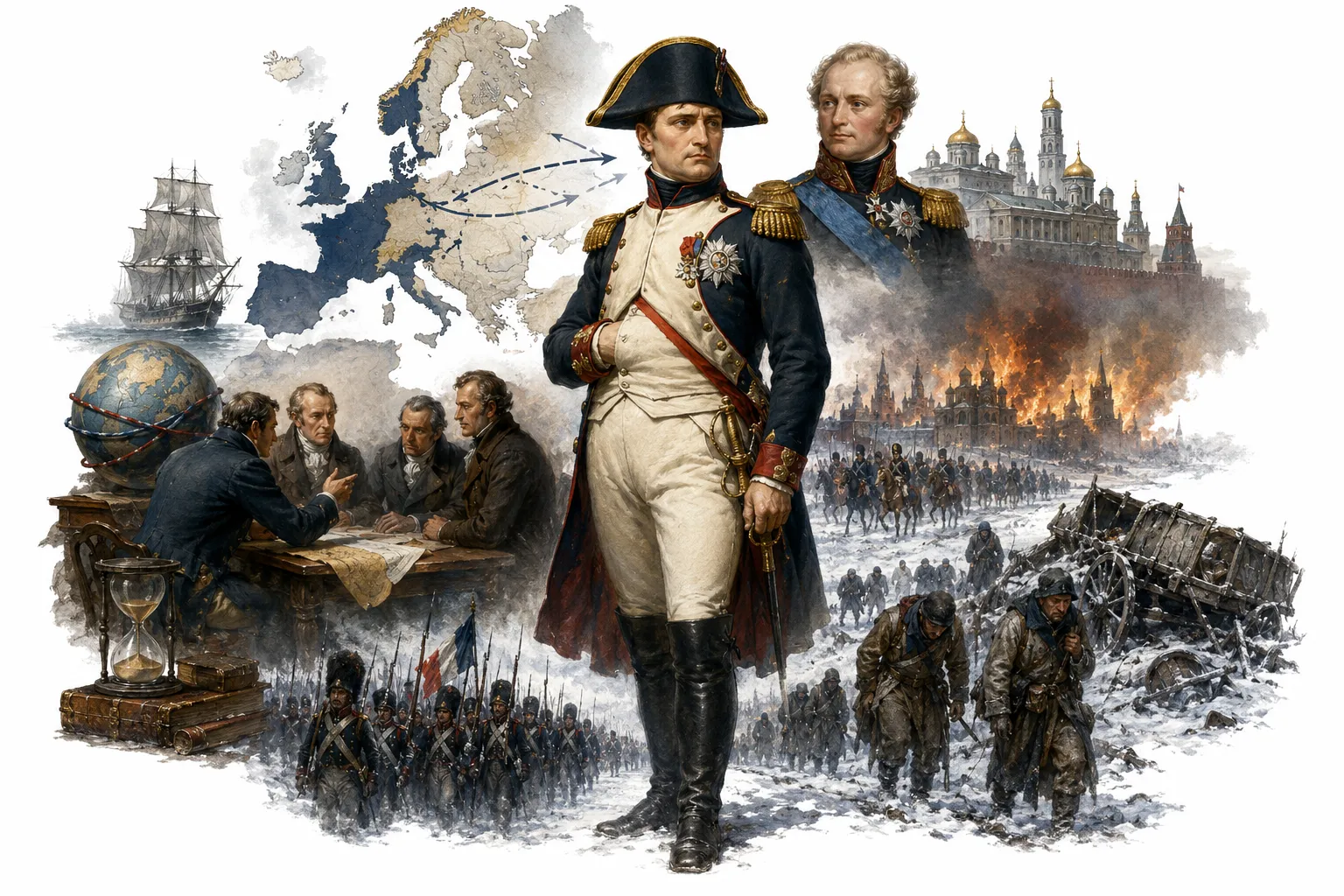
Napoleon reached Moscow in September. The city was on fire. Someone, probably the Russians, had set it ablaze.
He waited in Moscow for five weeks for a surrender that never came.
The retreat began in October. By November, winter had arrived with a vengeance.
Visual answer
The Destruction of Napoleon's Grand Army
How 600,000 men became 10,000.
June 1812
Napoleon crosses the Niemen River with 600,000 men.
Summer
The Russian army retreats. Heat, disease, and hunger reduce Napoleon's army to 160,000.
September 7
The Battle of Borodino. Bloody stalemate. Napoleon loses 30,000 more.
September 14
Napoleon enters Moscow. The city is on fire. He waits for surrender.
October 19
Napoleon orders retreat. Winter is coming.
November-December
The retreat through snow and ice. Russian attacks. Starvation. Freezing. Barely 10,000 survive.
Story in brief
Story in Brief
1806
Napoleon establishes the Continental System, a blockade to cripple Britain.
1810
Tsar Alexander I withdraws from the Continental System.
Napoleon saw this as treason. He decided to punish Russia.
June 24, 1812
Napoleon invades Russia with 600,000 men.
August-September
The Russian army retreats east, burning everything behind them.
Napoleon's army found no food, no shelter, and no rest.
September 7, 1812
The Battle of Borodino. Over 70,000 casualties. Bloodiest day of the Napoleonic Wars.
September 14, 1812
Napoleon enters Moscow. The city is burning.
October 19, 1812
Napoleon orders retreat. Winter arrives early.
Temperatures dropped to -30 degrees Celsius. Horses froze standing up. Men froze in their sleep.
December 1812
Napoleon abandons his army and races back to Paris. Barely 10,000 men follow.
The Story
How the Snow Saved Russia
Napoleon had conquered most of Europe. He had defeated Austria, Prussia, and Russia before. He thought he could do it again. He was wrong.
The Russian army refused to fight. They retreated. They burned their own farms, their own villages, their own crops. Napoleon's army advanced through a wasteland. There was no food for his men. There was no hay for his horses. The summer heat killed thousands. Dysentery killed thousands more.
By the time Napoleon reached Moscow, his army of 600,000 had been reduced to 100,000. He expected the tsar to surrender. The tsar did not. Napoleon waited in Moscow for five weeks. Then he waited too long. The Russian winter arrived, a month early and twice as brutal as usual. The retreat became a slaughter. Men froze to death in their sleep. Horses died in their tracks. The army collapsed. Napoleon abandoned his men and raced back to Paris. He had lost an empire in the snow.
Famous Quote
"From the sublime to the ridiculous is but a step."
, Napoleon Bonaparte
He said this after the retreat from Moscow. The 'sublime' was his invasion. The 'ridiculous' was what remained of his army.
Evidence
Why the Invasion Failed
The Russian strategy of scorched earth denied Napoleon food and supplies.
StrongThe Russian army refused to give battle, denying Napoleon a decisive victory.
StrongThe winter of 1812 was unusually early and unusually severe.
StrongNapoleon's supply lines were too long and too vulnerable.
StrongKey Points
Key Points So Far
Napoleon invaded Russia to force it back into his blockade against Britain.
The Russian army retreated and burned everything behind them.
Napoleon reached Moscow but found it abandoned and on fire.
He waited too long for a surrender that never came.
The winter retreat destroyed his army. Only 10,000 of 600,000 survived.
Analogy
Like Walking into a Giant Freezer
The familiar part
Imagine walking into a walk-in freezer wearing a summer shirt. You think you will be in and out quickly. Then the door locks behind you.
How it applies
Napoleon walked into Russia in summer clothes. He thought the campaign would last a few weeks. The door locked behind him. He could not get out. The freezer was Russia. The temperature was minus 30.
Where the analogy breaks
Walk-in freezers do not have Cossacks attacking you with sabers. Russia did.
Curiosity Notes
Details Most People Miss
Why this still matters
Why This Still Matters
The invasion of Russia is still studied in military academies as the ultimate example of overreach. Napoleon had everything: the best army in Europe, a brilliant mind, and a track record of victory. He lost because he underestimated his enemy and ignored logistics. An army marches on its stomach. Napoleon's army marched on empty stomachs through the snow. That is a lesson that never gets old.
Key Findings
- ✓Core findingNapoleon invaded Russia in 1812 to enforce his blockade against Britain.
- ✓Strong evidenceThe Russian army retreated and used scorched earth tactics.
- ⚠Main consequenceNapoleon reached Moscow but found it abandoned and burning.
- ✓Wider legacyThe brutal winter of 1812 destroyed his army during the retreat.
- ★Bottom lineOf 600,000 men, only about 10,000 survived.
Final insight
A Last Thought
Napoleon invaded Russia because he could not imagine losing. He had won so many battles that defeat seemed impossible. Russia taught him otherwise. The snow did not care about his genius. The cold did not respect his reputation. He marched 600,000 men into the freezer. He marched 10,000 out. The rest stayed, frozen in the Russian soil. That is the price of arrogance. That is the cost of ignoring the weather.
Quick answers
Common questions
How cold was it during the retreat? +
Temperatures dropped to -30 degrees Celsius (-22 degrees Fahrenheit). Men froze to death in their sleep. The cold was so intense that soldiers who stopped to rest never got up again.
Why didn't Napoleon wait until spring? +
He could not. His army was already starving in Moscow. The Russians were not going to surrender. Waiting meant his entire army would freeze or starve. He had to retreat. He just waited too long to start.