History

Why Is July 4 Independence Day?

The vote for independence actually happened two days earlier — July 4 just got the better paperwork. Ask most Americans when their country declared independence, and they'll say July 4th without hesitation. Ask a historian the same question, and you'll get a slightly awkward pause, because the vote that actually severed ties with Britain happened on July 2nd. July 4th is the date stamped on the document, not the date of the vote itself. It's a small discrepancy that somehow won out over the historically more accurate option. The story involves a founding father who predicted the wrong date for the holiday, and got the sentiment exactly right anyway.

Quick answer

July 4th is celebrated as Independence Day because that's the date the Declaration of Independence was formally adopted and dated by the Continental Congress, even though the actual vote for independence took place on July 2nd, 1776. John Adams was so certain July 2nd would become the holiday that he wrote his wife predicting fireworks and celebrations on that date — he got the tradition right and the date wrong.
Why Is July 4 Independence Day? hero image

The mystery

The story involves a founding father who predicted the wrong date for the holiday, and got the sentiment exactly right anyway.

The short answer

July 4th is celebrated as Independence Day because that's the date the Declaration of Independence was formally adopted and dated by the Continental Congress, even though the actual vote for independence took place on July 2nd, 1776.

The twist

John Adams was so certain July 2nd would become the holiday that he wrote his wife predicting fireworks and celebrations on that date — he got the tradition right and the date wrong.

Common mistake

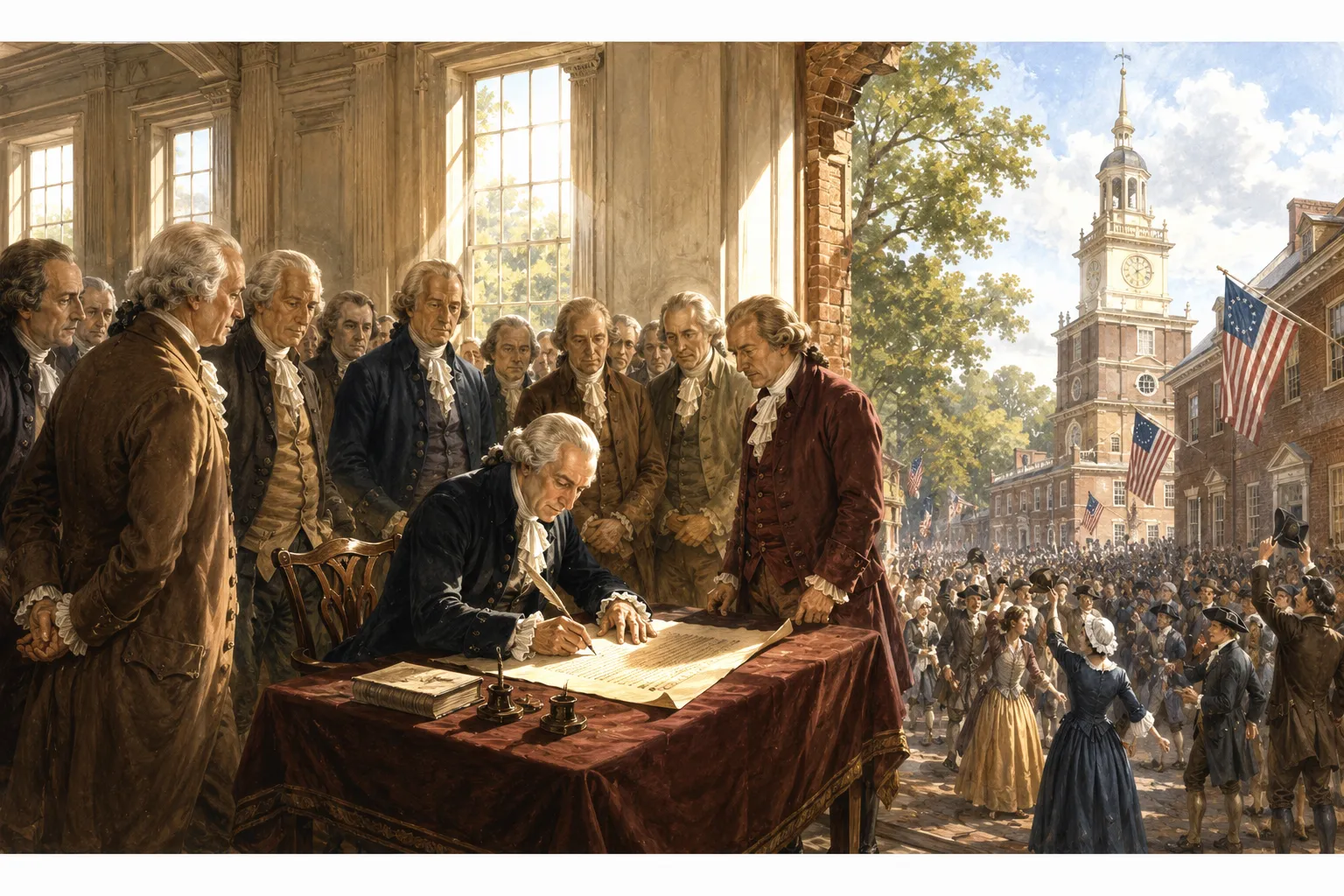
Popular depictions often suggest all signers gathered and signed together on Independence Day itself.

A vote, then a document, then a mix-up

The story of American independence has a vote and a document, and history ended up commemorating the document instead of the vote.

The actual vote: July 2nd

On July 2nd, 1776, the Continental Congress voted to approve a resolution declaring the American colonies independent from Great Britain. This was, in the most literal sense, the moment independence was decided.

John Adams considered this the pivotal date, writing to his wife Abigail that it would be celebrated by future generations with pomp, parades, and fireworks — a prediction that came remarkably true, just attached to the wrong day.

John Adams predicted the entire holiday almost perfectly, and simply picked the wrong date to hang it on.

The document: adopted July 4th

Two days after the vote, on July 4th, Congress formally adopted the text of the Declaration of Independence — the document explaining and justifying the decision already made on the 2nd.

Because the printed copies distributed afterward were dated July 4th, that became the date associated with independence in the public imagination, even though the actual break with Britain had already legally occurred.

Independence happened on the 2nd. The paperwork just happened to be dated the 4th, and paperwork, it turns out, sticks in memory better than votes.

How the date got locked in

Early celebrations were inconsistent, sometimes marking July 2nd, sometimes the 4th. Over subsequent decades, July 4th steadily won out in public celebration and eventually in official recognition.

In 1870, Congress made July 4th a federal holiday, cementing a date that had already won the cultural argument decades earlier, even if the historical argument was always a bit murkier.

By the time it became official, July 4th had already won by popular vote, so to speak, regardless of what actually happened on that day.

How a two-day gap became permanent history

A few practical decisions, made without much fanfare, ended up shaping how an entire nation remembers its founding.

1

01. The vote happened quietly, without fanfare

The July 2nd vote wasn't accompanied by public announcement or celebration, so it left little cultural footprint compared to the document that followed.

2

02. The printed Declaration carried the July 4th date

Because the widely distributed printed copies of the Declaration were dated July 4th, that date became the public-facing symbol of independence.

3

03. Tradition solidified before anyone corrected it

By the time historians clarified the timeline, generations of Americans had already built celebrations, fireworks, and civic identity around July 4th, making a correction largely symbolic rather than practical.

The signatures came even later

Contrary to popular imagination of everyone signing together on July 4th, most delegates actually signed the Declaration over the following weeks and months, with some signatures added as late as November 1776.

The famous image of a unified signing ceremony is largely a product of later artistic interpretation rather than a strictly accurate historical record.

Surprising Declaration of Independence facts

Two signers later became president on the same day
Thomas Jefferson and John Adams, both signers, died on the same day — July 4th, 1826, exactly fifty years after the Declaration's adoption.
The original draft was edited substantially by committee
Jefferson's initial draft went through significant revisions by Congress, including the removal of a passage condemning the slave trade, before reaching its final adopted form.

Did all fifty-six signers sign the Declaration on July 4th?

Myth

Popular depictions often suggest all signers gathered and signed together on Independence Day itself.

Iconic paintings, like John Trumbull's famous depiction, compressed the process into a single dramatic scene, cementing a simplified version of events in public memory.

Reality

Most signatures were actually collected over the following weeks and months, with the formal signing ceremony most historians point to occurring on August 2nd, 1776.

Most signatures were actually collected over the following weeks and months, with the formal signing ceremony most historians point to occurring on August 2nd, 1776.

Where the July 2nd vs. July 4th confusion still shows up

History textbooks and trivia
Many textbooks note the July 2nd vote as a footnote, while the broader cultural narrative remains fixed on July 4th as the singular moment of independence.
Founding-era letters and diaries
Correspondence from figures like John Adams provides direct evidence of how contemporaries themselves expected the 2nd, not the 4th, to become the historic date.

Why the distinction still matters to historians

Understanding the gap between the vote and the document helps clarify how national narratives can form around symbolic dates rather than strictly the most legally significant moment.

This has become a useful case study in how public memory and formal historical record can diverge, even for a heavily documented event like American independence.

Worth noting

A holiday built on a technicality

July 4th endures as Independence Day not because it was the moment independence was decided, but because it was the moment independence was written down — and written dates, it turns out, are what history remembers best. America didn't declare independence on the 4th of July. It just finished writing about it.

Quick answers

Common questions

Is July 4th also when the Revolutionary War ended?

No — the Revolutionary War continued for years after 1776, formally ending with the Treaty of Paris in 1783.

History

Related questions

Most historians point to August 2nd, 1776, as the date most delegates gathered to sign, with a handful of additional signatures added in the months following.

The founding father who predicted the holiday, wrong date and all

John Adams

A key figure in the push for independence who wrote confidently to his wife Abigail predicting future generations would celebrate the moment with festivities — attaching that prediction to July 2nd rather than the 4th.

Where the July 2nd vs. July 4th confusion still shows up

History textbooks and trivia

Many textbooks note the July 2nd vote as a footnote, while the broader cultural narrative remains fixed on July 4th as the singular moment of independence.

Where the July 2nd vs. July 4th confusion still shows up

Founding-era letters and diaries

Correspondence from figures like John Adams provides direct evidence of how contemporaries themselves expected the 2nd, not the 4th, to become the historic date.

Did all fifty-six signers sign the Declaration on July 4th?

Most signatures were actually collected over the following weeks and months, with the formal signing ceremony most historians point to occurring on August 2nd, 1776.

Most signatures were actually collected over the following weeks and months, with the formal signing ceremony most historians point to occurring on August 2nd, 1776.