1
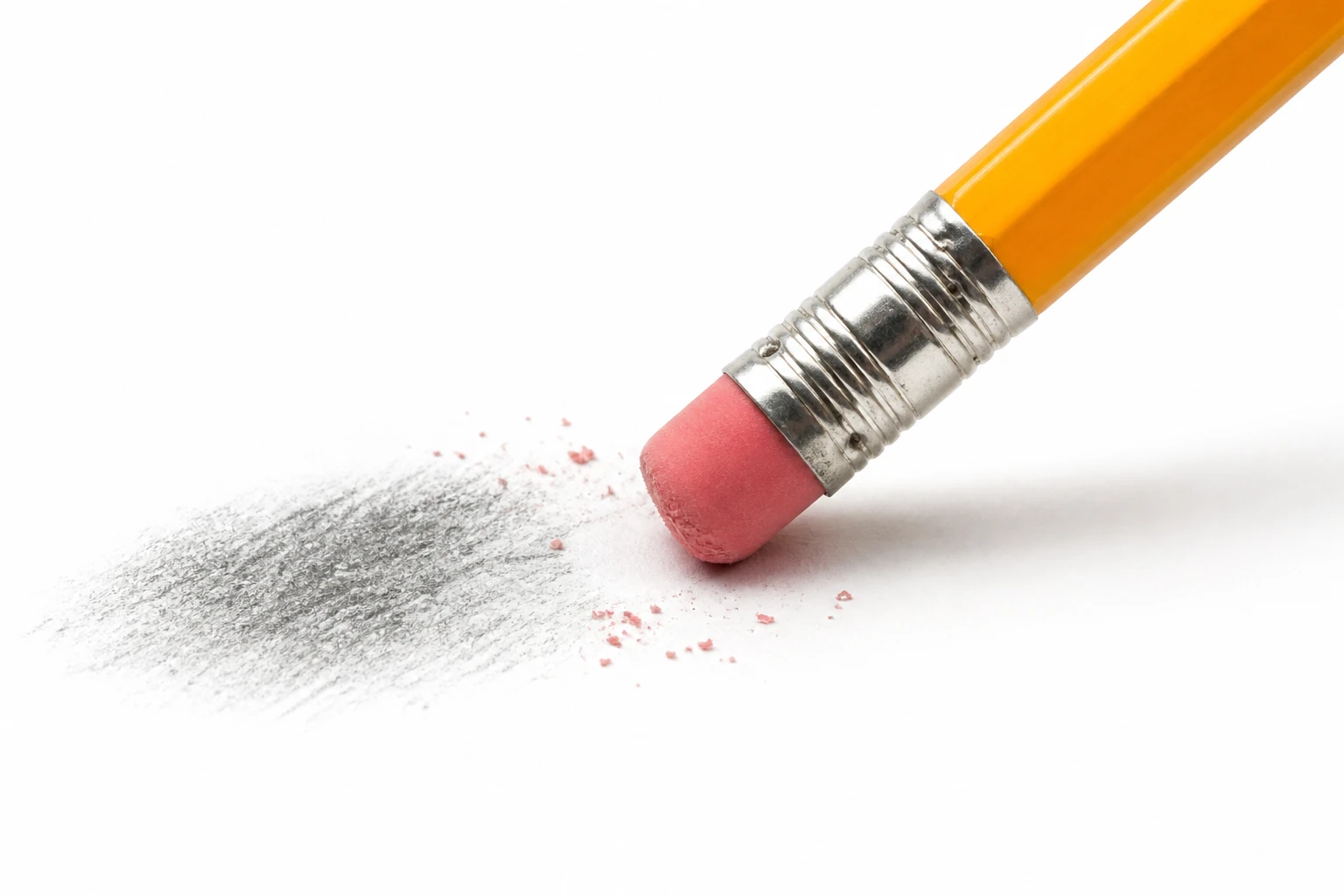
01. Rubber contacts paper surface
The slightly sticky rubber surface makes molecular contact with graphite-bearing paper fibers.
History & Design
A design marriage that was considered obvious once, controversial before that, and is now entirely taken for granted. Pencils and erasers were separate tools for over 200 years before someone thought to attach them. When they finally were combined, the result was so convenient that the idea immediately spread worldwide. It also generated a surprisingly heated patent dispute and was initially banned in France for encouraging sloppiness. The answer involves a 1858 patent, a French educational philosophy, and what rubber has to do with the word eraser.
Quick answer
Pencils have erasers because Hymen Lipman patented the combination in 1858, solving the practical inconvenience of carrying two separate tools. The eraser itself works because rubber is slightly tacky and abrasive enough to physically lift graphite particles from paper's surface texture without dissolving them. Lipman's patent was eventually invalidated by the US Supreme Court in 1875, which ruled that combining two existing items did not constitute a novel invention - making the eraser-pencil combination essentially open to any manufacturer.
The mystery
The answer involves a 1858 patent, a French educational philosophy, and what rubber has to do with the word eraser.
The short answer
Pencils have erasers because Hymen Lipman patented the combination in 1858, solving the practical inconvenience of carrying two separate tools. The eraser itself works because rubber is slightly tacky and abrasive enough to physically lift graphite particles from paper's surface texture without dissolving them.
The twist
Lipman's patent was eventually invalidated by the US Supreme Court in 1875, which ruled that combining two existing items did not constitute a novel invention - making the eraser-pencil combination essentially open to any manufacturer.
Common mistake
The combined pencil eraser seems so obviously useful that it must have been immediately embraced everywhere.
History & Design
High-end pencils are typically intended for art and precision work, where a separate high-quality eraser is preferred over the small, imprecise eraser attached to a pencil.
The inventor of the eraser pencil
A Philadelphia stationer who patented the combined pencil and eraser in 1858, sold the rights for a large sum, and watched his patent eventually declared invalid by the Supreme Court.
Where eraser mechanics matter
Different eraser types are used in technical drawing to selectively remove marks without damaging adjacent lines.
Where eraser mechanics matter
Dry-erase markers use ink that does not penetrate surface pores, allowing removal by a similarly non-chemical, physical wiping mechanism.
Was the pencil eraser always considered a good idea?
It was controversial in educational contexts, banned in France, and legally contested - the obvious idea took time to become universally accepted.
Continue learning