1
01. A particle meets its opposite
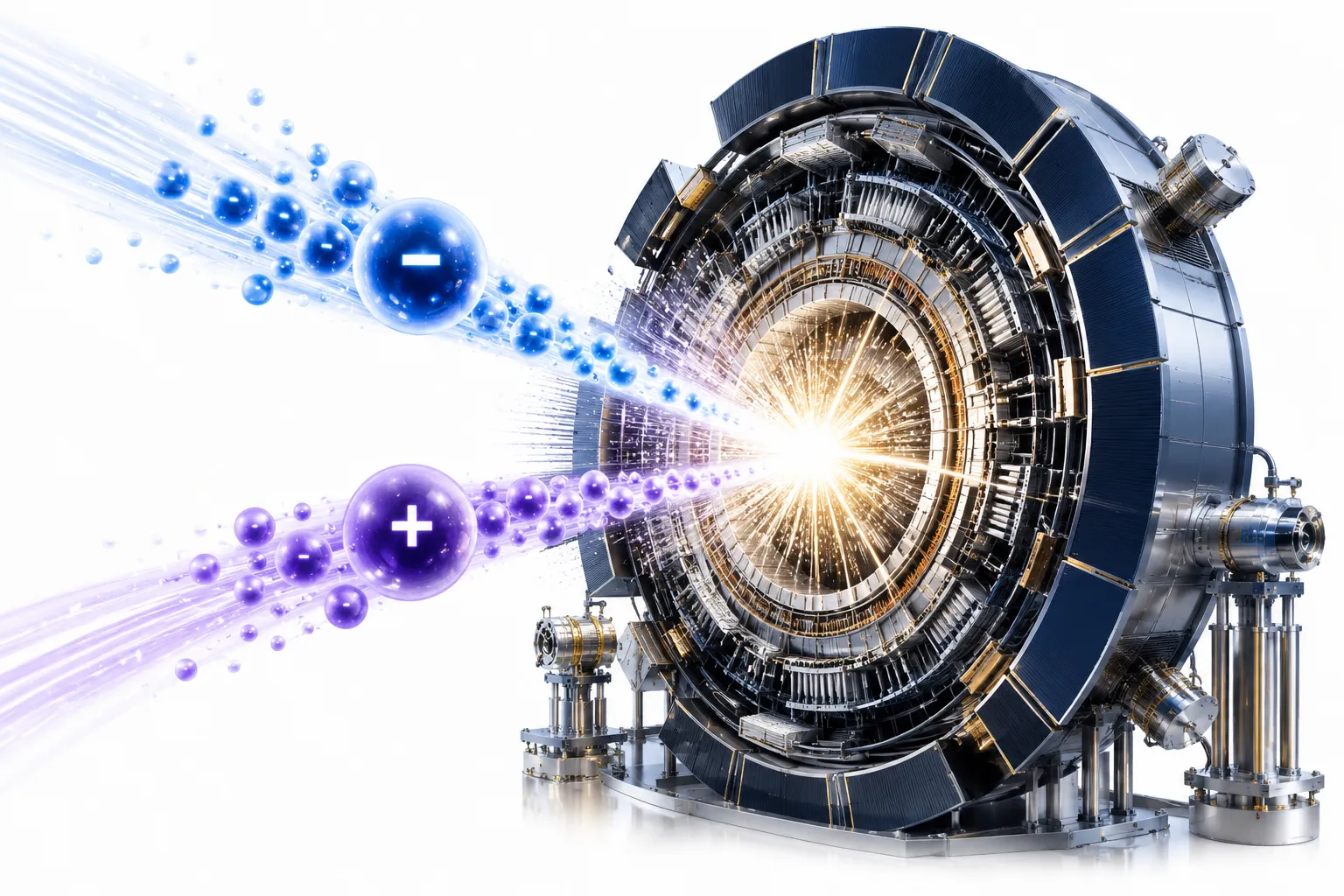
When a matter particle, like an electron, encounters its antimatter counterpart, a positron, the two are drawn together by their opposite charges.
Physics
Yes — and hospitals use it, physicists manufacture it, and the universe is oddly short on it. Antimatter sounds like something a screenwriter invented to justify a spaceship engine. It has the vague menace of a word borrowed from science fiction, which makes its actual, mundane reality somewhat disorienting. Antimatter is real, has been detected since 1932, gets manufactured in laboratories on purpose, and is quietly involved in a medical scan that millions of people undergo every year. The story includes a Caltech physicist, a scan you may have had done at a hospital, and one of the biggest unsolved mysteries in physics.
Quick answer
Antimatter is real. It consists of particles that mirror ordinary matter but carry opposite electric charge, and it has been observed, measured, and even manufactured since the 1930s. The strange part isn't that antimatter exists — it's that there's almost none of it left in the universe, even though physics predicts the Big Bang should have created equal amounts of both.
The mystery
The story includes a Caltech physicist, a scan you may have had done at a hospital, and one of the biggest unsolved mysteries in physics.
The short answer
Antimatter is real. It consists of particles that mirror ordinary matter but carry opposite electric charge, and it has been observed, measured, and even manufactured since the 1930s.
The twist
The strange part isn't that antimatter exists — it's that there's almost none of it left in the universe, even though physics predicts the Big Bang should have created equal amounts of both.
Common mistake
Popular fiction often treats antimatter as an imminent, near-limitless energy or weapons source.
Physics
They would annihilate completely, converting their entire combined mass into an enormous release of energy, far exceeding chemical or even nuclear reactions of the same mass.
The physicist whose equations demanded antimatter
A British theoretical physicist who, while working to reconcile quantum mechanics with relativity, arrived at equations that mathematically required the existence of a positively charged electron counterpart.
Where antimatter shows up in real research
PET scans remain the most widespread practical application of antimatter, used daily in hospitals worldwide to detect cancer and monitor organ function.
Where antimatter shows up in real research
Facilities like CERN produce and trap antimatter specifically to study why the universe ended up with so much more matter than antimatter.
Could antimatter be used as a weapon or fuel source soon?
Current production methods yield such minuscule amounts, at such enormous cost and energy input, that antimatter remains far from practical as fuel or weaponry with existing technology.
Continue learning
Thought Experiments
Another familiar question explained by simple physics.

Philosophy & Thinkers
Another familiar question explained by simple physics.

Science & Discovery
Another familiar question explained by simple physics.