ECONOMIC CONCEPT

What Is the Free Rider Problem? Why People Benefit Without Paying

You listen to public radio. You never donate. You are a free rider. You benefit from the service without contributing to it.

Editorial illustration of a person enjoying a public good while others pay
Creator Classic economic conceptOrigin EconomicsYear ClassicalCategory Economics

QUICK ANSWER

Here is the idea in plain English.

The free rider problem is a situation where people benefit from a shared resource without contributing to it. It occurs with public goods that are non-excludable and non-rivalrous. The problem explains why public goods are often underprovided. The solution is to use taxes, subsidies, or collective action to overcome free riding.

If you remember only a few things, remember these.

The basic move

The free rider problem is simple: you benefit from something without paying for it. You listen to public radio. You do not donate. You are a free rider.

Why it matters

The problem occurs with public goods. Public goods are non-excludable. You cannot stop people from using them. So people do not pay. The good is underprovided.

Use it deliberately

When designing a system, ask: how can I prevent free riding? What incentives will encourage contribution?

CORE IDEA

The concept in its simplest useful form.

What Does the Free Rider Problem Mean in Simple Terms?

The free rider problem is simple: you benefit from something without paying for it. You listen to public radio. You do not donate. You are a free rider.

The problem occurs with public goods. Public goods are non-excludable. You cannot stop people from using them. So people do not pay. The good is underprovided.

The solution is to make people pay. Taxes are the solution. Compel people to contribute.
The small mechanism underneath the big idea.

01

The Story Behind the Free Rider Problem

The free rider problem is one of the oldest problems in economics. It was recognized by economists centuries ago. The problem is simple: if people can benefit from a resource without paying, they will not pay.

The classic example is a public good like a lighthouse. Ships benefit from the lighthouse. But they cannot be excluded. So they do not pay. The lighthouse is underprovided.

The solution is to use taxes or subsidies. Make people pay. The free rider problem is why governments provide public goods.

02

Why the Free Rider Problem Became Famous

The free rider problem became famous because it explains why public goods are underprovided. The problem is central to public economics.

The concept is widely used in economics and public policy.

Today, the free rider problem is a foundational concept in economics.

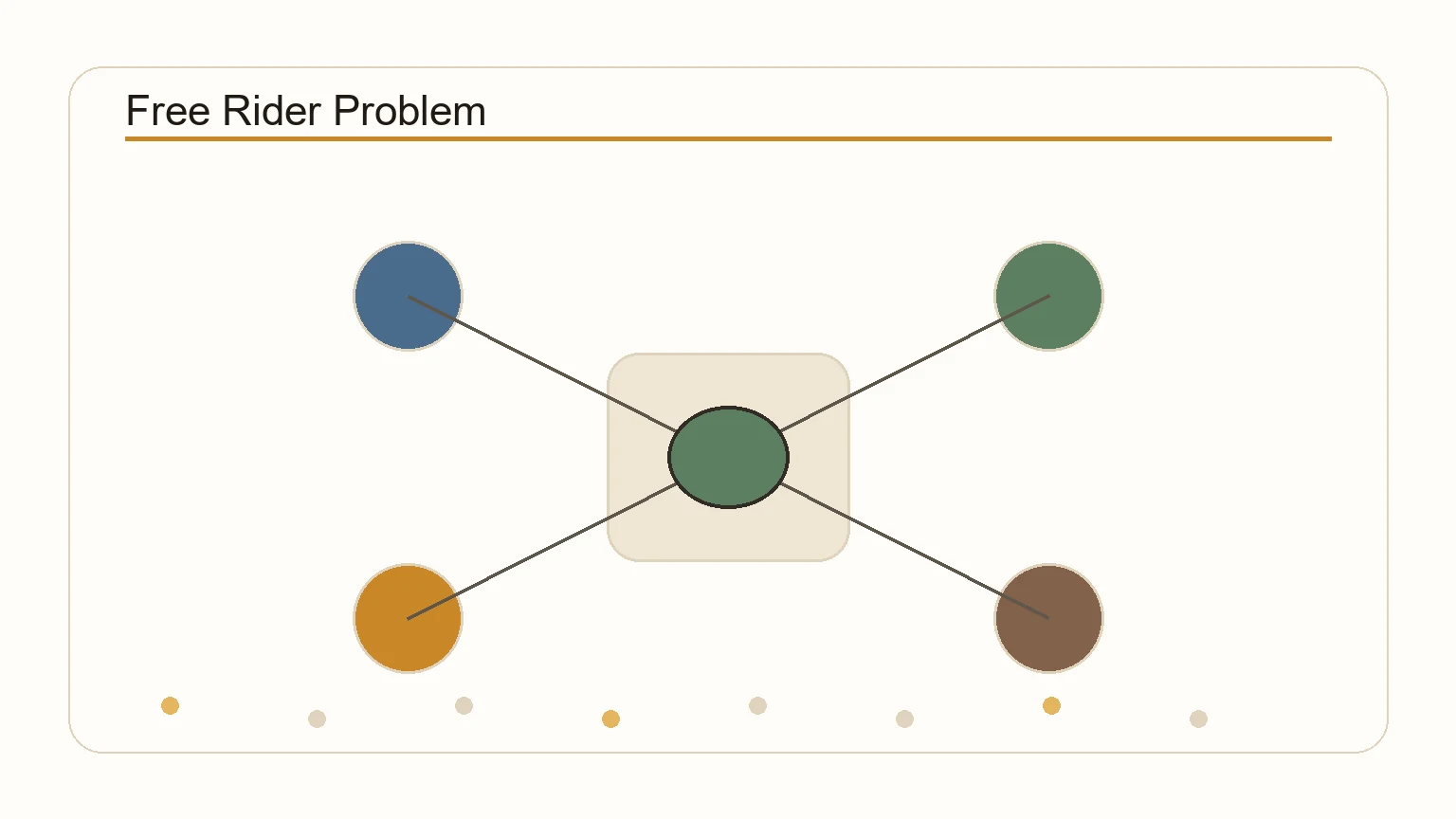
Diagram showing the free rider problem and why public goods are underprovided
A diagram showing how free riders benefit without paying and why public goods are underprovided.

Where this idea shows up outside the textbook.

History

The classic example is a lighthouse. Ships benefit. They do not pay. The lighthouse is underprovided.

Public Radio

People listen to public radio without donating. They are free riders. The station relies on donations.

Open Source

Companies use open-source software without contributing. They are free riders. The software relies on volunteers.

Environment

People benefit from clean air without paying. They are free riders. The environment relies on regulation.

CONCEPT MAP

Every idea has neighbors. This is where the current concept sits in the TinyThat knowledge graph.

Current concept

Free Rider Problem

People benefit from a resource without contributing to it.

What people often get wrong about this idea.

Free riders are bad people.

No. Free riding is rational. People respond to incentives. The problem is structural, not personal.

The free rider problem only applies to public goods.

No. It applies to any situation where people can benefit without paying.

You can eliminate free riding.

You cannot eliminate it. You can only manage it. Taxes, subsidies, and collective action are tools.

Three simple ways to apply the idea without turning it into a slogan.

1

When designing a system, ask: how can I prevent free riding? What incentives will encourage contribution?

When designing a system, ask: how can I prevent free riding? What incentives will encourage contribution?

2

Use taxes, subsidies, and collective action to overcome free riding

Use taxes, subsidies, and collective action to overcome free riding.

3

Be aware of free riding in your own life

Be aware of free riding in your own life. You might be a free rider. Recognize it.

EXPLORE NEXT

The best next ideas to read after this one.

Quick answers to common questions.

What is the free rider problem in simple terms?

You benefit from a resource without paying for it. You are a free rider. The resource is underprovided.

What is an example of the free rider problem?

You listen to public radio without donating. You benefit. You do not pay. You are a free rider.

How do you solve the free rider problem?

Use taxes, subsidies, or collective action. Make people pay. Compel contribution.

Why is the free rider problem a problem?

It leads to underprovision. Public goods are not provided. The collective suffers.