Visual answer
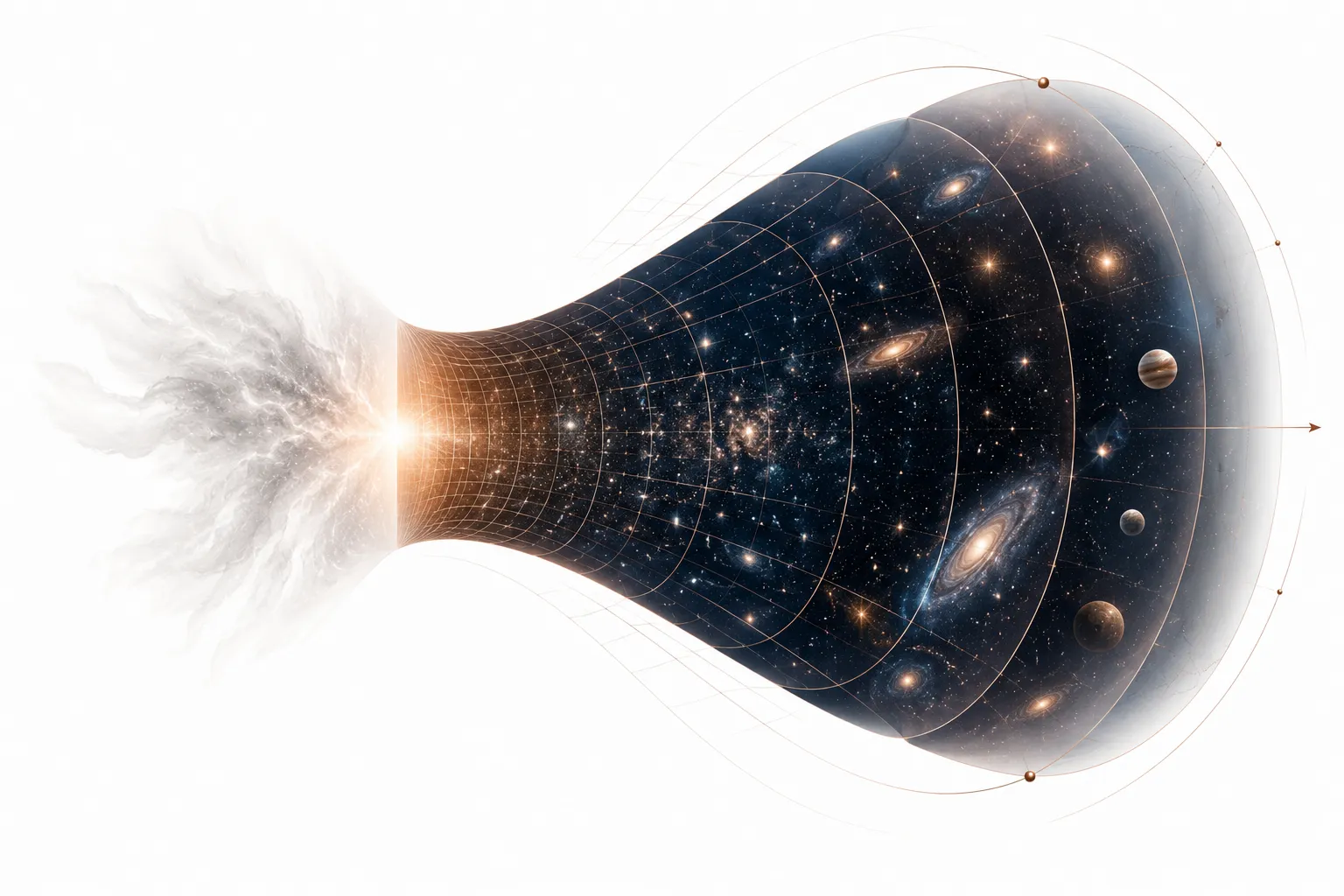
The Entropy Arrow of Time
How entropy's growth creates the experience of time moving forward.
Big Bang minimum entropy
The universe begins in a state of extraordinary order the source of time's arrow.
Entropy increases
Every physical process statistically moves toward higher disorder.
Present higher entropy
Stars, galaxies, planets complex but more disordered than the initial state.
Far future maximum entropy
'Heat death' uniform temperature throughout, no further change possible.
The Verdict
Verdict
The laws of physics allow time reversal entropy makes it extraordinarily improbable
The equations of Newtonian mechanics, electromagnetism, quantum mechanics, and general relativity are all time-symmetric: reverse the time variable and the equations still hold. A movie of fundamental particle interactions played backward is physically valid. But macroscopic processes smashing glasses, burning wood, aging are governed by thermodynamics, and the Second Law (entropy increases) gives time its direction. This isn't a law that forbids backward time; it's a law about probability. A shattered glass could spontaneously reassemble it's just so astronomically improbable that you will never see it.
Useful analogy
Imagine a room full of gas molecules all crowded into one corner. Nothing forbids them from all moving back there but with 10²³ molecules moving randomly, the probability of that happening spontaneously is so small it would take longer than the age of the universe to expect it once.
The catch
The deepest puzzle isn't why entropy increases that follows from statistics. It's why entropy was so incredibly low at the Big Bang. The universe's initial state was extraordinarily ordered, and we don't know why. That initial condition is what gives time its direction.
Entropy Explained
What Entropy Actually Is and Why It's the Arrow of Time
Entropy is often described as 'disorder,' but more precisely it measures the number of ways a system can be arranged while looking the same from the outside. A neat pile of sand has fewer possible microscopic arrangements than a spread-out pile it has lower entropy. A broken egg has more possible arrangements than an intact one.
The Second Law of Thermodynamics says that in a closed system, entropy never spontaneously decreases. Not because any physical law forbids it, but because the overwhelming majority of possible futures involve higher entropy. When you start in a low-entropy state, almost every path forward leads to higher disorder.
This is why you remember the past and not the future your memories are low-entropy records that required energy and order to create. It's why causes precede effects. It's why you age. Every manifestation of time's arrow traces back to entropy, which traces back to the universe's astonishingly low-entropy beginning.
The Myth
"Time Moving Backward Is Forbidden by Physics"
What people think
The intuition that physics itself mandates time flows forward
It feels like time moving backward would break fundamental laws that physics has a built-in arrow pointing from past to future.
What actually happens
Physics is almost perfectly time-symmetric the arrow comes from statistics, not law
With one tiny exception (CP violation in weak nuclear interactions, discovered 1964), fundamental physics equations are fully reversible. A film of particle collisions played backward is indistinguishable from a valid forward interaction. The arrow of time is an emergent, statistical consequence of the universe's initial state not a fundamental law.
What If It Could?
What Would Time Running Backward Actually Look Like?
Imagine this
Imagine a region of spacetime where entropy genuinely ran backward where the statistical arrow of time pointed the other way.
What would happen
Broken objects would spontaneously reassemble. Heat would flow from cold to hot. Memories would form of the future and fade for the past. Causes would follow effects. Life would un-age. The physics equations would all still work but every intuition you have about causality, memory, and experience would be inverted.
Why this matters
Some cosmologists (Julian Barbour, Sean Carroll) have proposed models where the universe may have a two-branched structure time flowing 'forward' in both directions from the Big Bang's low-entropy beginning, like two arrows pointing away from a single nock. Beings in the other branch would experience their time as flowing normally toward what we'd call the past.
Quick answers
Common questions
Final insight
Time's Arrow Is an Accident of Our Beginning
The fact that time runs forward isn't written into the laws of the universe. It's a consequence of the universe beginning in an extraordinarily unlikely, low-entropy state and then statistically evolving toward disorder. Every experience you have of time's flow every memory, every anticipation, every sense of cause and effect traces back to that singular initial improbability. The arrow of time is real, but it's borrowed from the Big Bang.
Quick answers
Common questions
Is time actually a dimension like space? +
In relativity, yes time is the fourth dimension of spacetime. But it's not quite like the spatial dimensions: you can move freely in any spatial direction, but you're constrained to move in one temporal direction. This asymmetry is exactly the puzzle of the arrow of time.