Visual answer
From Watching to Yawning: What Happens in the Brain
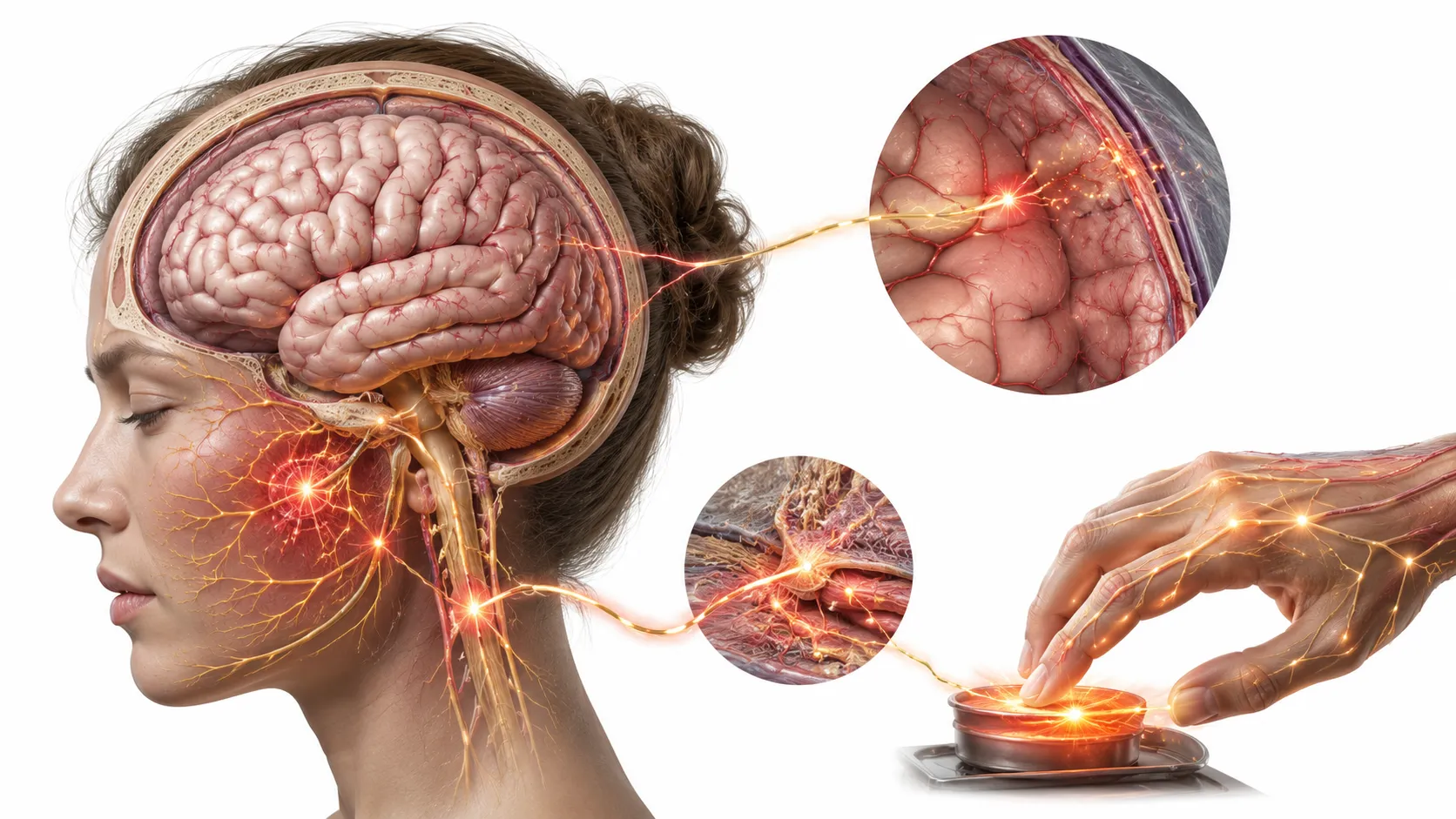
A chain of events runs from your eyes seeing a yawn to your body producing one.
Visual signal detected
Your eyes see a jaw open wide. The superior temporal sulcus in your brain processes this biological motion.
Mirror network activates
The signal reaches the inferior frontal gyrus, part of the mirror neuron network. It fires as if you were doing the yawning yourself.
Motor plan triggered
Your brain builds a motor plan to imitate the action, even before you're conscious of it happening.
You yawn
The plan runs: your jaw drops, your lungs fill, and you've caught the yawn, sometimes despite trying to suppress it.
Real reason
Your Brain Simulates What It Sees
In a 2013 fMRI study, volunteers watched videos of people yawning, laughing, or holding neutral expressions. When they caught a yawn, brain scans lit up in the inferior frontal gyrus, part of the region associated with mirror neurons. Laughing or neutral faces didn't trigger the same response.
Mirror neurons are brain cells that activate both when you perform an action and when you watch someone else do it. The idea is that watching a yawn triggers a kind of internal simulation of the yawn, your brain runs through the motor program for yawning even before your body executes it.
You don't need to see it. Reading the word 'yawn' or imagining one can be enough. That's how strong the social mirroring system is. It's also why it's so hard to suppress a contagious yawn once it starts, by the time you notice it, the process is already running.
Myth vs reality
Myth vs Reality
What people think
You only catch yawns from people you know
Closeness does increase it, you're more likely to catch a yawn from a family member than a stranger. But strangers' yawns are contagious too. And you can catch a yawn from a drawing, a photo, or a sentence describing one.
What actually happens
It's social mirroring, not just familiarity
Contagious yawning is linked to social synchronization, behaviors that help groups stay in sync. It's more powerful with people you're close to, but it's not limited to them. Even reading the word 'yawn' can trigger one because your brain's imitation system is that sensitive.
Common triggers
What Can Trigger a Contagious Yawn
Seeing someone yawn
Strongest trigger, the visual motion of a jaw opening activates mirror networks directly
Hearing a yawn
Audio alone is enough to set off the mirroring response
Reading or thinking about yawning
Even abstract representation activates the imitation system, as you may be discovering right now
Quick answers
Common questions
Does not yawning when others do mean I lack empathy? +
Not necessarily. Research has shown that susceptibility to contagious yawning varies a lot between individuals and is stable over time, but it doesn't reliably track overall empathy levels. Some people just yawn less contagiously.
Why does trying to stop a yawn make it worse? +
By the time you try to stop it, the motor plan is already running. Focusing on it may actually reinforce the signal. Some people manage to redirect it, but fighting a mid-yawn usually just slows it down.
Can animals catch yawns from humans? +
Dogs seem to catch yawns from their owners, and some research shows they catch them from strangers too. Chimpanzees also show contagious yawning. It appears most common in social mammals.
At what age do kids start catching yawns? +
Contagious yawning typically doesn't show up in children until around age 4 or 5. This lines up with when kids develop theory of mind, the ability to understand that others have their own thoughts and feelings.
Is yawning actually contagious over video call? +
Yes, seeing a yawn on a screen is enough. The visual stimulus is the same; your mirror system doesn't require the person to be in the room with you.
Why is yawning contagious but sneezing isn't? +
Sneezing is triggered by physical irritation of nasal nerves, it's a reflex, not a social signal. Yawning has a social layer that sneezing doesn't. There's no social mirroring system that makes people sneeze when they see a sneeze.