Visual answer
How the Pilomotor Response Creates Goosebumps
From nerve signal to arrector pili contraction to hair standing up.
Sympathetic nervous system fires
Cold, fear, awe, music, or adrenaline activates your sympathetic nervous system, the same automatic system behind fight-or-flight responses.
Norepinephrine released
The chemical norepinephrine is released near hair follicles. This is the signal that starts the pilomotor response.
Arrector pili muscles pull
Each arrector pili muscle contracts. These are the tiny muscles that make hairs stand up.
Bump forms at surface
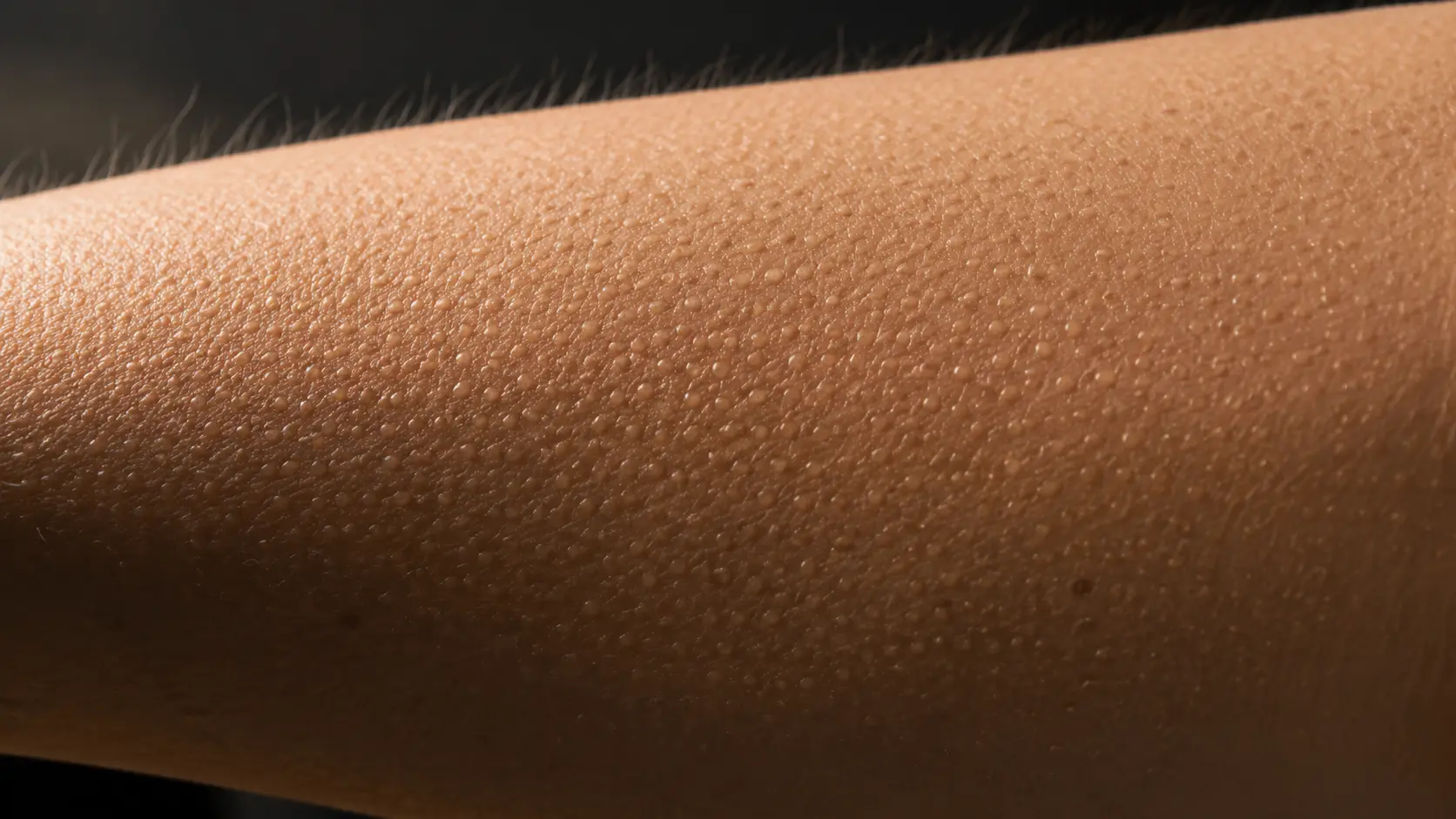
The follicle and nearby skin are tugged upward, forming the visible bump. In furry animals, the raised hair also puffs the coat.
Real reason
Tiny Muscles Are Pulling Your Hair Upright
The hidden actor is the arrector pili muscle. Every hair follicle has one of these tiny smooth muscles attached to it. You cannot control it directly, because it is wired into the autonomic nervous system rather than the voluntary muscles you use to move your arms or legs.
When your sympathetic nervous system switches on, it releases norepinephrine near those follicles. The arrector pili muscles contract. That contraction pulls the hair shaft more upright and tugs the surrounding skin into a small raised bump.
This whole reflex is called the pilomotor response or piloerection. It is the same basic mechanism behind the phrase 'the hairs on the back of my neck stood up.' The hair is not choosing to rise. A tiny muscle is pulling it.
For our distant ancestors who had much more body hair, this served two functions: puffed-up fur trapped more warm air against the skin in the cold, and made the animal look larger and more threatening to a predator. Humans do not have enough body hair for either effect to matter much anymore, but the reflex stayed because it is attached to a nervous system we still need.
Myth vs reality
Myth vs Reality
What people think
Goosebumps mean your hair is growing
Because goosebumps happen around hair follicles, it is easy to imagine the bump is a sign of hair growth. But the visible bump is immediate muscle contraction, not new hair appearing.
What actually happens
Goosebumps are a muscle reflex around existing hair follicles
The arrector pili muscles contract around hairs you already have. Some research suggests repeated cold-triggered activation can influence hair follicle stem cells over time, but a goosebump itself does not make a hair grow in that moment.
Triggers
What Triggers the Pilomotor Response
Cold temperature
Skin temperature sensors detect cold, and the sympathetic system activates the arrector pili muscles. In furry animals, raised hair helps trap insulating air.
Fear or threat
Adrenaline and sympathetic nerve signals prepare the body for danger. Raised hair once helped animals look larger.
Powerful music or emotional moments
Awe, suspense, memory, or musical release can activate the same arousal pathway even without cold or danger.
Hair standing up
The hairs stand up because arrector pili muscles pull on follicles. The muscles are tiny, involuntary, and attached at the base of individual hairs.
Quick answers
Common questions
What muscle causes goosebumps? +
The arrector pili muscle causes goosebumps. Each one is a tiny smooth muscle attached to a hair follicle. When it contracts, it pulls the hair upright and creates a small bump in the surrounding skin.
What is the pilomotor response? +
The pilomotor response is the automatic reflex that makes hairs stand up and creates goosebumps. It is also called piloerection and is controlled by the sympathetic nervous system.
Why do I get goosebumps from music? +
Strong emotional arousal, awe, beauty, tension, release, activates the sympathetic nervous system just like cold or fear does. The arrector pili muscles respond to the same signal regardless of the cause.
Do goosebumps serve any useful purpose in humans? +
In humans with little body hair, not really. The warming and intimidation effects that worked for our furry ancestors don't apply. Some researchers suggest the arrector pili muscles may play a role in hair follicle stem cell activation, but this is still being studied.
Can you get goosebumps voluntarily? +
Most people cannot. The arrector pili muscles are controlled by the sympathetic nervous system, which is involuntary. A small number of people report being able to trigger them deliberately, but this is rare.
Why do the hairs on the back of my neck stand up when I'm scared? +
The same mechanism, arrector pili contracting. The back of the neck is one of the more sensitive and noticeable areas. In animals, a raised neck mane is a clear threat signal. The nerve connections in that area are particularly strong.
Is it true goosebumps can help grow hair? +
Not in the instant, everyday sense. A goosebump does not make a hair grow on the spot. Research from NIH-funded scientists at Harvard found that cold-induced goosebumps may help stimulate stem cells in hair follicles over time, but this is a secondary biological link, not the main reason goosebumps evolved.
Why do goosebumps go away on their own? +
Once the sympathetic nervous system stimulus passes, the cold warms up, the fear subsides, the song ends, the chemical signal fades and the arrector pili muscles relax, letting the hairs lie back down.