The retina is part of the central nervous system. Looking into someone's eye with an ophthalmoscope is the only place in medicine where you can directly observe living brain tissue.
Body & Brain
How does the human eye work?
How the Eye Works
Right now, there is a hole in your field of vision. A real hole, where you are completely blind. You have never noticed it, and you will not be able to notice it after reading this sentence, even knowing it is there.
On this page
The short answer
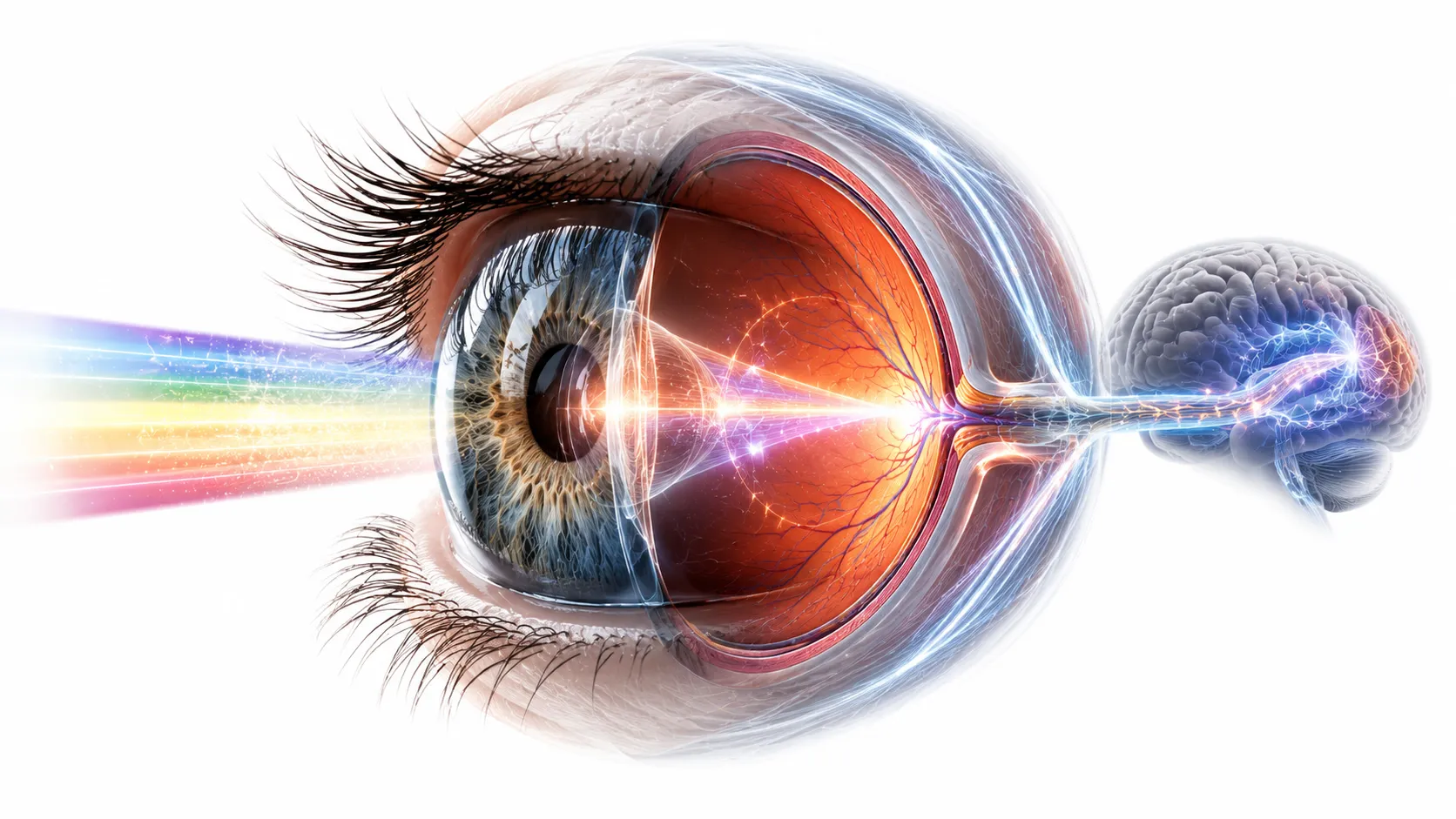
The eye works by focusing incoming light onto the retina through the cornea and lens, where photoreceptor cells convert light into electrical signals that the brain processes into the experience of vision.
Light enters through the cornea, which provides about two-thirds of the eye's focusing power, passes through the pupil, crosses the lens, which fine-tunes focus for distance, and lands on the retina. The retina contains approximately 120 million rod cells, which detect light levels and motion, and about six million cone cells, which detect color at high resolution. These photoreceptors convert photons into electrochemical signals via a cascade involving photosensitive pigments. The signals travel through the optic nerve to the visual cortex, where the actual experience of seeing is constructed.
At a glance
The eye's front structures create a focused image on the retina.
You see the world in high resolution everywhere in your visual field.
The retina is technically part of the brain, not the eye. It is a piece of neural tissue that migrated outward during embryonic development to take up residence behind the eyeball.
Imagine a camera that was partly designed by committee, partly evolved under time pressure, has a significant manufacturing flaw that creates a permanent blind spot, and yet produces images good enough to navigate the world with extraordinary precision.
Behind the science
The story behind it
The Discovery of the Blind Spot
The blind spot was discovered by Edme Mariotte in 1660. He demonstrated it to King Charles II of England, and the two reportedly entertained themselves at court by positioning people so that their blind spots landed exactly where another person's head appeared, making heads vanish and reappear.
It was the first experimental demonstration that the subjective experience of an unbroken visual field is a neural construction rather than a direct recording.
The greatest optical illusion is not a trick image. It is the continuous seamless visual world you have been experiencing your entire life.
George Wald's photopigment biochemistry, 1950s and 1960s
Wald identified the molecular mechanisms of phototransduction, showing how the photosensitive pigment rhodopsin changes shape when it absorbs a photon and triggers the electrical cascade that becomes a visual signal.
A single molecule changing its three-dimensional shape in response to a single photon can initiate a cascade that amplifies the signal hundreds of thousands of times. Wald received the Nobel Prize in 1967.
Diagram
How the Eye Works: the idea in one diagram
Vision begins with optics but ends as interpretation: the eye focuses light, the retina converts it into neural signals, and the brain edits those signals into a stable visual world.
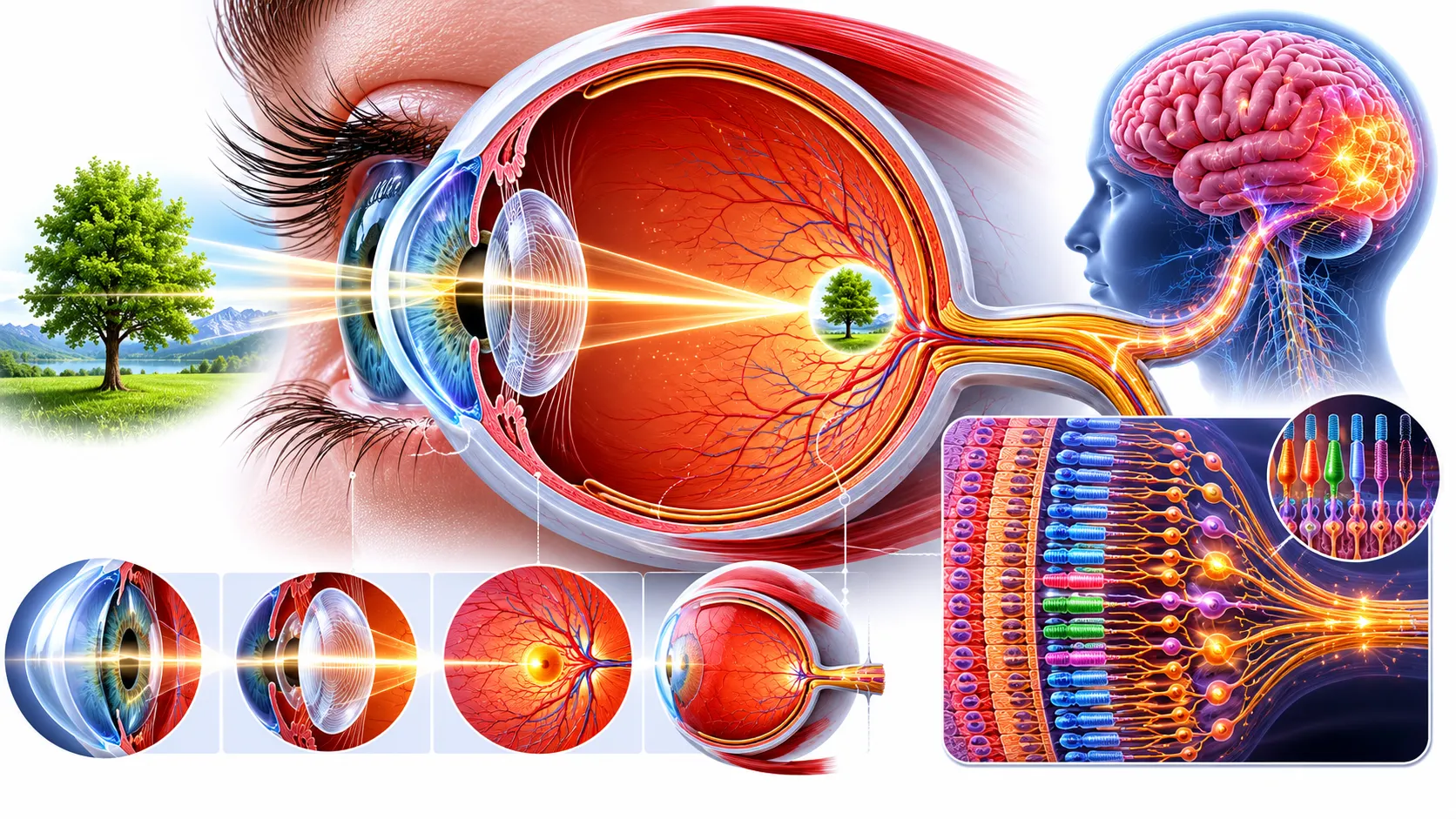
- 1Light is focused
The eye's front structures create a focused image on the retina.
- 2Photoreceptors convert photons
The retina translates light into neural code.
- 3The brain constructs the scene
Seeing is constructed, not simply recorded.
How it works
The mechanism
Vision begins with optics but ends as interpretation: the eye focuses light, the retina converts it into neural signals, and the brain edits those signals into a stable visual world.
- Step 01
Light is focused
The cornea bends most incoming light, the pupil controls how much enters, and the lens fine-tunes focus for distance.
A two-part biological camera lens.
The eye's front structures create a focused image on the retina.
- Step 02
Photoreceptors convert photons
Rods and cones turn light into electrochemical signals through photosensitive pigments.
Solar panels turning light into usable electrical information.
The retina translates light into neural code.
- Step 03
The brain constructs the scene
Signals travel through the optic nerve to visual cortex, where the brain flips, fills, stabilizes and interprets the image.
A live editor assembling a coherent broadcast from imperfect footage.
Seeing is constructed, not simply recorded.
Surprises
Facts worth sitting with
The retina is part of the central nervous system. Looking into someone's eye with an ophthalmoscope is the only place in medicine where you can directly observe living brain tissue.
Surprising facts
What seems backwards
Worth comparing
In everyday life
Easy to get wrong
Pressure points
Where the simple answer gets interesting
Where exactly is the blind spot, and why do you never notice it?
The blind spot is where the optic nerve exits the eye, approximately 15 degrees to the nasal side of your central vision in each eye. There are no photoreceptors here at all. You do not notice it because the brain fills in the gap using surrounding visual information, a process so automatic and complete that the filled-in area is indistinguishable from genuine perception.
There is a region of your visual field where you are completely blind right now, and your brain has been quietly lying to you about it your entire life.
How can the eye detect a single photon?
Under ideal dark-adapted conditions, a single photon is sufficient to trigger a rod photoreceptor. The phototransduction cascade inside the rod cell amplifies the single-photon signal hundreds of thousands of times before it exits the cell. Conscious perception of a single photon is rare because the brain filters out lone photon events as probable noise.
The eye's hardware is sensitive enough to detect a single quantum of light. It is the brain's quality control that prevents this sensitivity from flooding consciousness with noise.
Why do some people see colors differently?
Color vision depends on three types of cones sensitive to different wavelength ranges. Color blindness usually involves a mutation in the gene encoding one of these cone pigments, causing that cone type to be absent or shifted in sensitivity. Because the genes for red and green cone pigments sit on the X chromosome, color blindness is far more common in males.
Color vision is a genetic variable. Some women carry four distinct cone types rather than three and may be tetrachromats, experiencing a richer color space than the rest of the human population.
Clarify
Myth and reality
Myth
You see the world in high resolution everywhere in your visual field.
Reality
Only the central two to three degrees of vision are in high resolution. Beyond this the image degrades rapidly. The brain creates the subjective experience of sharpness across the whole field by rapidly moving the fovea and reconstructing a false composite from memory.
Evidence
Vision tests measuring acuity at increasing eccentricities from the fovea show dramatic resolution loss within a few degrees of center.
Myth
The eye works like a camera.
Reality
A camera records passively. The eye predicts, selects, fills in, and actively constructs the visual scene. It is less a camera than a hypothesis-generating machine that uses incoming light to confirm or update its model of the world.
Evidence
Numerous visual illusions demonstrate cases where the brain's predictive model overrides incoming sensory data.
Looking closer
The deeper pattern
The eye's imperfections, the blind spot, the inverted image, the tiny high-resolution patch surrounded by a blurry periphery, are all actively concealed from conscious awareness by the brain's visual processing system.
One way to think about it
Vision is not a report on reality. It is a sales presentation. The brain curates, fills in, smooths over, and presents a version of the world designed to be navigable rather than accurate.
What you see and what is there are always slightly different. The brain has made the decision on your behalf that the approximation is good enough.
Limits
Where the explanation bends
Tetrachromacy: four cone types instead of three.
Some women carry a fourth cone gene, typically a shifted version of the red or green cone, producing four distinct spectral sensitivity curves. Behavioral testing suggests some can distinguish color differences invisible to trichromats.
It suggests that normal color vision represents only one point on a spectrum of possible color experience.
In daily life
What this helps you notice
Understanding that your visual experience is a brain construction rather than a direct recording has practical consequences for eyewitness testimony, design, and any discipline that depends on people accurately reporting what they saw.
The unreliability of eyewitness testimony in criminal cases is partly a visual neuroscience problem: humans confidently report seeing things that the visual system reconstructed from context rather than directly perceived.
Remember
Key takeaways
- 1
The retina is part of the brain, the only brain tissue visible from outside the body.
- 2
The eye produces an inverted, reversed, low-resolution image that the brain silently corrects.
- 3
You have a genuine blind spot in each eye that the brain fills in from surrounding information.
- 4
You are briefly blind during every eye movement, and the brain suppresses your awareness of this.
- 5
Some women may have four cone types and experience a dimension of color others literally cannot perceive.
Vision is less about what the eye captures and more about what the brain decides to present. The eye is an input device. Seeing is an editorial process.
Somewhere in your visual field right now, there is a hole. The brain has been filling it in since you were born. It is doing it as you read this sentence. You will never catch it in the act.
Read around the idea
More questions with the same curious pull
Nearby doors from the TinyThat archive, chosen by topic, intent, and reader curiosity.
Body & Brain
Can an Eye Be Donated?
Parts of the eye can be donated, though not the whole eye for transplant.
Body & Brain
Can the Brain Feel Pain?
The brain controls all pain in your body, yet it cannot feel pain itself. Discover why, and what this strange fact re...
Body & Brain
Does Your Brain Eat Itself?
Your brain really does consume parts of itself. Learn about autophagy, synaptic pruning, and why self-consumption is...