When woken during REM sleep, even people who claim to never dream almost universally report ongoing dream experiences in the moment of waking.
Body & Brain
Does every person dream?
Does Everyone Dream?
About one in twenty people will tell you they simply do not dream. Never have. They go to sleep, they wake up, and the night is a blank. Science has been studying these people with considerable interest.

On this page
The short answer
Almost certainly yes, everyone with a healthy brain dreams during REM sleep. The roughly five percent of people who report never dreaming almost certainly dream but have no memory of it.
REM sleep, the stage where dreaming is most vivid and complex, is a universal feature of human sleep architecture. Brain scans during REM sleep show the same activity patterns in people who report dreaming and in people who report they never dream. The difference lies in the memory encoding process that transfers dream content from the short-term experience of sleep into waking recall.
At a glance
Dreaming can happen even if no memory survives.
If you cannot remember your dreams, you are not dreaming.
Dream recall is not a passive process of memory storage. It is an active process that can be suppressed, damaged, and in some cases, entirely absent even in people with completely normal sleep.
Imagine living in a house where a room fills with vivid, complex events every night, but every morning the door is sealed and the events erased before you wake up. The events happened. You simply have no access to them.
Behind the science
The story behind it
Charcot-Wilbrand Syndrome: The Patient Who Lost Dreams
Jean-Martin Charcot and Hermann Wilbrand each described patients in the late 19th century who, following strokes or other brain injuries, completely lost the ability to dream. Modern neuroimaging has localized the responsible damage primarily to the temporo-parietal junction and posterior cortical networks.
These cases established that dreaming is not an inevitable side effect of sleep but a specific neurological function with identifiable neural substrates that can be selectively lost.
The things that feel most universal about human experience turn out to have very specific biological addresses.
Siclari et al., the neural correlates of dreaming, 2017
Using high-density EEG, researchers identified a posterior cortical hot zone whose activity reliably predicted whether a sleeping subject was having a conscious dream experience, regardless of sleep stage.
Dreaming was shown to occur not only during REM sleep but during NREM sleep as well, whenever the posterior hot zone was active.
Diagram
Does Everyone Dream: the idea in one diagram
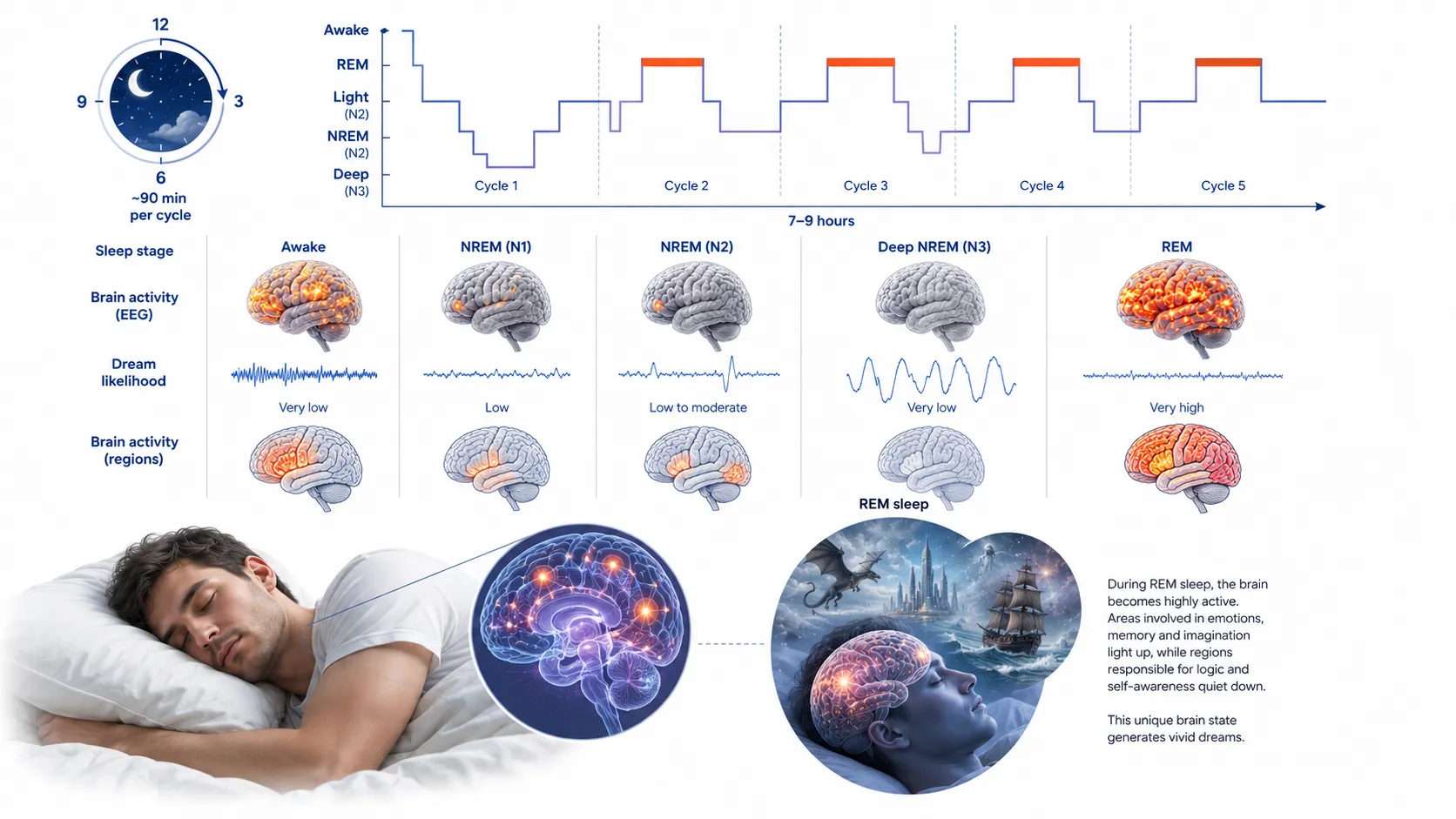
Dreaming and remembering dreams are separate processes: the sleeping brain generates experiences, but waking recall depends on timing, brief awakenings and memory encoding.
- 1The dream occurs
Dreaming can happen even if no memory survives.
- 2A waking bridge is needed
Dream recall depends heavily on waking timing.
- 3Memory either stores it or loses it
Non-dreamers are usually non-recallers.
How it works
The mechanism
Dreaming and remembering dreams are separate processes: the sleeping brain generates experiences, but waking recall depends on timing, brief awakenings and memory encoding.
- Step 01
The dream occurs
During REM and sometimes NREM sleep, brain networks generate vivid sensory, emotional and narrative experiences.
A private theater running while the audience is asleep.
Dreaming can happen even if no memory survives.
- Step 02
A waking bridge is needed
Brief awakenings during or after dreams help transfer fragile dream content into memory.
Opening a door before the room clears itself.
Dream recall depends heavily on waking timing.
- Step 03
Memory either stores it or loses it
If dream content is not encoded quickly, it disappears before waking consciousness can retrieve it.
Writing on steam-covered glass before it evaporates.
Non-dreamers are usually non-recallers.
Clarify
Myth and reality
Myth
If you cannot remember your dreams, you are not dreaming.
Reality
Dream recall is physiologically independent from dreaming. Normal adults wake from REM sleep and report ongoing dream content immediately upon waking, even those who routinely claim never to dream.
Evidence
Sleep laboratory awakenings during REM yield dream reports from essentially all human subjects, including self-described non-dreamers.
Myth
Vivid dreams mean you are not sleeping well.
Reality
High dream recall correlates with higher brain reactivity during sleep, which is different from poor sleep quality.
Evidence
Sleep quality metrics including total sleep time, sleep efficiency, and REM percentage do not systematically differ between high and low dream recallers.
Surprises
Facts worth sitting with
When woken during REM sleep, even people who claim to never dream almost universally report ongoing dream experiences in the moment of waking.
Surprising facts
What seems backwards
Worth comparing
In everyday life
Easy to get wrong
Pressure points
Where the simple answer gets interesting
Is there anyone who genuinely cannot dream?
Cases of true dream cessation have been documented following specific brain damage, particularly to the temporo-parietal junction and the frontal white matter. These patients show normal REM sleep on EEG but report absolutely no dream content when woken from REM, even immediately after waking. This is sometimes called Charcot-Wilbrand syndrome. The condition is rare and always follows identifiable neurological injury.
True dreamlessness requires brain damage to a very specific region, suggesting that dreaming is a robust default state of the sleeping brain.
Why do some people have far more vivid dreams than others?
Vividness of dream recall correlates with activity in the posterior hot zone of the brain, a network spanning parts of the parietal, occipital, and temporal cortex. People with higher baseline activity in this zone during both waking and sleeping tend to report more vivid, detailed dreams.
The same neural signature that makes some people more perceptually sensitive during waking may make them more vivid dreamers at night.
Do blind people dream visually?
People who were sighted before becoming blind typically dream visually, though visual content gradually diminishes over years. People born blind or who lost sight before age five dream almost never visually but have rich auditory, tactile, and spatial dream experiences.
Dreaming uses whatever sensory architecture the brain has available. The content adapts to the hardware.
Looking closer
The deeper pattern
The widespread belief that some people simply do not dream reflects a broader confusion between experience and memory that operates throughout waking life as well.
One way to think about it
We routinely confuse the absence of memory with the absence of experience. The brain generates vastly more than it records. Most of what happens to us, awake or asleep, is never encoded into accessible memory.
The record of a life is always partial. Most of the living happens in the gaps between what can be recalled.
Limits
Where the explanation bends
Dream recall in highly trained meditators.
Some long-term meditators report substantially more vivid and controllable dream content, including higher frequencies of lucid dreaming.
Deliberate training of waking attention may modify the sleeping brain's capacity for self-reflective experience.
In daily life
What this helps you notice
Setting an alarm to wake you during natural waking transitions, or simply waking without an alarm and lying still for a few minutes before getting up, dramatically improves dream recall in people who wish to remember their dreams.
Keeping a dream journal on the bedside table and writing immediately upon waking, before checking a phone or speaking to anyone, is the single most effective behavioral intervention for improving dream recall.
Remember
Key takeaways
- 1
Almost certainly everyone with a healthy brain dreams, including people who say they never do.
- 2
Dreaming and remembering dreams are neurologically separate processes.
- 3
When woken directly from REM sleep, even self-described non-dreamers usually report ongoing dream content.
- 4
The temporo-parietal junction is the brain region that, when damaged, genuinely eliminates dream recall.
- 5
Dream recall is associated with brain reactivity during sleep, not with poor sleep quality.
Everyone who claims they never dream has simply never been woken up at the right moment.
The dreams are there. Every night, reliably, the brain generates its private theater. Some people wake to find the doors wide open and the stage still lit. Others wake to a room that has already been cleared. The show went on. They just were not given a ticket to remember it.
Read around the idea
More questions with the same curious pull
Nearby doors from the TinyThat archive, chosen by topic, intent, and reader curiosity.
Body & Brain
Can the Brain Feel Pain?
The brain controls all pain in your body, yet it cannot feel pain itself. Discover why, and what this strange fact re...
Body & Brain
Does Your Brain Eat Itself?
Your brain really does consume parts of itself. Learn about autophagy, synaptic pruning, and why self-consumption is...
Body & Brain
Why Does Brain Fog Happen?
Brain fog is not imaginary. Learn what actually causes that thick, cloudy feeling in your head and what science says...